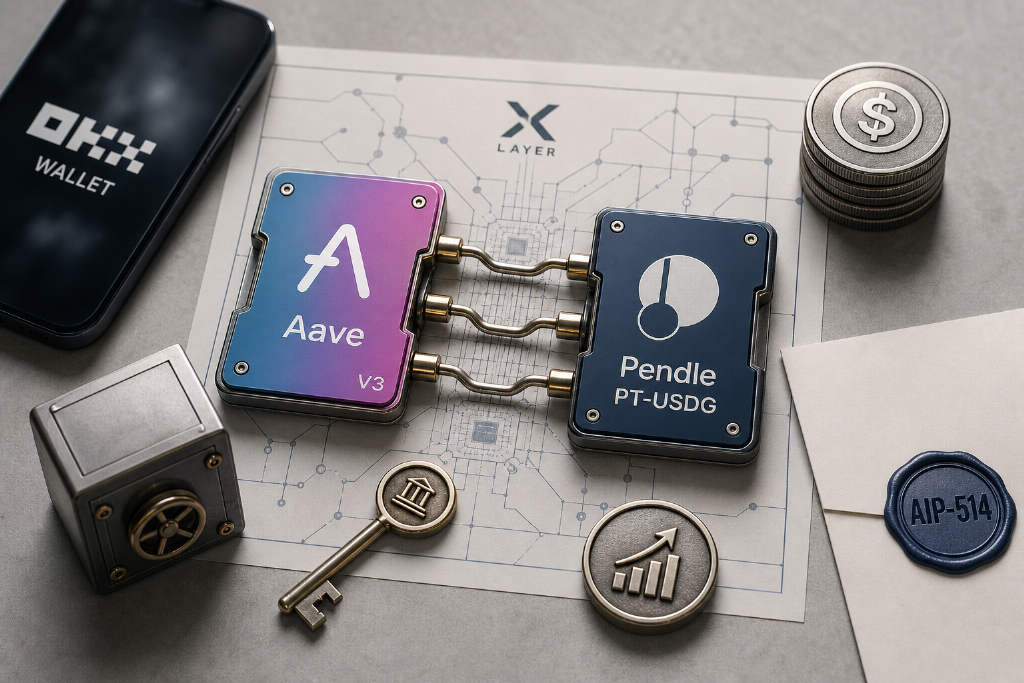
According to official information reported by Odaily Planet Daily, Aave's governance proposal AIP-514 has been formally approved. This makes Pendle PT-USDG a supported collateral asset on Aave V3, which runs on X Layer. As a result, Pendle's fixed-income market is now further connected with Aave's lending protocol. In a parallel move, OKX Wallet has launched a limited-time incentive campaign for PT-USDG. Users can access the campaign through the DeFi section of the wallet and take part in a one-stop manner, with the maximum annual percentage yield reaching 6.8%. The official notice adds that, once PT-USDG is integrated into Aave, the stablecoin yield and lending scenarios on X Layer will be further enriched. The report is a market analysis brief published by Odaily Planet Daily, citing official sources. It centers on the approval of AIP-514 and the corresponding product updates from Pendle and OKX. The approved proposal, identified as AIP-514, is the governance action behind this development. The exact end time for the OKX Wallet incentive was not specified in the source.
According to an official announcement, Aave's governance proposal AIP-514 has been approved, and Pendle PT-USDG is now accepted as collateral on Aave V3 on X Layer. The move brings Pendle's fixed-income market closer to Aave's lending protocol.
OKX Wallet has introduced a limited-time incentive for PT-USDG in parallel. Users can participate through the wallet's DeFi section directly, earning up to 6.8% APY.
The official message says the integration will further diversify stablecoin yield and lending options on X Layer.
This article was originally published by Bit.Fan. For more cryptocurrency news and market insights, visit www.bit.fan. Disclaimer:
The market information, project data, and third-party content displayed on this platform are for industry information sharing only and do not constitute any form of investment advice or return commitment.
Cryptocurrency trading carries high risks. Users should fully assess their risk tolerance and make independent decisions. All profits, losses, and legal responsibilities are borne by the users themselves.