
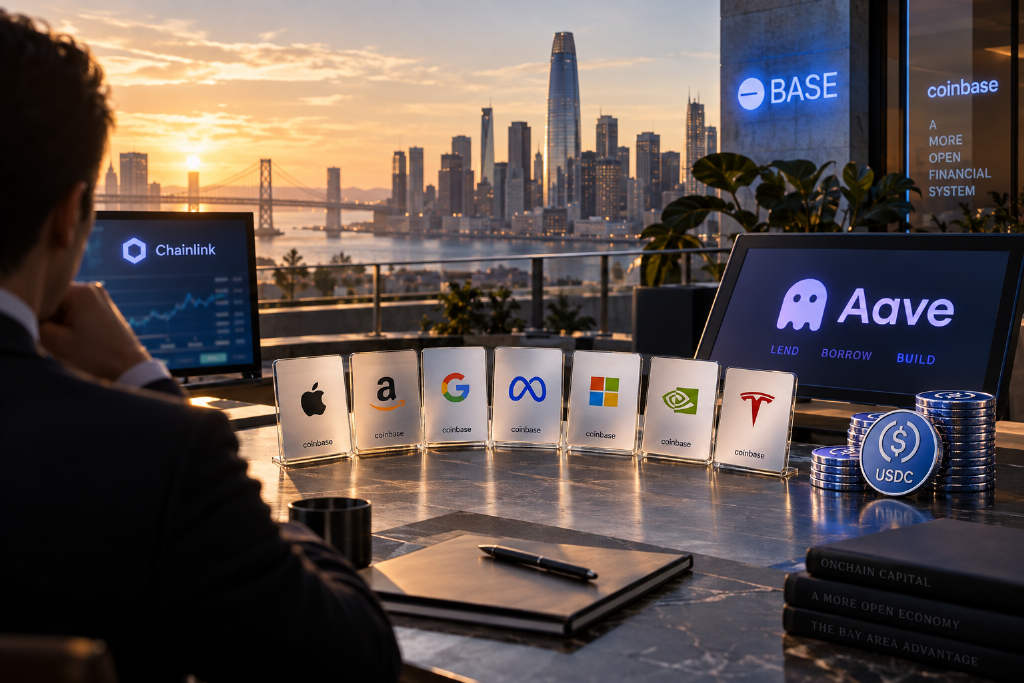
Aave V4 has launched Equities Hub on Base, allowing eligible non-U.S. users to post seven Coinbase-issued tokenized U.S. stocks as collateral and borrow USDC from the protocol. The move extends Aave’s lending activity beyond crypto assets and into tokenized public equities.
Seven tokenized equities are live in the first batch
Equities Hub went live on Sept. 25. The first seven tokenized stocks track Apple, Amazon, Alphabet, Meta, Microsoft, Nvidia and Tesla, and all are issued by Coinbase. Chainlink provides onchain pricing for the assets through its tokenized stock price feeds.
Under the setup described by BlockTempo, eligible users outside the United States can deposit these tokenized equities as collateral and borrow USDC. At this stage, the seven assets are only available as collateral and cannot yet be borrowed directly.
Hub and Spoke design keeps risk settings separate by asset
Equities Hub uses Aave V4’s Hub and Spoke architecture. All stock collateral flows into a single USDC market, while risk parameters are configured independently for each asset. That structure is intended to keep issues in one stock from spilling over into the others.
LlamaRisk, Aave’s risk provider, set the initial parameters as follows: a combined collateral cap of about $29 million across the seven stocks, a USDC supply cap of $32 million and a borrow cap of $21 million. Collateral factors differ by stock and range from 65% to 79%.
More tokenized stocks may be added later
Aave said additional Coinbase tokenized stocks could be introduced in the future. It also said GHO may be added to the list of borrowable assets, though any such change would still need to go through governance and risk review.
Stani Kulechov says tokenized stocks now have a lending use case
Aave Labs founder and CEO Stani Kulechov said in the announcement that public equities represent one of the world’s largest capital pools and that tokenization is bringing that capital onchain. He said, “Until now, tokenized stocks were something you could hold or trade. Today, they become collateral you can borrow against.”
The report also noted that Kulechov said in a mid-September interview with The Block that institutions “bring scale,” which could drive a sharp increase in onchain borrowing demand. In that interview, he said tokenization and DeFi are no longer facing a technical problem, but a distribution problem.
After the CLARITY Act was blocked in the Senate by a 49-50 vote, Kulechov also argued that DeFi may need to follow a path similar to Uber’s, expanding to a large enough user base before lawmakers are forced to address the regulatory questions.
Chainlink, Coinbase and Base each play a role
The rollout brings together several parties. Aave provides the DeFi lending protocol, Coinbase issues the tokenized stocks, and Chainlink supplies the onchain pricing layer.
Johann Eid, Chainlink’s chief business officer, said Aave’s use of Coinbase tokenized stocks with Chainlink as the official oracle solution marks an important step in bringing the global equity market, valued at more than $150 trillion, onchain.
Antonio García-Martínez, head of growth at Base, said qualified customers outside the U.S. can borrow USDC against these stocks, while USDC suppliers can earn interest. He said the product adds a new source of liquidity to the Base ecosystem and creates a closed loop with Coinbase’s own tokenized stock offering.
Aave pushes deeper into RWA-backed lending
BlockTempo said Aave has reached $3.6 trillion in cumulative deposits and more than $1 trillion in total loans. By bringing tokenized U.S. equities into the collateral mix, the protocol is moving from crypto-only lending toward a broader RWA-backed lending model.
The report also said the initial $29 million collateral cap is relatively conservative. The next points to watch are whether LlamaRisk loosens those limits and whether Aave eventually allows tokenized stocks to become borrowable assets rather than collateral only.