
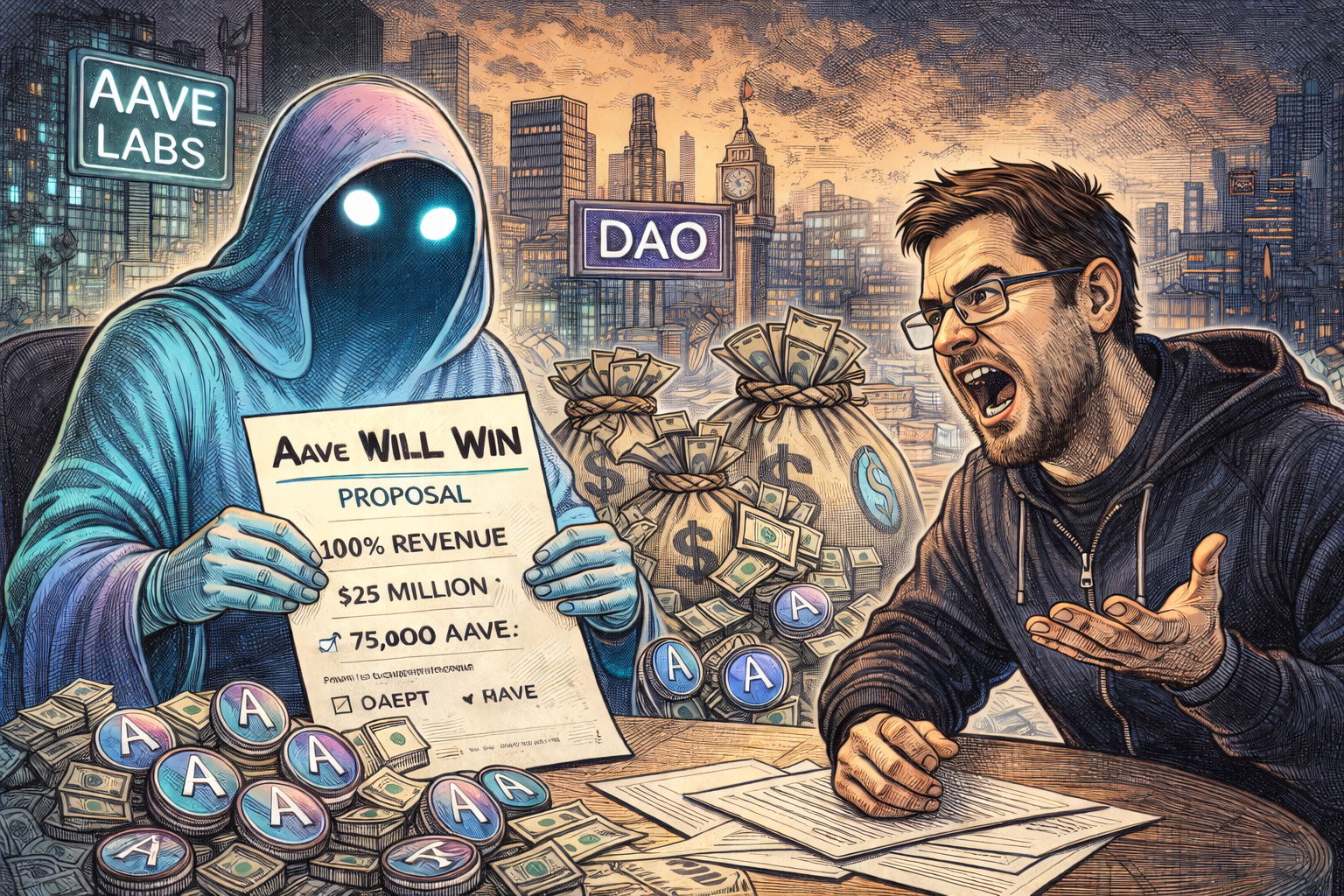
Aave Labs submitted its “Aave Will Win” framework to the Aave DAO on February 12, proposing that 100% of revenue from Aave-branded products be routed to the DAO treasury. The proposal covers revenue from Aave v3 and v4, the aave.com frontend, Aave Card, and business lines mentioned in the plan such as a future AAVE ETF. It also says trademarks and intellectual property would be transferred to a newly created Aave Foundation.
The controversy sits in the price attached to that offer. Aave Labs asked the DAO for $25 million in stablecoins and 75,000 AAVE as operating capital, while also requesting five separate $3 million grants for the development and promotion of Aave App, Aave Pro, and Aave Card, plus another $2.5 million for Aave Kit. Based on the figures cited in the source material, the total funding request comes to roughly $50 million.
Marc Zeller calls the proposal a disguised cash-out
Marc Zeller, founder of Aave Chan Initiative, one of the more influential governance participants in the Aave ecosystem, attacked the plan in blunt terms. He described it as “a disguised cash-out attempt wrapped in goodwill” and argued that Aave Labs was using an aggressive proposal as leverage to force an outcome through governance.
His criticism also reaches back to an unresolved dispute inside the community. At the end of 2025, Aave members clashed over who should control the project’s trademarks, domains, social accounts, and other brand assets: the DAO or Aave Labs. That question has not been fully settled. In Zeller’s view, pushing a vote before that conflict is resolved amounts to procedural bullying.
Zeller also said earlier uncertainty around revenue and governance had already erased about $500 million from AAVE’s market value. In that framing, governance friction itself has become one of the main risks for token holders.
The proposal reaches beyond treasury flows
The plan is not just about redirecting protocol income. According to the source, Aave Labs tied the revenue transfer to conditions requiring the DAO to coordinate v4 development with Labs and pause new feature development for v3. That shifts the debate away from simple revenue sharing and toward who controls product timing, execution, and leverage inside the protocol.
This tension is common across DeFi. A DAO may be the formal decision-making body, but core teams usually retain control over engineering, branding, and day-to-day operations. Token holders can vote yes or no on proposals already placed before them, yet they often lack the ability to execute an alternative on their own. The imbalance is structural.
Aave’s dispute reflects a wider DeFi governance strain
The source places the clash inside a broader governance pattern across DeFi: once a protocol becomes large and profitable, the fight turns to who decides how revenue is used. That question reaches far beyond Aave.
The article notes that Aave’s governance participation rate has remained below 10% for a long period. In practice, that leaves decisions concentrated among core contributors, venture investors, and a small number of large holders. The confrontation between Aave Labs and Marc Zeller is, at its core, a public negotiation over the boundary between developer power and token-holder authority.