

Aave Labs rolled out Stable Vaults on July 9, adding a fixed-rate wrapper on top of Aave’s lending markets for businesses that want to offer savings products without building the whole stack themselves. The product is aimed at digital banks, crypto wallets and payroll providers. After a single integration, those firms can show users a stable yield inside their own app while the deposits are deployed into Aave in the background.
The article frames the product less as a rate innovation and more as a distribution layer built around convenience. In DeFi, users are often asked to choose a chain, compare pools, watch rates, move funds and judge whether a page is legitimate or a phishing copy. Aave has spent six years building to roughly 2.5 million users, while Revolut, built around a simpler retail experience, has 65 million users. Seen that way, packaging Aave for mainstream users is a practical move rather than a cosmetic one.
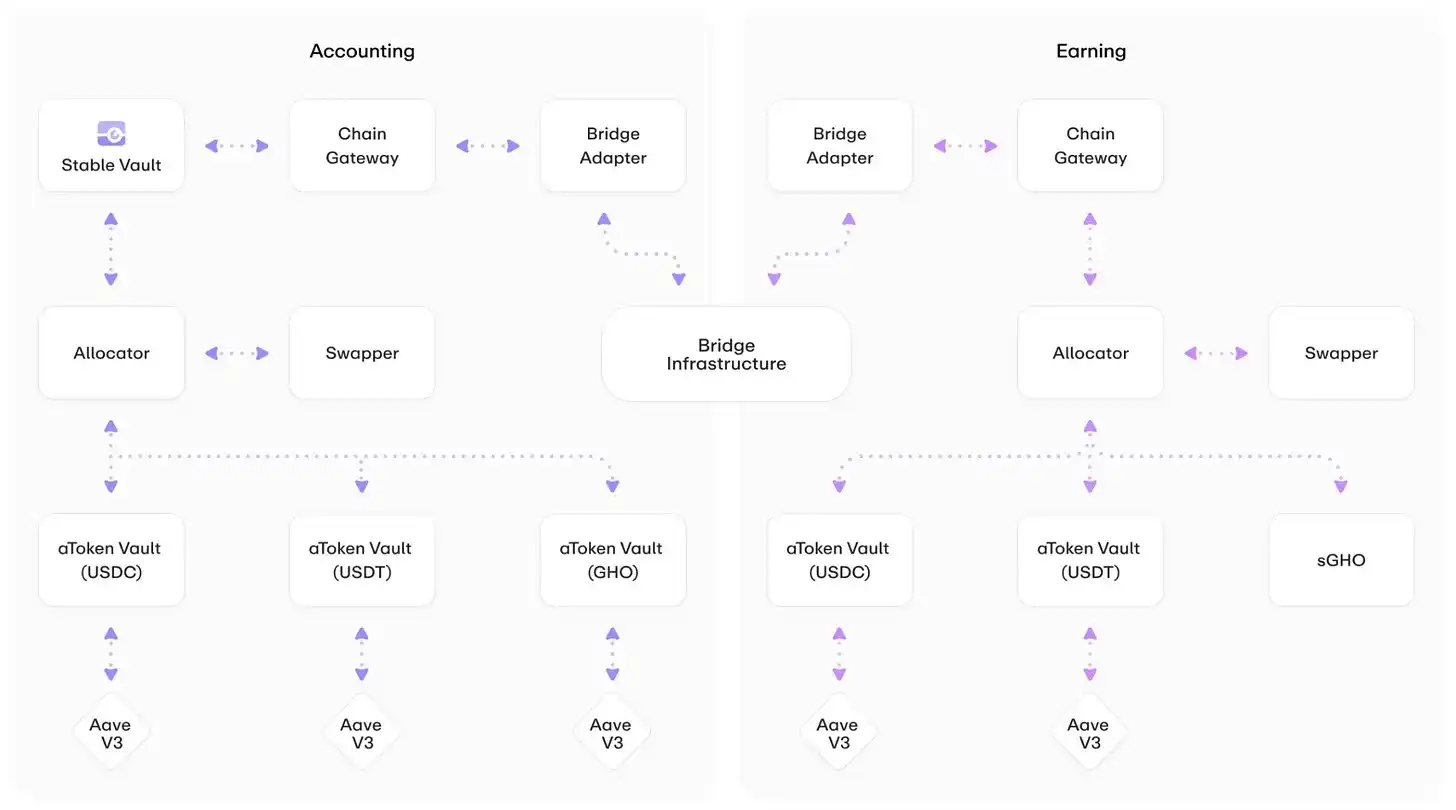
How Stable Vaults work
From January to July this year, the annualized yield on Aave’s USDC pool moved between 2% and 9%, according to the article. That is normal in DeFi, where users shift capital toward the highest return. It is much harder to sell that kind of variability to a mainstream savings user.
Stable Vaults sit between that floating-rate market and the retail interface. An operator can choose the rate shown to the end user, for example 4%. No matter how the underlying Aave market moves, the vault keeps paying the user 4% annualized. If Aave earns less than 4%, the operator covers the gap. If Aave earns more than 4%, the excess belongs to the operator.
That makes the vault a rate-smoothing layer. Users get a predictable number. Operators take the interest-rate spread and the risk that comes with it. Aave supplies the underlying pool and the tooling that lets operators segment rates across products or user tiers.
What users gain, and what they give up
For depositors, the attraction is straightforward: certainty. The article notes that when Aave’s USDC pool fell to 2% in the spring, a vault promising 4% would still pay 4%, with the operator making up the difference.
That certainty has a price. The article compares it to a fixed-rate mortgage, where a borrower may pay 50 to 100 basis points more than a floating rate in exchange for predictability. In Stable Vaults, the cost shows up in two places.
- Upside is capped. If the underlying pool pays 6% or 9%, the user may still receive only the preset 4%.
- The spread becomes harder to see. A floating rate shows the market return directly, while a fixed rate hides how much the operator keeps in the middle.
The article says that many users will accept that trade because the product can remove nearly all of the operational burden that comes with native DeFi. They do not need to create a wallet, store a seed phrase, bridge funds or choose a chain. A platform can add human support, account recovery and face-ID login. It also notes that Aave’s own app has SOC 2 certification and supports two-factor authentication.
The risk stack changes rather than disappears
The article is explicit that Stable Vaults do not eliminate risk. They add a new layer on top of Aave. A user depositing directly into Aave mainly faces protocol-level code risk. A user entering through a vault also takes on the financial condition of the operating company and the possibility of failure in the private scripts used to route funds in the background.
So even if Aave itself has no bug, users can still be exposed if the operator fails or if internal fund-movement code malfunctions.
The article also argues that pricing is less transparent than in traditional fixed-income or swap markets. There, supply and demand help pull fixed rates toward a market-clearing level. In Stable Vaults, the operator sets the rate. Users may not compare a 4% vault to a 6% underlying Aave yield. They may compare it to a bank savings account instead. The piece notes that Aave’s page places its rate next to the U.S. national average savings rate of 0.4% cited by the Federal Deposit Insurance Corporation, or FDIC, making the vault look compelling in that frame.
Why operators would want it
For operators, the appeal is the spread. The article offers a simple example: if a digital bank holds $200 million in idle user stablecoins and has already paid to acquire those customers, then a single Stable Vaults integration and a public 4% annual yield could turn dormant balances into a profit center. If the underlying Aave pool earns 6%, the 2% difference would add $4 million in annual profit.
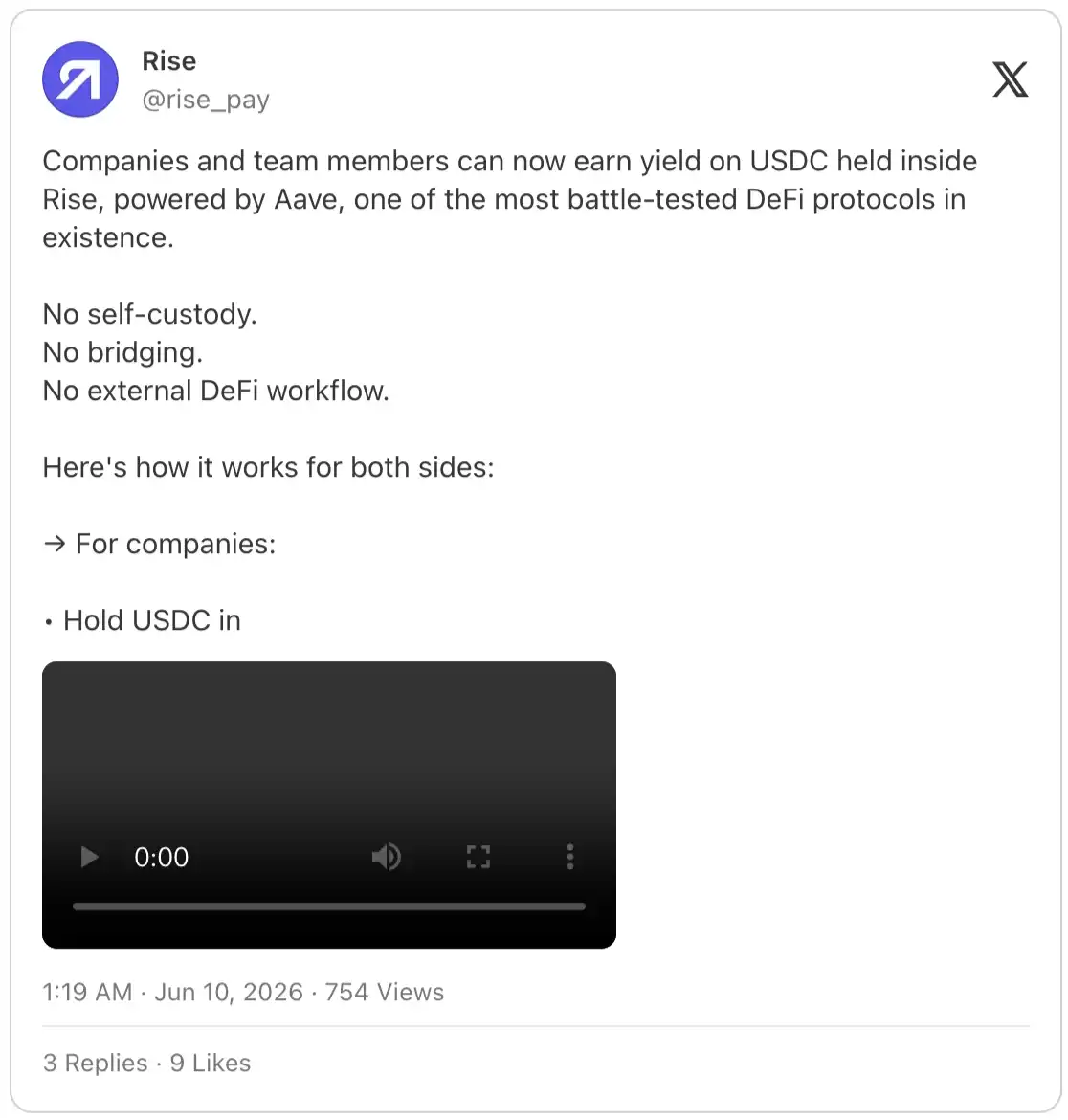
That is very different from the approach taken by payroll service Rise, which the article uses as a benchmark. Rise pays contractors in 190 countries and has processed more than $1.5 billion. Companies usually prefund payroll in USDC a week before payday, leaving that capital idle in the meantime. Rise launched Rise Earn to place that prefunded USDC into Aave’s USDC pool on Arbitrum until the payroll date.
Rise charges 1% of the total yield and no other fees. At a 6% annualized underlying return, that means Rise keeps 6 basis points and the contractor receives 5.94%, with the live Aave floating rate shown throughout.
The article says that on a comparable capital base, an operator using Stable Vaults could earn a 200-basis-point spread instead of 6 basis points, a 33-fold difference in revenue share.
What Aave is selling
The article argues that Aave is not selling deposits so much as packaging. Stable Vaults let operators create layered rates for different user groups or promotions. A premium tier could receive 5% while a standard user gets 3.5%, even though both are funded by the same underlying lending pool.
For fintechs that issue their own stablecoin, the product can also turn that token into the deposit asset for a closed-loop flow. A steady yield may improve retention, and retained balances are valuable on their own.
Operators do not collect the spread for free. They also absorb the downside when rates move against them. The article points out that when the underlying pool dropped to 2% in the spring, any vault promising more than 2% had to fund the difference out of pocket.
The April 18 stress event
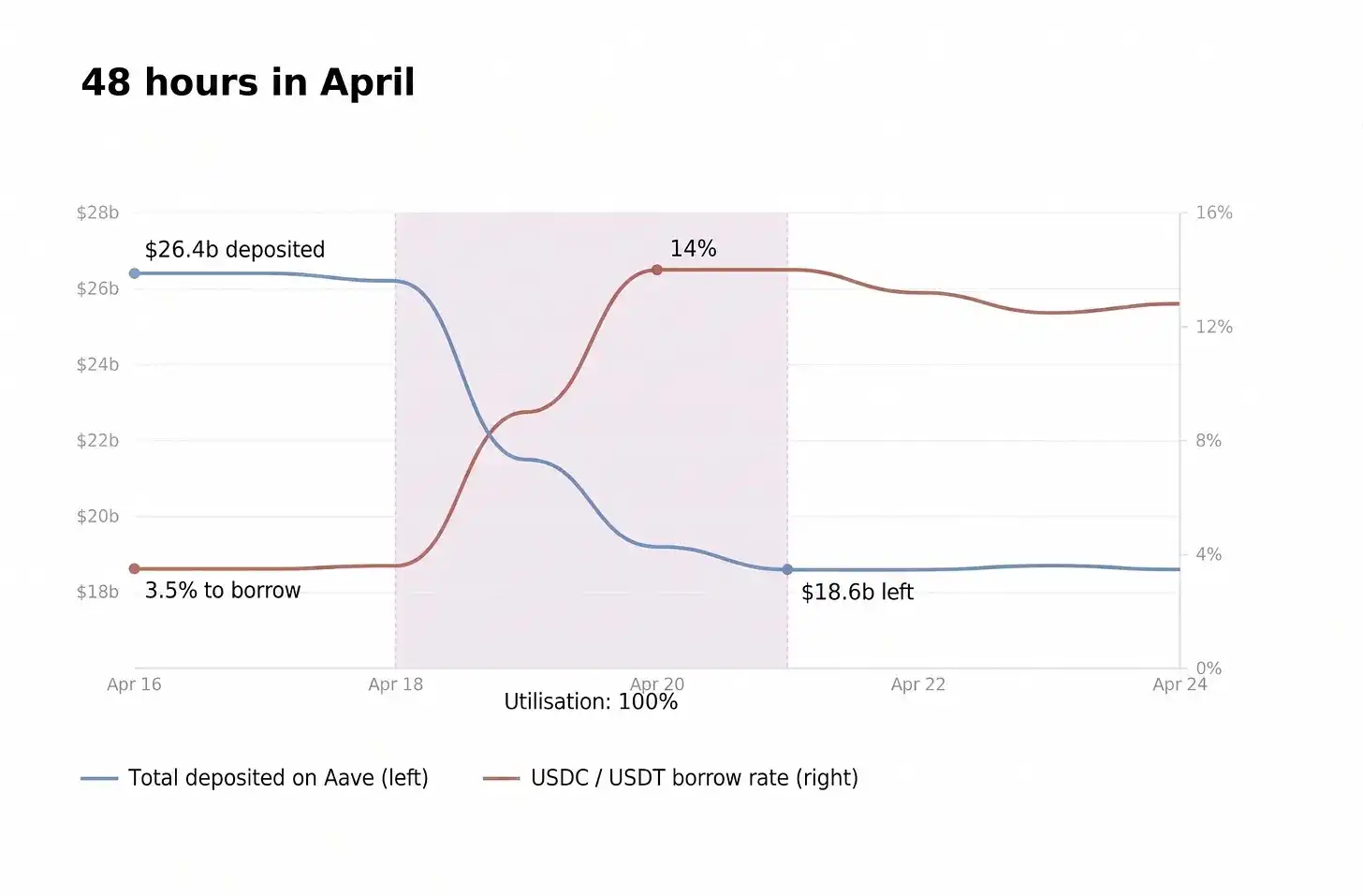
The piece uses an event on April 18 to show how liquidity stress can break the clean retail story. It says a hack on the Kelp DAO bridge triggered a broad run on an Aave pool. Utilization hit 100%, all withdrawals froze, and both user principal and the operators’ paper gains were trapped in the withdrawal queue.
At that point, vault users and direct Aave users faced the same immediate problem: no one could redeem. Any excess yield stayed on paper and remained tied to the underlying principal.
If liquidity later returns, the operator can settle the accumulated paper gains from the frozen period in one shot. The article describes that gain as the premium paid by the market for scarce liquidity, while the cost of the freeze is borne by depositors. If liquidity does not return and the pool develops bad debt, the vault can end up with a yield shortfall. The piece says Aave’s documentation states that an authorized party can cover a system deficit, but it does not set out a reserve backstop to do so.
The article adds that Aave can truthfully say its own contracts were not hacked and that the issue sat with Kelp’s bridge rather than Aave code. It also notes that risk collateral rsETH was frozen within hours. But it says the community had earlier voted to accept that high-risk collateral at a 93% collateral ratio, and that the eventual losses fell on ordinary users after the risk lead left.
A commercial missing piece for a broader audience
The article presents Stable Vaults as a major addition to Aave’s mainstream strategy. It points to Rise routing idle payroll balances into Aave, Kraken building a customized protocol called Tydro on its own layer-2 network using Aave V3 and plugging retail savings into it, and Cap Finance placing stablecoin reserves into Aave pools.
It also places the product alongside other distribution channels. Horizon works with Circle and Franklin Templeton on loans backed by tokenized Treasuries. Aave’s own app serves retail users directly. Stable Vaults open an industry-wide access channel and package Aave as a diversification solution for third-party apps.
According to the article, Aave does not lack deposits today. It cites Aave founder and CEO Stani Kulechov, who told The Block in March that DeFi is dealing with excess liquidity and needs to focus on the borrowing side. That is presented as a key reason why underlying USDC yields have sat around 2% to 3% for a long time instead of returning to the earlier 8% range.
DeFi capital has long been highly rate-sensitive. A difference of 50 basis points can trigger large rotations. By contrast, payroll apps and wallets control the user relationship, and capital routed through them can behave more like sticky bank deposits than hot money.
Why sticky deposits matter under Aave’s economics 3.0
The article links Stable Vaults to Aave’s economics 3.0 model, which went live on June 27 and uses protocol revenue to buy back and burn AAVE automatically. In that framing, stable revenue matters in both bull and bear markets. In weaker market conditions, sticky deposits become more important because they support the revenue base behind buybacks. Stable Vaults are presented as one way to attract that kind of capital.
Compared with Coinbase and Robinhood, Aave offers a lighter build path
The article compares the model with consumer savings products already on the market. Coinbase offers roughly 4% annualized on USDC. Robinhood launched its savings feature on July 1 with a yield close to 7% and 2.8 million funded accounts. Both describe those offerings as savings accounts.
Under the hood, Coinbase connects to Morpho and Ethena. Robinhood built its setup on Morpho and Maple, with risk parameters set by Steakhouse.
The article says those companies invested heavily in custody arrangements, asset selection, risk teams and months of legal work. Stable Vaults aim to remove that buildout. An app integrates once, displays a fixed yield to the user, and handles the spread or loss between that display rate and the underlying Aave return on its own.
Why users may still choose it
The article ends by arguing that even if users understand the tradeoff, many will still prefer the product. In pure functional terms, it says a user could reproduce what Stable Vaults do in 20 to 30 minutes: create a wallet, move in USDC and deposit into native Aave. That path avoids KYC, avoids an operating intermediary, avoids private rebalancing scripts and passes through the full underlying yield, such as 6%, with full visibility into pool data.
But retail behavior often moves in another direction. The article cites research by Iyengar and Huberman on retirement plans showing that participation falls as the number of fund choices rises. Faced with too many options, many people do nothing at all.
It says crypto has shown the same pattern over the last 15 years. The industry has repeatedly promoted self-custody as safer, yet most onchain card-spending flows still go through custodial platforms. For a newcomer with $2,000 and little crypto experience, the most common failure cases are not subtle protocol exploits but losing a seed phrase or sending funds to the wrong address. A custodial app with face ID and account recovery removes those human-error risks.
In the article’s telling, paying a 200-basis-point spread is not irrational. It is a purchase of protection against one’s own mistakes. That is why the author sees Stable Vaults as commercially logical for Aave: a DeFi protocol with abundant liquidity but limited user loyalty has strong reasons to package itself for mainstream distribution. The product, in that view, accepts what many retail users want from finance in the first place: safer-looking balances, a predictable number on screen and as little operational work as possible.