


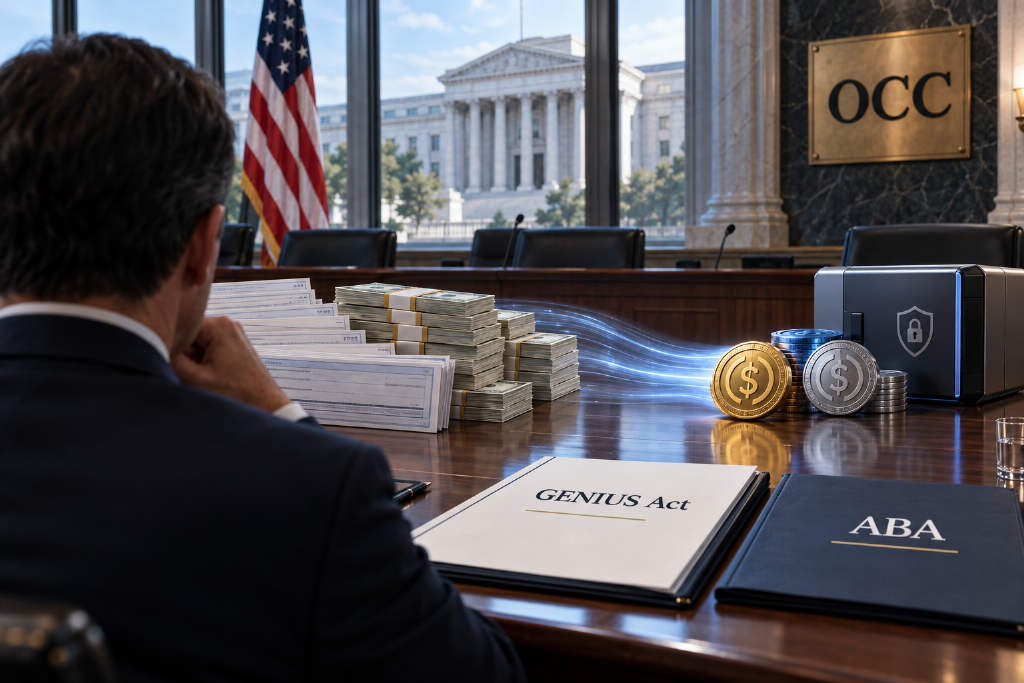
The American Bankers Association, or ABA, on Wednesday criticized the Office of the Comptroller of the Currency for removing a presumption in its final GENIUS Act rule that had treated certain third-party yield arrangements as suspect, saying the change could let payment stablecoin issuers bypass the law’s yield ban and pull funds away from bank deposits.
The clash comes after the OCC finalized its rule for payment stablecoin issuance and custody ahead of the GENIUS Act’s effective date of Jan. 18, 2027. In a public statement, the ABA said the agency’s reading of the statute strayed from what Congress intended when it wrote the ban on yield.
The fight centers on deleted language in the yield section
The ABA said the final rule includes what it called several positive steps, but it focused its criticism on one change in particular: the OCC removed protective language from the proposal that would have presumed some third-party arrangements to violate the yield prohibition.
The group said the deleted language was designed to address indirect structures involving affiliates, exchanges, and other issuance partners. In the ABA’s words, the result is that payment stablecoin issuers can "technically evade the statutory prohibition" while "substantively paying equivalent yield."
The banking group also said the OCC declined to adopt a broader presumption for arrangements meant to circumvent the yield ban, leaving what it described as a structural gap in the rule.
ABA says the line between deposits and stablecoins is being blurred
The ABA’s central argument is that the GENIUS Act drew a clear boundary between payment stablecoins and traditional bank deposits, and that the OCC’s final approach weakens that distinction.
In its statement, the group said those gaps risk undermining the line Congress established between payment stablecoins and traditional bank deposits, and threaten funding that banks use to support lending in the U.S. economy.
That framing pushes the dispute beyond a technical argument over presumptive violations. It turns the issue into a broader fight over bank funding.
Banking groups and crypto groups are split
The rule has drawn sharply different reactions across the industry. Blockchain Association backed the OCC’s decision to remove the yield presumption, saying the final rule is closer to the statutory text.
Bank Policy Institute, another banking industry lobbying group, aligned with the ABA and said removing the presumption replaced clarity with ambiguity, exposing banks and their customers to the risk of deposit outflows.
At this stage, the divide is less about disagreement within banking and more about a direct split between the banking camp and the crypto camp.
With CLARITY Act stalled, the yield dispute shifts to agency interpretation
Stablecoin yield has been a recurring point of conflict in debates over the GENIUS Act and the Digital Asset Market Clarity Act, or CLARITY Act. That market structure bill is still moving through Washington, but it stalled after a procedural vote in the Senate last month.
Until broader market structure legislation is settled, the OCC’s interpretation of the rule is effectively setting the standard for whether yield can be paid.
Fed and Treasury rules are the next battleground
The OCC moved first before the GENIUS Act takes effect in January 2027. Other federal agencies, including the Federal Reserve and the Treasury Department, are expected to issue related rules within their own jurisdictions.
That means authority over how the yield provision is interpreted will no longer sit with the OCC alone. The ABA’s latest statement appears to be an early push before those rules arrive, with banking lobby groups expected to keep pressing for indirect arrangements and evasive conduct to be brought back into the category of presumed violations.
For stablecoin issuers, regulatory uncertainty in the second half of 2026 remains a major variable.