
Embodied AI fundraising in China has climbed to striking levels in 2026, and a new article following ITjuzi’s release of its China Embodied AI Entrepreneur Ecosystem Profile Report puts a spotlight on one particularly visible force in the field: startups built directly by professors, universities and research institutes.
The article uses a narrower definition for what it calls the sector’s “academic camp.” It does not refer simply to universities supplying graduates, nor to companies that only invite professors to serve as advisers or chief scientists. Instead, it focuses on two types of companies: startups founded by professors who still hold university positions and can draw on support from their schools, and companies spun out directly from universities, research institutes or laboratory platforms.
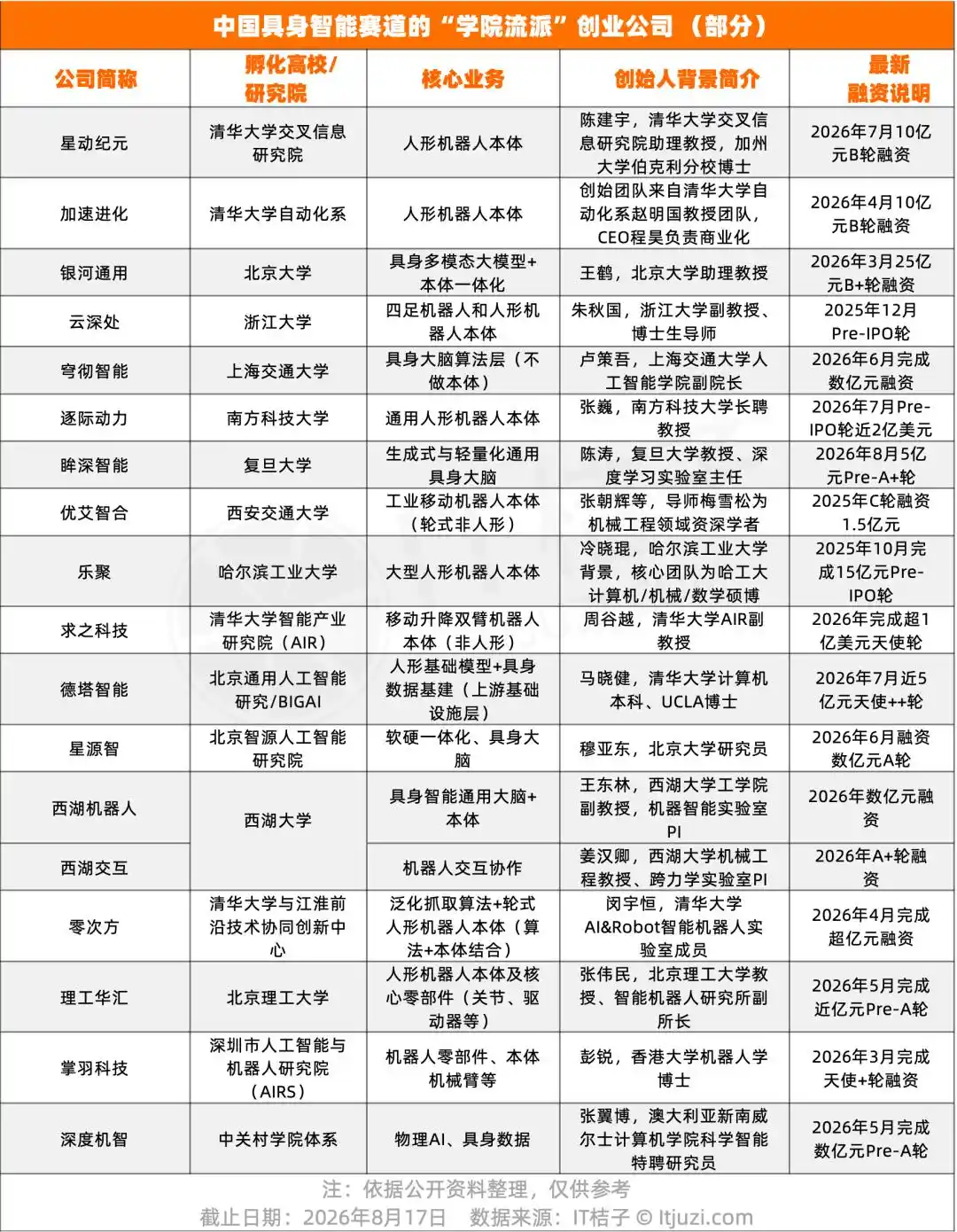
Under that standard, the article compiles a list of 18 embodied AI companies. It says that, in the first eight months of 2026, these 18 companies disclosed total fundraising of about 15 billion yuan on an estimated basis, with more than 13 billion yuan clearly disclosed.
Professor-led startups still rooted in universities
One of the best-known examples is Xingdong Jiyuan, in which Tsinghua University holds a stake. The company focuses on humanoid robot bodies. Founder Chen Jianyu is an assistant professor at Tsinghua University’s Institute for Interdisciplinary Information Sciences and holds a PhD from the University of California, Berkeley. The company was founded in August 2023, started from an incubation project inside the institute, and completed a 1 billion yuan Series B round in July 2026. The article says it became a unicorn in a little more than two years.
Another Tsinghua-linked company is Jiasu Jinhua, which also develops humanoid robot bodies. Founded in June 2023, the company came out of Professor Zhao Mingguo’s humanoid robotics team in Tsinghua’s Department of Automation, while CEO Cheng Hao took charge of commercialization. In April 2026, it completed a 1 billion yuan Series B round and also entered unicorn status.
Peking University’s representative in the field is Yinhe Tongyong, which combines an embodied multimodal large model with a general-purpose humanoid robot body. Founder Wang He is an assistant professor at the Frontier Computing Research Center of Peking University’s School of Computer Science. The company was founded in May 2023, raised 1.1 billion yuan in June 2025 in a round led by CATL, and completed a 2.5 billion yuan Series B+ round in March 2026. The article adds that the company opened a smart retail store in Haidian last year where humanoid robots were put to work.
From Zhejiang University, Yunshenchu is highlighted as a representative professor-founded company. It focuses on quadruped robots and humanoid robot bodies, with strengths in power inspection and emergency rescue. Founder Zhu Qiuguo is an associate professor and doctoral adviser at Zhejiang University. The company started in Hangzhou in 2017 and is listed as one of the city’s “Six Little Dragons.” In July 2025, it completed a financing round of nearly 500 million yuan led jointly by Fortune Capital and Guoxin Fund, then finished a Pre-IPO round in December. The article describes Yunshenchu as one of the earliest among these professor-founded companies to achieve real commercialization.
Shanghai Jiao Tong University’s representative is Qiongche Intelligence, which does not build robot bodies and instead targets the embodied-brain algorithm layer. Founder Lu Cewu is vice dean of the School of Artificial Intelligence at Shanghai Jiao Tong University and a Changjiang Scholar. Founded in November 2023, the company developed Noematrix Brain and completed a financing round worth several hundred million yuan in June 2026. Investors in that round included the Shanghai Jiao Tong University AI Future Fund and a wholly owned subsidiary of the Shanghai Institute of Innovation and Creative Intelligence.
Nanfang Tech’s representative is Zhuji Dynamics, which develops general-purpose humanoid robot bodies. Founder Zhang Wei is a tenured professor at Southern University of Science and Technology and previously held a tenured professorship at The Ohio State University. He has researched humanoid robotics for more than a decade. The company was founded in 2022, completed a $200 million Series B round in February 2026, then raised nearly another $200 million in a Pre-IPO round in July. Its valuation reached 15 billion yuan. Shareholders listed in the article include Alibaba, SAIC Motor, NIO and JD.com. The piece also says nearly 70% of that financing came from overseas institutions, including capital from the Middle East and Europe.
Fudan University-backed Moushen Intelligence is another example, but on the algorithm side. The company develops a generative and lightweight general embodied brain. Co-founder Chen Tao is a Fudan professor and director of the university’s deep learning laboratory. Founded in January 2025, the company completed a 500 million yuan Pre-A+ round in August 2026.
The article says companies including Moushen Intelligence, Qiongche Intelligence, Delta Intelligence and Xingyuanzhi are all trying to secure positions in the embodied-brain layer, showing that competition in embodied AI is shifting from the robot “body” toward the “brain.”
Xi’an Jiaotong University’s representative is Youaizhihé, which builds industrial mobile robots using wheeled platforms rather than humanoid forms. Its focus is factory logistics and intelligent inspection. Founding team members including Zhang Chaohui came from Xi’an Jiaotong University, and their mentor Mei Xuesong is a senior scholar in mechanical engineering. Founded in 2017, the company has placed products in semiconductor, new energy and 3C factory logistics, as well as inspection scenarios in utility tunnels, power distribution rooms and substations. It completed a 150 million yuan Series C round and has been recognized by the Ministry of Industry and Information Technology as a specialized and sophisticated “little giant” enterprise.
Harbin Institute of Technology’s representative is Leju, which develops large humanoid robot bodies. Founder Leng Xiaokun has a Harbin Institute of Technology background. Founded in 2016, the company is described as one of China’s earliest large-humanoid robotics companies. Its core team is based in Shenzhen and Harbin, with members drawn from the university’s computer science, mechanical engineering and mathematics programs. In October 2025, Leju Robotics completed a 1.5 billion yuan Pre-IPO round backed by more than a dozen institutions including Shenzhen Investment Holdings Capital, Longhua Capital and CITIC Jinshi. Its cumulative fundraising exceeded 1.7 billion yuan. The article says Leju’s “Kuafu” series has built ecosystems with more than 40 companies including Huawei, Tencent, China Mobile and FAW, and that it has already begun small-batch deliveries.
The article also excludes some companies that are often grouped into the category. Qianxing Technology once relied on Zhejiang University, it says, but later exited that relationship. Moce Intelligence was incubated by Tsinghua University x-lab, but the article notes that x-lab is an on-campus entrepreneurship incubator under Tsinghua’s School of Economics and Management and is more oriented toward students and alumni, without a direct institutional relationship after incubation.
Research institutes spinning out companies directly
The second group in the article includes startups created more directly from university institutes and research platforms.
Tsinghua University’s Institute for AI Industry Research, or AIR, incubated Qiuzhi Technology. AIR is headed by Zhang Yaqin. Qiuzhi develops mobile lifting dual-arm robots on a non-humanoid platform and targets research training and commercial service scenarios. In 2026, the company completed an angel round of more than $100 million backed by eight institutions. Founder Zhou Guyue holds a doctorate from the Hong Kong University of Science and Technology, studied under Li Zexiang, was an early core member at DJI, joined Tsinghua AIR as an associate professor in 2020, and commercialized laboratory results in 2023.
The Beijing Institute for General Artificial Intelligence, or BIGAI, incubated Delta Intelligence. The company focuses on foundation models and data infrastructure for embodied AI. It released a head-mounted full-body data collection device called Delta D1, designed to capture motion data while the wearer performs normal tasks. Delta Intelligence was founded only in January 2026 and secured nearly 500 million yuan in an angel++ round by July, completing six rounds of financing within half a year. Founder Ma Xiaojian earned his undergraduate degree in computer science from Tsinghua University and his PhD from the University of California, Los Angeles. He previously worked at Google Robotics and NVIDIA Research before becoming a BIGAI researcher.
The Beijing Academy of Artificial Intelligence incubated Xingyuanzhi. The article describes BAAI as a national-level platform in China’s large AI model field. Xingyuanzhi works on embodied-brain models that can be deployed across different robot bodies, along with an integrated hardware-software architecture that combines the “brain” with high-compute edge hardware. Founded in August 2025, the company raised 1 billion yuan in 10 months through a 200 million yuan angel round, an angel+ round worth more than 100 million yuan, and a Pre-A round. According to the article, its integrated solution now covers more than 70% of leading embodied AI companies, and it is also the world’s largest shipper of NVIDIA Jetson Thor.
Tsinghua University and the Jianghuai Frontier Technology Collaborative Innovation Center jointly incubated Lingcifang. The company focuses on generalized grasping algorithms while also building wheeled humanoid robot bodies, combining software and hardware in one route. Registered in Hefei, it completed a financing round of more than 100 million yuan in April 2026, led by Runze Group. The article says its generalized grasping technology does not require task-specific programs for particular objects, allowing robots to judge how to grasp unfamiliar items on their own. Its ZERITH-H1 wheeled humanoid robot was exported as a complete machine to Malaysia in 2026.
Beijing Institute of Technology’s representative company is Ligong Huahui, which builds humanoid robot bodies and key components including joints and actuators. Founded in 2015, it completed a Pre-A round worth nearly 100 million yuan in May 2026. The article describes it as a typical “professor plus university-run industry” path.
Other research institute spinouts still in an early stage include Zhangyu Technology, incubated by the Shenzhen Institute of Artificial Intelligence and Robotics for Society, and Shendu Jizhi under the Zhongguancun College system.
Westlake University has incubated 18 startups in total, the article says, including two major embodied AI companies. Westlake Interactive came out of the Cross-Mechanics Lab of Jiang Hanqing, chair professor of mechanical engineering at Westlake University, and focuses on embodied AI solutions, including a flexible variable-stiffness robotic arm. Westlake Robotics works on autonomous general-purpose humanoid robot bodies and embodied brains. Founder Wang Donglin is a tenured professor at Westlake University and deputy director of its Department of Artificial Intelligence.
Another company, “Zhongke Xinsong / Duoke Robotics,” was incubated by the listed company Siasun Robot & Automation rather than being included in the list. The article notes that in 2000, the Shenyang Institute of Automation under the Chinese Academy of Sciences established Siasun, described as China’s first robotics company and named after academician Jiang Xinsong. Siasun later listed on the A-share market and was called the “first robotics stock.” The company makes a full range of industrial robot bodies. In 2025, it formally entered embodied AI, launched the “Songyi” wheeled humanoid and “Songxing” biped humanoid robots, and set up an embodied intelligence research institute.
Zhongke Xinsong completed an A+ round worth several hundred million yuan in July 2026. In April 2026, nearly 100 heavy-load industrial robots from Siasun entered Geely Auto’s main welding line. The article says that marked the first batch deployment of domestic spot-welding robots on an automotive welding line.
Tsinghua-linked density and direct university capital
The article closes with three observations about this “academic camp.”
First, Tsinghua University appears with unusual frequency across embodied AI. Xingdong Jiyuan, Jiasu Jinhua, Qiuzhi Technology and Lingcifang are all presented as direct Tsinghua-line projects, while several institutes in the ecosystem are also powered by talent and platforms linked to Tsinghua and Peking University. The article attributes this to a relatively complete conversion chain from university to institute to company, supported by platforms such as the Institute for Interdisciplinary Information Sciences, AIR, BAAI and laboratory resources tied to Tsinghua’s communications research system. In that network, core technologies, professors and students, capital and application scenarios are all closely connected.
Second, university capital is starting to enter companies directly. Xingdong Jiyuan’s shareholder list includes Huakong Technology Transfer Co., Ltd., a technology transfer platform under Tsinghua Holdings. Qiongche Intelligence’s investors include the Shanghai Jiao Tong University AI Future Fund. Xingyuanzhi’s financing involved the Beijing Academy of Artificial Intelligence. The article contrasts that with the earlier model, where university-company ties were centered more on paper output, patents and technology licensing. Now, it says, those ties are moving toward deeper equity alignment and incubation.
Third, the concentration of professors in this startup wave is unusually high. The article compares the moment with the large-model boom, arguing that large-model barriers are centered on data and computing power, while embodied AI is constrained by the physical world and depends on long-term accumulation in machinery, control systems and materials. In that setting, professors gain an edge.
The article also points to clear weaknesses. Strong technical teams still have to deal with mass production, supply chains and overseas channels, which it describes as the real line between survival and failure. It adds that some leading companies have already started to address that gap by building more complementary talent structures.
The original piece was published from the WeChat account ITjuzi (ID: itjuzi521) and attributed to author Wu Meimei, then republished by MarsBit.