
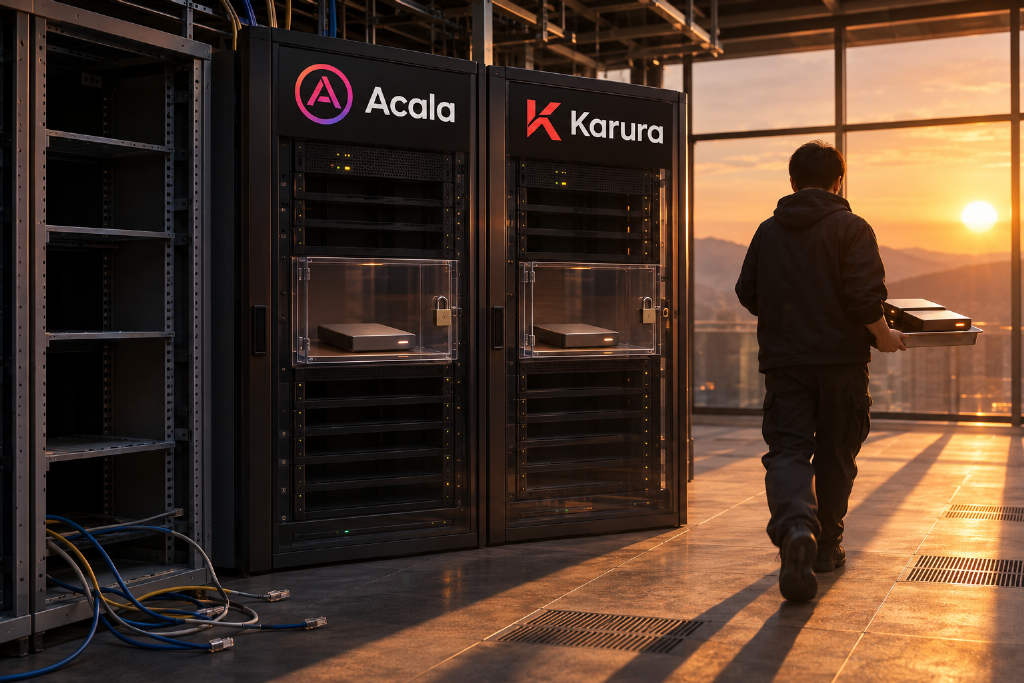
Acala, one of Polkadot’s leading DeFi parachains, has submitted Acala Referendum #195 to propose shutting down the network. Its sister chain Karura has opened Karura Referendum #137 at the same time. If both votes pass, the two networks will stop producing blocks on February 10, 2027.

In a letter to the community, the Acala team said Polkadot’s parachain architecture had spread ecosystem capital too thinly, leaving decentralized-finance liquidity severely insufficient. Node operation and network maintenance costs had also continued to exceed actual returns. The shutdown would end the operation of a flagship ecosystem that has spent about seven years being built and maintained, putting the durability of applications in a multichain environment under direct scrutiny.
External assets face phased withdrawal deadlines
The wind-down plan sets a clear cross-chain withdrawal window for external assets. Holders must move DOT, KSM, and USDT and USDC brought in through bridges to other networks by February 10, 2027. Native ACA and KAR cannot be exported across chains. Once the networks stop, those tokens will remain permanently on their respective ledgers.
Liquid-staking products have separate deadlines based on the time required to unbond. A standard Polkadot unbonding process takes 28 days. LDOT tied to a specific validator requires another 28 days to unlock, so applications for that process must be submitted by December 16, 2026. The deadlines for ordinary LDOT and LKSM unbonding are January 12, 2027, and February 2, 2027, respectively.
The team said the early withdrawal window is a technical security measure. After the shutdown, the network code and historical state ledger would remain in a public environment, allowing third parties to recompile and restart the network. As artificial-intelligence-assisted code-auditing tools become more common, legacy systems without ongoing maintenance could expose governance vulnerabilities. Clearing assets from the networks in advance is intended to prevent hackers from targeting funds left behind.
Most early parachain winners have stalled or exited
Acala won Polkadot’s first parachain slot in the network’s initial auction round in November 2021. More than 81,000 on-chain addresses took part in its crowdloan, which locked more than 32.5 million DOT. The 96-week lease provided shared security from the relay chain, but also left a large amount of capital tied up for an extended period and limited the efficiency of capital circulation within the ecosystem.
Five years later, most of the first winning projects have either left or stopped moving forward. Moonbeam stopped producing blocks around July 31, 2026, and moved GLMR to Base. Parallel Finance shut its products after a security incident. Clover also moved away from its original parachain identity. Astar is the only project listed in the report that continues active maintenance and upgrades.
The multichain structure and separate cross-chain wallet interactions added to the fragmented user experience, while limited on-chain liquidity continued to be spread across more venues. Polkadot has since shifted toward the elastic coretime model described in its Agile Coretime technical documentation and is advancing the parallel-computing upgrade outlined in the JAM protocol graypaper. Capital that left the ecosystem in its earlier phase, however, is unlikely to return in the short term.
Signaling votes await execution proposals
Both shutdown plans remain at the signaling-vote stage. Data from Subsquare showed about 23.1 million ACA votes in favor of Acala Referendum #195 and about 1.28 million KAR votes in favor of Karura Referendum #137. Neither referendum had recorded opposing votes at the time described.
If the signaling votes pass, the teams will submit on-chain execution proposals to carry out the shutdowns. The official plan promises to keep nodes running before the halt and maintain access to coretime. External assets that are not withdrawn by the deadlines will be sent back to the corresponding Asset Hub addresses where possible, but the teams do not guarantee full recovery. External assets held in the treasuries are planned for donation to the respective relay-chain treasuries.



