

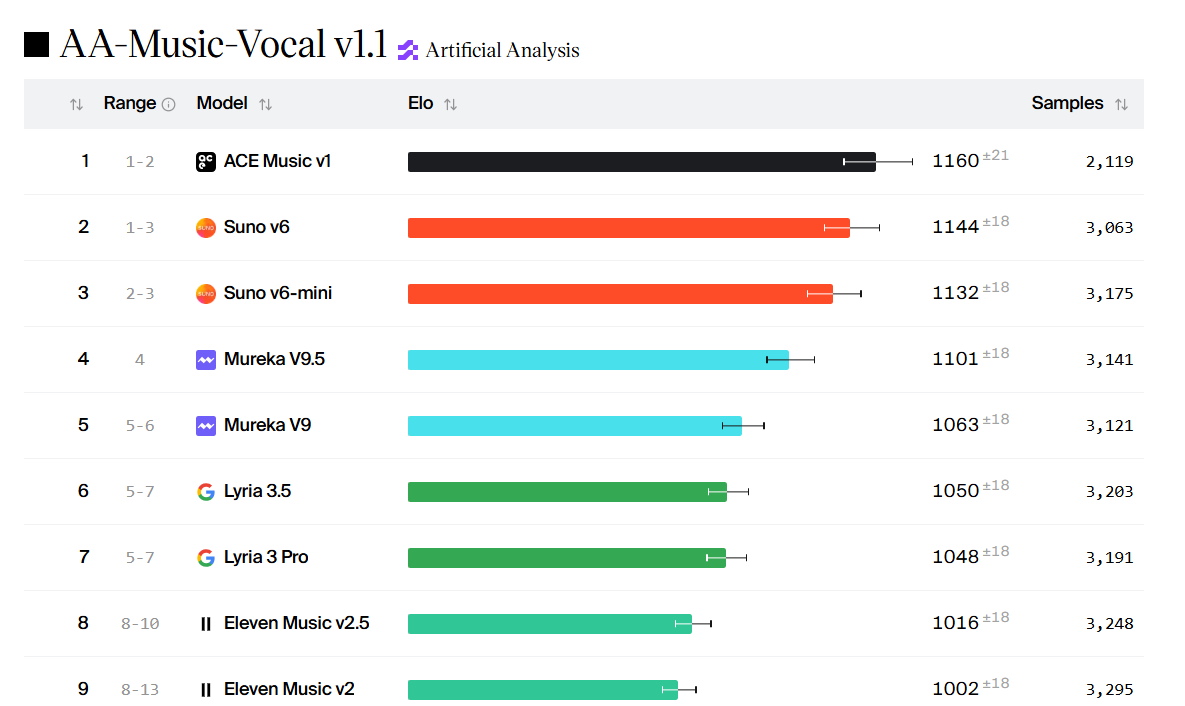
ACE Music v1, an AI music model from ACE Studio, has taken first place on Artificial Analysis’ vocal music leaderboard, scoring 1,160 Elo points against 1,144 for Suno v6. The 16-point lead is narrow: the models’ statistical confidence intervals overlap. Suno remains first on the separate instrumental music leaderboard.
The AA-Music-Vocal v1.1 benchmark evaluates AI-generated songs with vocals. Listeners hear tracks made from identical prompts without being told which model generated each one, then select the track they prefer. Those preferences feed into an Elo-style rating, with higher scores reflecting stronger listener preference.
Decrypt tested ACE directly and found it consistently made more melodic, coherent songs in mainstream styles. Its vocal performances generally sounded more natural, with fewer of the synthetic artifacts that can make AI singers stumble over lyrics, lean heavily on autotune or invent words to fill gaps.
ACE also handled endings better in the review’s tests. Suno sometimes added odd sounds, unnecessary repetitions, hallucinated material or abrupt musical shifts near the end of a track. ACE generally held to its structure and delivered cleaner conclusions. That distinction matters because a convincing chorus is relatively easy to produce compared with carrying a musical idea through a whole composition, including the section after the lyrics have ended.
Suno had the advantage in some less conventional genres. In a melodic death metal test, ACE repeatedly generated tracks with a woman singing in a clear, pleasant, clean voice, rather than the aggressive vocal delivery associated with the requested style. The review found that ACE confused metal genres more broadly. Suno produced more creative arrangements in the appropriate heavy styles and showed stronger stylistic consistency across several similarly demanding prompts.
Those results were subjective, not the product of a controlled benchmark. A win on a leaderboard does not, by itself, make a model the better choice for every musician.
More than a prompt-to-song generator
ACE’s songwriting workflow may be its most distinctive feature. Its “Idea” function can turn a basic concept into lyrics and a structured composition, identifying the sections of a song and describing how they should be arranged. Users can refine that material instead of repeatedly generating entirely new tracks.
The v1.1 Preview adds another step: it creates a musical score before generating audio. “Each generation is a new performance, so the sound may differ even when the score stays the same,” the developers explain. Users can edit melodies and chords, regenerate performances, export MIDI files and separate vocals from instruments for additional production work.
The workflow puts ACE closer to a music production assistant than a simple prompt-to-song application.
Flagship stays closed-source as open-source efforts continue
ACE Music v1 remains closed-source and has no public API. Users can generate music only through the official website. ACE Studio and StepFun have also released ACE-Step 1.5, a separate model family with publicly available code and weights. Unlike the proprietary flagship, ACE-Step can run on users’ own hardware, though it is a weaker model.
The developers say they plan to open-source ACE Music v1 Flash in late 2026. The version is designed to balance output quality, generation speed and hardware requirements, according to the company’s website.
ACE Music is available through a browser application with a limited free tier and paid subscriptions. Commercial rights for songs made with the flagship model require a paid plan. ACE-Step has a separate free generation option. For now, ACE Music v1 leads Suno v6 by 16 Elo points in vocal generation; the planned Flash release would give local users another model to try before the end of 2026.



