
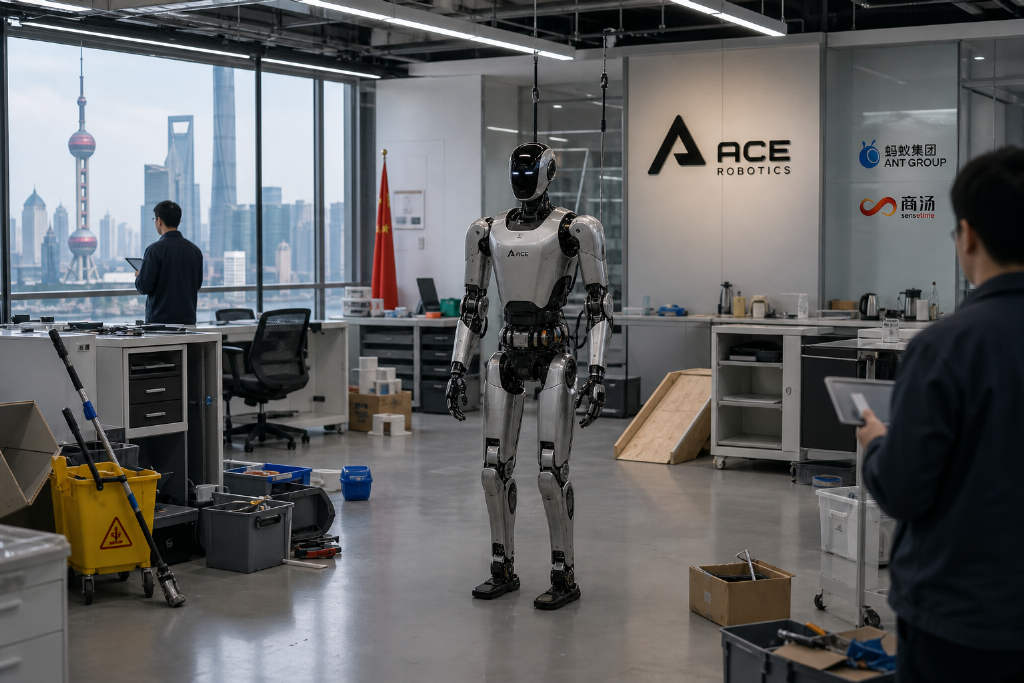
Humanoid robots can walk, dance, and box, but getting them to do useful work reliably in the unpredictable physical world remains one of artificial intelligence's hardest problems.
Reuters reported that ACE Robotics Chairman Wang Xiaogang believes progress in AI models and real-world training data could soon give robots the intelligence they need to move past demos and into commercial use.
"We expect to reach the 'ChatGPT moment' for embodied intelligence by the end of next year, driven by world models and environmental data capture," Wang told Reuters.
Funding, backers, and IPO plans
ACE Robotics was founded in July 2025. The Chinese startup develops AI models for humanoid robots. It is backed by Ant Group and SenseTime, raised more than $100 million in the first half of 2026, and plans to pursue an IPO "as early as permitted," according to Reuters.
Why data remains a bottleneck
Large language models such as ChatGPT and DeepSeek have spread quickly, yet robots still struggle with a broad range of tasks in unfamiliar environments. A shortage of training data remains a central obstacle.
Embodied AI allows robots and other physical agents to perceive their surroundings, reason about them, and turn decisions into actions through sensors and actuators. World models, in parallel, help AI learn how the physical world works by modeling how objects and environments behave.
For robots, that means anticipating what may happen before they move, pick something up, or interact with their surroundings.
Wang said the industry has accumulated roughly 100,000 hours of data over the past few years, which he described as far from enough to train embodied foundation models.
Other groups are working on similar systems
Researchers elsewhere are testing related approaches. In October, researchers unveiled HumanoidExo, a wearable exoskeleton designed to capture human movements for training humanoid robots.
Companies are also building their own robot AI stacks.
In January, Boston Dynamics unveiled the production version of its Atlas humanoid and said progress in AI had brought the robot closer to commercial deployment. In June, Alibaba introduced Qwen-Robot Suite, a group of AI models built to help robots navigate, carry out physical tasks, and simulate real-world environments.