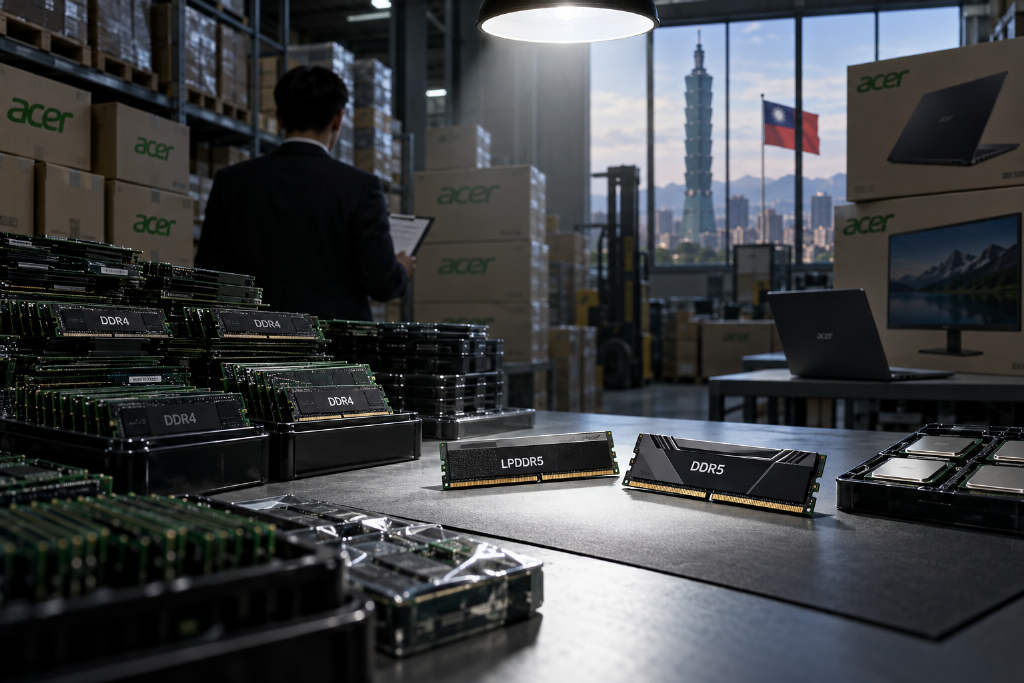
Acer Chairman Jason Chen said on the 19th that memory is no longer in short supply, with mainland Chinese suppliers continuing to release volume and disrupting pricing. Contract prices are now fluctuating at elevated levels, with mixed moves across products. Some components, including LPDDR5 and DDR5 9600 paired with N1 or N1X, remain tight, while DDR4 is already oversupplied. CPUs are generally available, except for Small Core specifications used in Microsoft low-license-fee project models.
Chen said price increases in key components this year have been unprecedented, pushing customers from complaints to stockpiling. Acer has raised inventory of lower-cost components to cope with the situation, while facing pressure to lift PC prices every quarter. In the fourth quarter, different product lines are still expected to see selling price increases of 5% to 20%.
He added that although the three major memory suppliers have signaled optimism that the uptrend could last through 2027, continued output from mainland China means prices are unlikely to keep rising indefinitely. Acer expects its SSD and memory holding costs in 2027 to come in below this year’s level, with a chance for prices to stop rising and stabilize in the second half of next year.
According to ChainCatcher, Acer Chairman Jason Chen said on the 19th that memory is no longer in short supply. He said suppliers in mainland China are continuing to release volume, making them price disruptors, while contract prices are fluctuating at elevated levels with mixed gains and declines.
Chen said some parts are still tight, including LPDDR5 and DDR5 9600 paired with N1 or N1X. At the same time, more products have moved into oversupply, with DDR4 cited as one example. CPUs are also not in short supply at the moment, except for Small Core specifications used in Microsoft low-license-fee project models, where supply remains tight.
He said price increases in key components this year have been unlike anything seen before. Customers, in his words, have gone from complaining to scrambling for supply. Acer has increased inventory of lower-cost components in response, and the company is facing pressure to raise PC prices every quarter. In the fourth quarter, selling prices for different products are still expected to rise by 5% to 20%.
On the outlook, Chen said the three major memory suppliers have expressed confidence that the price uptrend could continue through 2027. Still, he said mainland China is releasing effectively unlimited capacity, which means prices are no longer likely to keep rising on a sustained basis.
He expects Acer’s holding costs for SSDs and memory in 2027 to be lower than this year. He also said there is a chance prices will stop rising and move toward stability in the second half of next year. In the first quarter of 2027, prices may still have room to move higher, but the increase should narrow. After semiconductor capacity expansion comes online around the middle of 2027, prices could peak and then enter a more stable phase.
This article was originally published by Bit.Fan. For more cryptocurrency news and market insights, visit www.bit.fan. Disclaimer:
The market information, project data, and third-party content displayed on this platform are for industry information sharing only and do not constitute any form of investment advice or return commitment.
Cryptocurrency trading carries high risks. Users should fully assess their risk tolerance and make independent decisions. All profits, losses, and legal responsibilities are borne by the users themselves.