
From Campus Club to IPO Candidate
In China's embodied-intelligence sector, "raise and invest simultaneously" has shifted from a niche tactic of a few leaders to an industry-wide norm by 2026. Data from IT Juzi shows at least 29 domestic embodied-intelligence firms are actively making external investments. Among them, AELOS Robotics — known in Chinese as Leju (乐聚) — stands out for its pace.
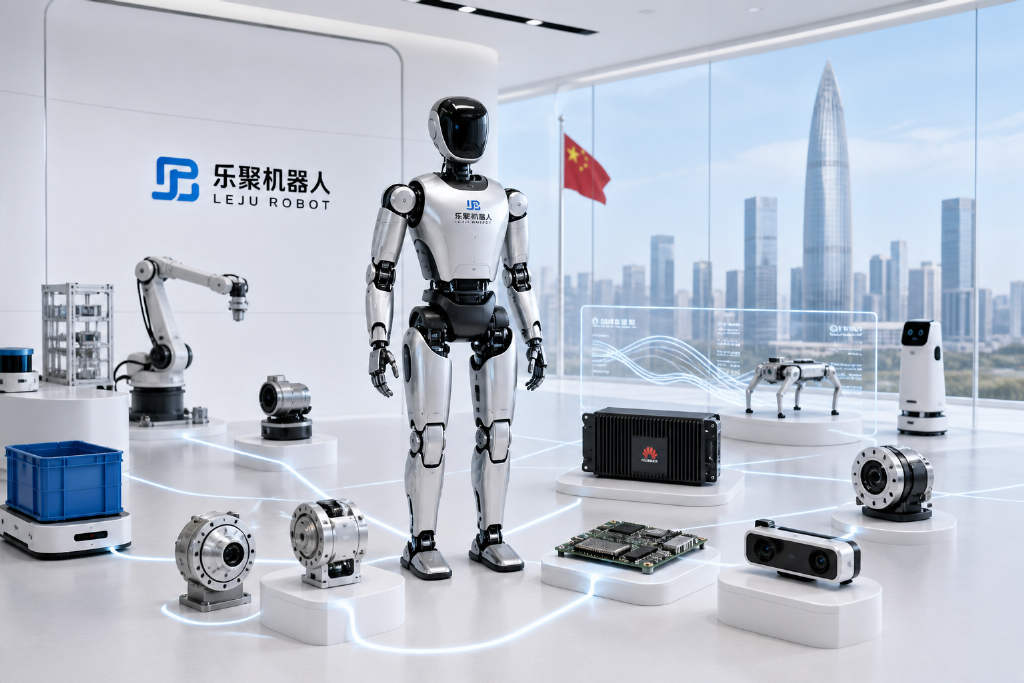
Founded in 2016 in Shenzhen by Leng Xiaokun and fellow members of the Harbin Institute of Technology robotics club, Leju spent a decade developing Kuavo (夸父) — China's first full-size, high-dynamic humanoid robot capable of jumping and multi-terrain walking, and the first to run on OpenHarmony with Huawei's Pangu large model integrated.
According to Omdia and IDC, Leju's 2025 shipments ranked among the global top four, with its full-size bipedal units placing second worldwide. That year, 577 Kuavo units were sold, generating roughly 178 million yuan in revenue — a roughly 12-fold year-on-year increase — and accounting for nearly 70% of total sales. Overall revenue climbed from 54 million yuan in 2023 to 258 million yuan in 2025.
Profitability, though, remains elusive. Cumulative net losses over three years exceeded 170 million yuan, and gross margin slid from 50.45% to 40.78%, a pattern consistent with a volume-over-margin strategy.
In May 2026, Leju's ChiNext IPO application was accepted by the Shenzhen Stock Exchange — the first filing under its "fourth-tier criteria." The company aims to raise 2.6 billion yuan at a post-money valuation of 4.327 billion yuan. Its prospectus lays out a dual-track logic: push core-component localization and supply-chain cost synergies on one side, and fund an embodied-intelligence R&D center plus high-quality datasets on the other. That "cost down, full stack, scale up" playbook maps almost exactly onto the targets of its external investments over the past two years.
13 Deals Along the Value Chain
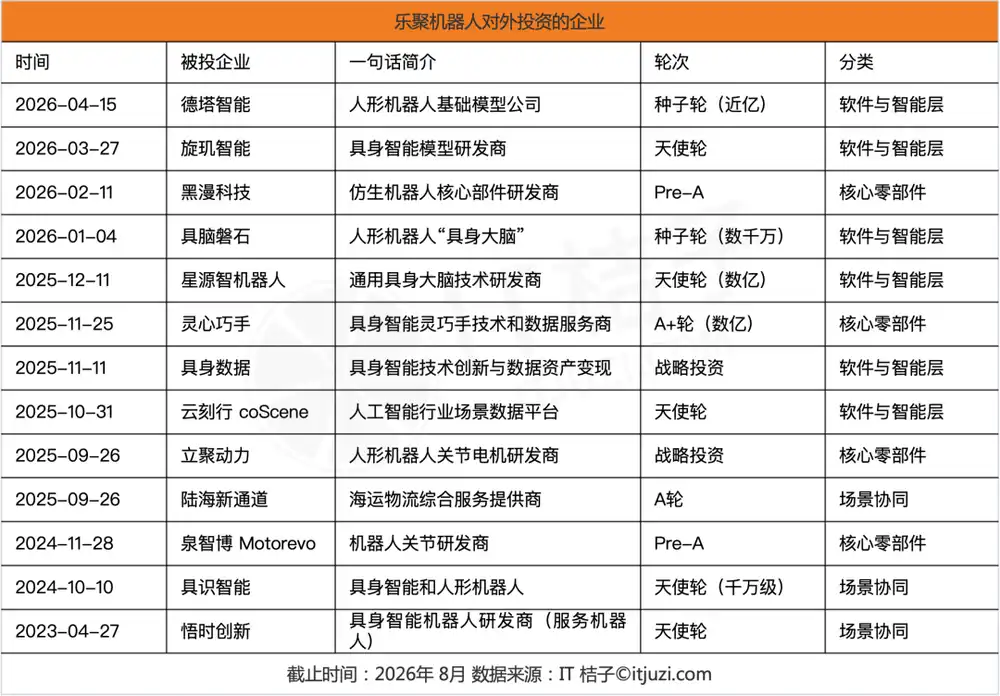
IT Juzi data shows that as of August 2026, Leju has made 13 investments as a backer. They fall into three categories along the value chain:
- Core components supply (4 deals)
- Software and intelligence layer (6 deals)
- Scenario joint ventures and industrial synergy (3 deals)
Core Components: Locking Down Cost Levers
The most expensive parts of a humanoid robot are its motion joints and end effectors. Leju's prospectus explicitly names "supply-chain synergy cost reduction" as the fundamental source of Kuavo's pricing edge. Four component-level investments effectively place those cost levers on Leju's own shareholder register.
The standout is Lingxin Qiaoshou (灵心巧手), a Beijing Haidian-based company that has reached unicorn status in the dexterous-hand segment, closing an A+ round worth several hundred million yuan. Dexterous hands are widely regarded as the "last puzzle piece" for humanoid robots — the end effector that determines whether a machine can grasp, pinch, and twist with precision. By backing the segment leader, Leju secures both supply and bargaining power for high-end dexterous hands, ensuring Kuavo can perform real-world tasks without relying on third-party procurement. This aligns tightly with the industrial and commercial-service deployments highlighted in the prospectus.
Further upstream, Quanzhi Bo (泉智博) in Wuxi focuses on joint modules and servo motors and holds high-tech enterprise certification, while Liju Dongli (立聚动力) in Ningbo specializes in joint motors. Together they form a "module + drive" combination that keeps the heaviest slice of Leju's cost structure in-house, avoiding the earlier predicament of importing core parts and spending millions of yuan on each prototype generation.
Heiman Tech (黑漫科技) fills in a future option — bionic core components — carving out differentiation space for next-generation platforms.
Software and Intelligence: Backup Brains
Leju's strength lies in the "cerebellum" — high-dynamic bipedal motion control. Its "cerebrum" has long relied on external partners such as Huawei Pangu. Six software-layer investments represent multiple backup forces on the brain side.
The youngest and boldest bet is Delta Intelligence (德塔智能), a company founded only in 2026 with a team carrying Google and Facebook pedigrees. It raised close to 100 million yuan in its seed round, targeting "humanoid foundation models" — a commanding height underpinned by world models and spatial intelligence.
Complementing that, Junao Panshi (具脑磐石) builds "embodied brains" for humanoid robots, with a team that has Huawei roots. While deeply tied to HarmonyOS and Pangu, Leju clearly wants an autonomous backup — diversifying rather than concentrating risk.
Jushen Data (具身数据) and Yunke Xing (云刻行) extend Leju's reach into training data. The former monetizes embodied-intelligence data assets; the latter operates an industry-scenario data platform with a team that includes Apple alumni. Both point directly at the IPO's earmarked "high-quality large-scale dataset" budget of roughly 616 million yuan, effectively outsourcing part of the R&D pipeline to fuel Kuavo's iterative improvement.
Xingyuanzhi Robotics (星源智机器人) and Xuanji Intelligence (旋玑智能) add further nodes in general embodied brains and multimodal vision, thickening the "outsourced brain" network.
Scenarios and Industrial Synergy: From Selling Hardware to Selling Solutions
The remaining three deals sit outside the pure supply chain and aim at real-world deployment. Leju wants more than financial returns — it wants channels to transform Kuavo from a standalone machine into a full solution package.
Luhai Xintongdao (陆海新通道) is a cross-border logistics provider with nearly a decade of operating history. Leju's investment opens a tangible pathway for humanoid robots to enter logistics handling and potentially ride Chinese manufacturing's overseas expansion, echoing the "logistics" industrial scenario spelled out in the prospectus.
Jushi Intelligence (具识智能) and Wushi Innovation (悟时创新) round out the whole-machine ecosystem. The former, a Shanghai-based humanoid robot company, can serve as a co-opetition partner for joint delivery and solution bundling. The latter, rooted in Shenzhen, builds service robots — a natural fit for Leju's showroom-guide and retail-assistant commercial scenarios.
By pulling upstream and downstream scenario partners into its orbit through investment, Leju completes the narrative arc of its industrialization story.
The Ecosystem Ambition — and Its Risks
On the eve of humanoid-robot industrialization, pure in-house hardware development no longer constitutes a moat. Leju's answer is to weave the value chain into a network through capital — self-developed body, externally linked brain, equity stakes in the supply chain. The structure tells a coherent story for IPO investors while laying groundwork for cost reduction at scale and scenario-driven deployment.
The risks are equally visible. Leju itself remains loss-making, with persistently negative operating cash flow and declining gross margins. Most of the 13 investments are early-stage, with undisclosed or small ticket sizes and long payback horizons. Few have yet generated quantifiable synergy revenue with the parent. Should the industry face short-term overcapacity and intensifying price wars, the promised "synergy dividends" of this ecosystem may not materialize on schedule.
Founder Leng Xiaokun once put it bluntly: "Only doing the dirty, grueling work creates a moat — technology alone won't necessarily become an industry barrier." With 13 external investments, Leju is turning those dirty, grueling pieces — joints, motors, dexterous hands, embodied data — into its own defenses, one deal at a time.
Source: IT Juzi (WeChat public account), author Judy.