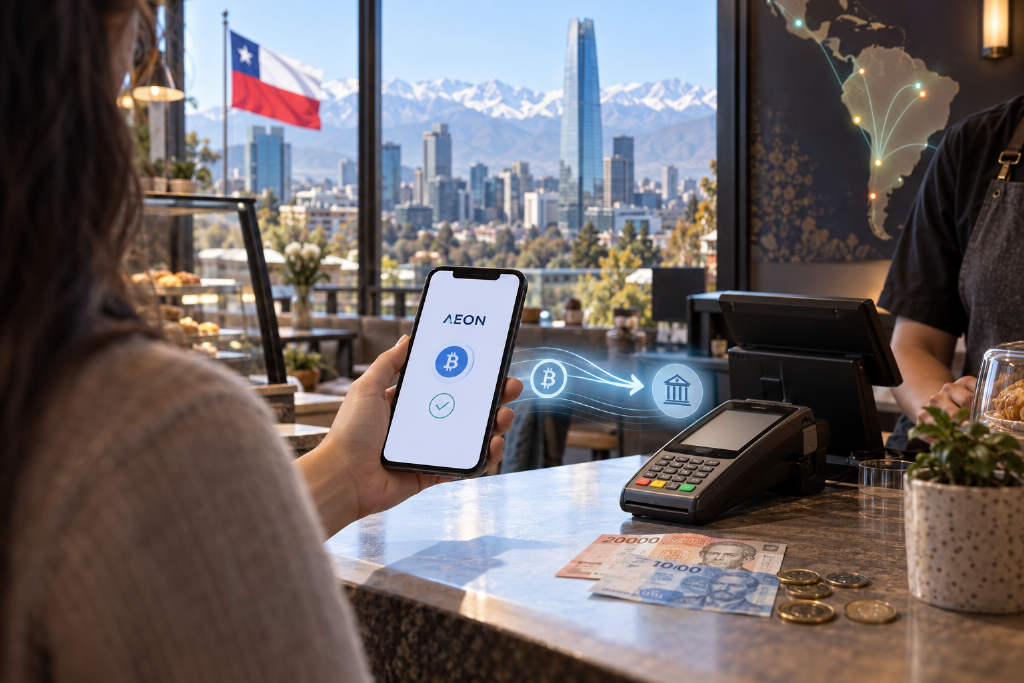
AEON, an AI economy settlement protocol, said it has added support for local bank transfer payments in Chile. The new option lets users enter an amount in Chilean pesos, or CLP, and complete the payment with crypto assets. AEON handles the asset conversion and settles funds to merchants through local banks.
According to the announcement cited by ChainCatcher, the integration broadens AEON’s local settlement network in Latin America. The company said the setup could allow AI Agents to use familiar banking payment rails for real-world spending in the future, extending practical purchasing power for the AI economy.
AEON also said it is already live in several Latin American markets, including Brazil, Mexico, Argentina, Peru, Bolivia, and Colombia. The Chile rollout adds another local payment corridor to that regional footprint.
AEON, an AI economy settlement protocol, has added support for local bank transfer payments in Chile, according to ChainCatcher.
Users can enter a payment amount in Chilean pesos (CLP) and pay with crypto assets. AEON handles the asset conversion and settles the funds to merchants through local banks.
The company said the integration expands its local settlement network in Latin America. AEON added that, in the future, AI Agents could use familiar bank payment systems to complete real-world purchases, giving the AI economy broader real-world purchasing power.
AEON said it is already available in several Latin American countries, including Brazil, Mexico, Argentina, Peru, Bolivia, and Colombia.
This article was originally published by Bit.Fan. For more cryptocurrency news and market insights, visit www.bit.fan. Disclaimer:
The market information, project data, and third-party content displayed on this platform are for industry information sharing only and do not constitute any form of investment advice or return commitment.
Cryptocurrency trading carries high risks. Users should fully assess their risk tolerance and make independent decisions. All profits, losses, and legal responsibilities are borne by the users themselves.