
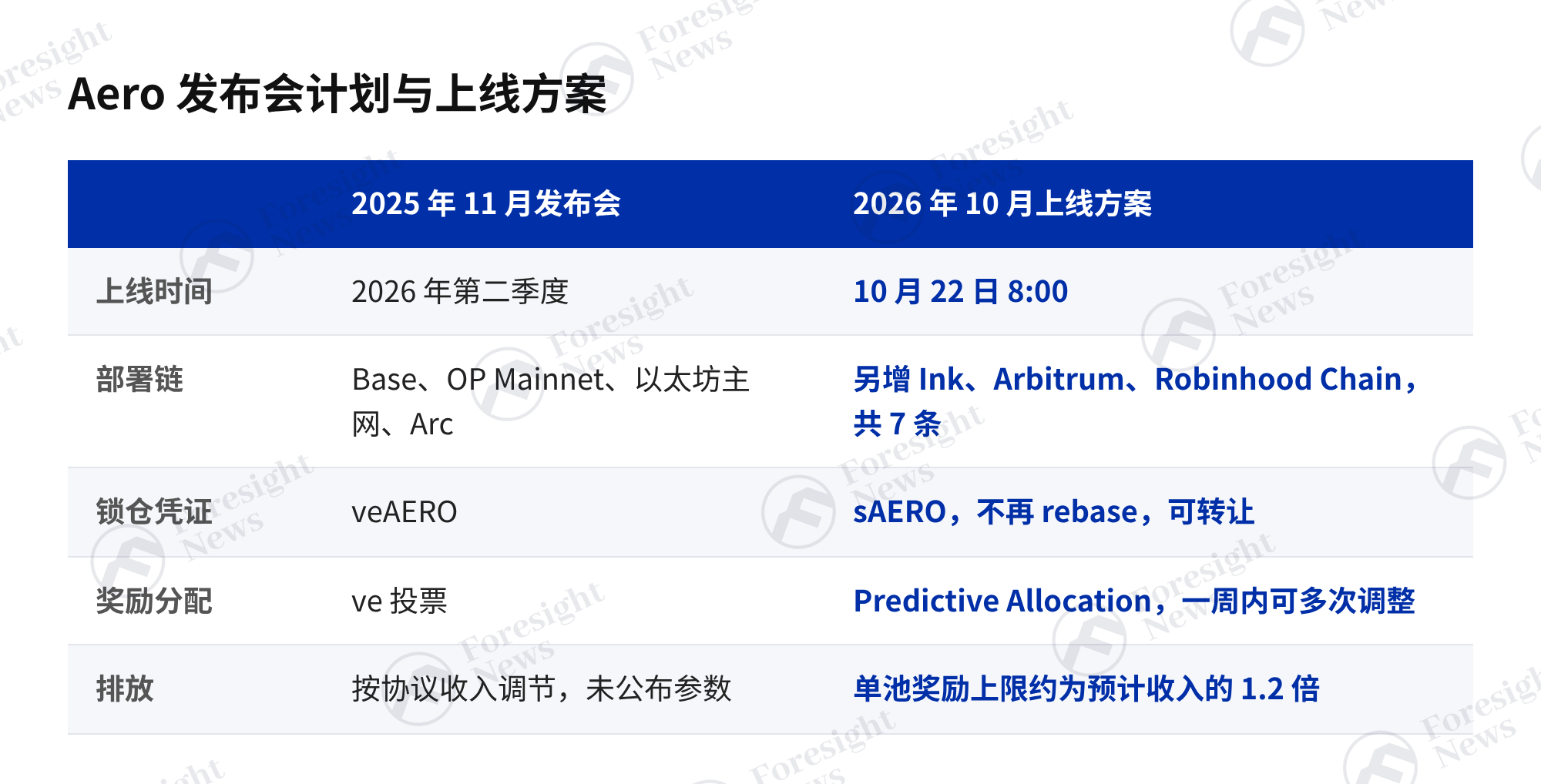
Aerodrome and Velodrome will stop emissions at 8:00 on Oct. 22, when the merged Aero launches across Base, Ethereum mainnet, OP Mainnet, Arc, Ink, Arbitrum and Robinhood Chain.
Under the conversion plan, legacy AERO will convert into new AERO on a 1:1 basis, while 1 VELO will convert into 0.044 new AERO. Holders from Aerodrome will account for about 94.5% of the new token, and Velodrome holders about 5.5%. Self-custodied tokens must be upgraded manually through the official upgrade portal, and the process cannot be reversed. Tokens held on exchanges will be converted by the platforms.
The merger plan was unveiled at the New Horizon event in November 2025. It was first scheduled to bring Ethereum mainnet and Arc online in the second quarter of 2026, then moved to September, and later pushed to October after the audit period was extended. The proposal itself also changed over the past year.
Weekly voting gives way to Predictive Allocation
Under the old Aerodrome and Velodrome design, ve holders voted once a week. Emissions for the following week were directed based on how much fee revenue each pool generated in the previous week.
At last year’s event, developer team Dromos said the ve(3,3) model would remain in place. The live version now shifts to staking instead. veAERO and veVELO will convert into sAERO, with the remaining lock period preserved and rounded up to full weeks. Permanent locks will become the maximum staking term, and positions cannot be unstaked before expiry. Unlike the old structure, sAERO will no longer rebase, and it will be transferable.

The weekly voting process will be replaced by Predictive Allocation, a new system that keeps rewards flowing into pools continuously. sAERO holders will no longer need to wait for a weekly voting window and can adjust allocations multiple times during the week. At launch, each position will face a 47-hour gap between two allocation changes. Holders will also receive revenue from the pools they choose.
Token issuers can pay allocators through Liquidity Payments and Launch Payments. Because sAERO is deployed on Base, holders need only one transaction on Base to direct rewards to pools on any of the seven supported chains, without handling each chain separately.
In a post on X, Aero said allocators are not betting on whether a token will rise or fall, but on whether a market will generate trading. That changes the incentive logic from rewarding last week’s performance to placing allocations in advance.
Emissions are being tied to revenue
In a tokenomics post published on Oct. 19, Aero said revenue flowing to veAERO holders totaled $14.9 million during the four weeks of September 2026. That figure included $6.1 million in trading fees and $8.9 million from Liquidity Payments and Launch Payments. Over the same period, AERO distributed to LPs under the fixed emissions schedule was worth $10.5 million.
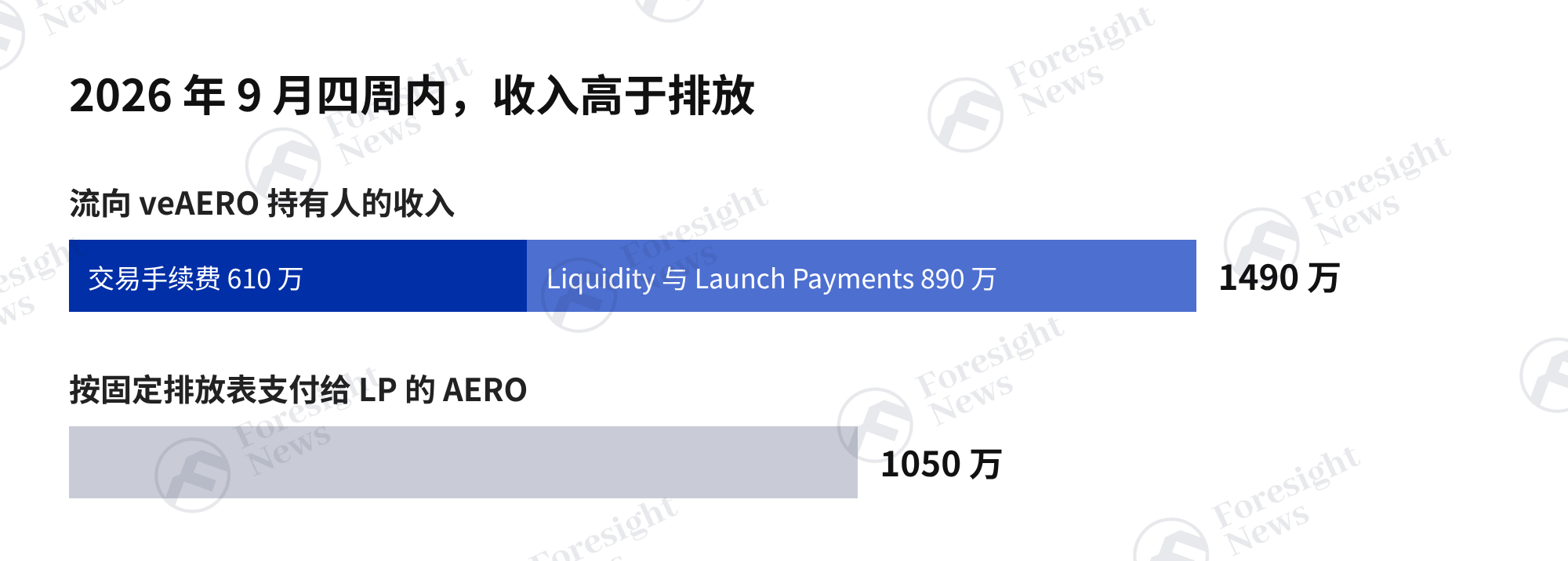
The issue, according to the project, is that token emissions had been released on a fixed timetable with no direct link to protocol revenue. Last year’s presentation said only that emissions would adjust with protocol revenue. The latest rollout adds specific parameters.
Gauge Caps tie each pool’s reward ceiling to its expected revenue. The long-term target is for average rewards across the exchange to sit at about 1.2x expected revenue, and any AERO above that ceiling will not be minted.
Rewards will also be minted only when claimed. LPs who withdraw before the minimum staking period will forfeit rewards, and those tokens likewise will not be minted.
By Aero’s estimates, AERO’s current annual issuance rate is about 11% of supply. Using the 1.2x cap and current revenue, that rate would be about 8%, while the annualized inflation ceiling is 20%. The Momentum Fund, which folded in the previous buyback plan, has bought back or locked about 110 million AERO.
As issuance becomes revenue-dependent, Aero is also changing the revenue side. Slipstream concentrated liquidity pools now use dynamic fees, raising fees during volatile periods and lowering them when markets are calm.
Aero said it backtested nine data sets across three pools during calm and volatile periods in August and September 2026. With the same average fee rate, dynamic fees produced more revenue than fixed fees in every case. A separate MEV tax will also be rolled out gradually. Transactions with priority fees above the threshold for ordinary retail trades will pay an extra charge, and that revenue will be distributed to LPs or sAERO holders in the same way as trading fees.
Most revenue still comes from Base
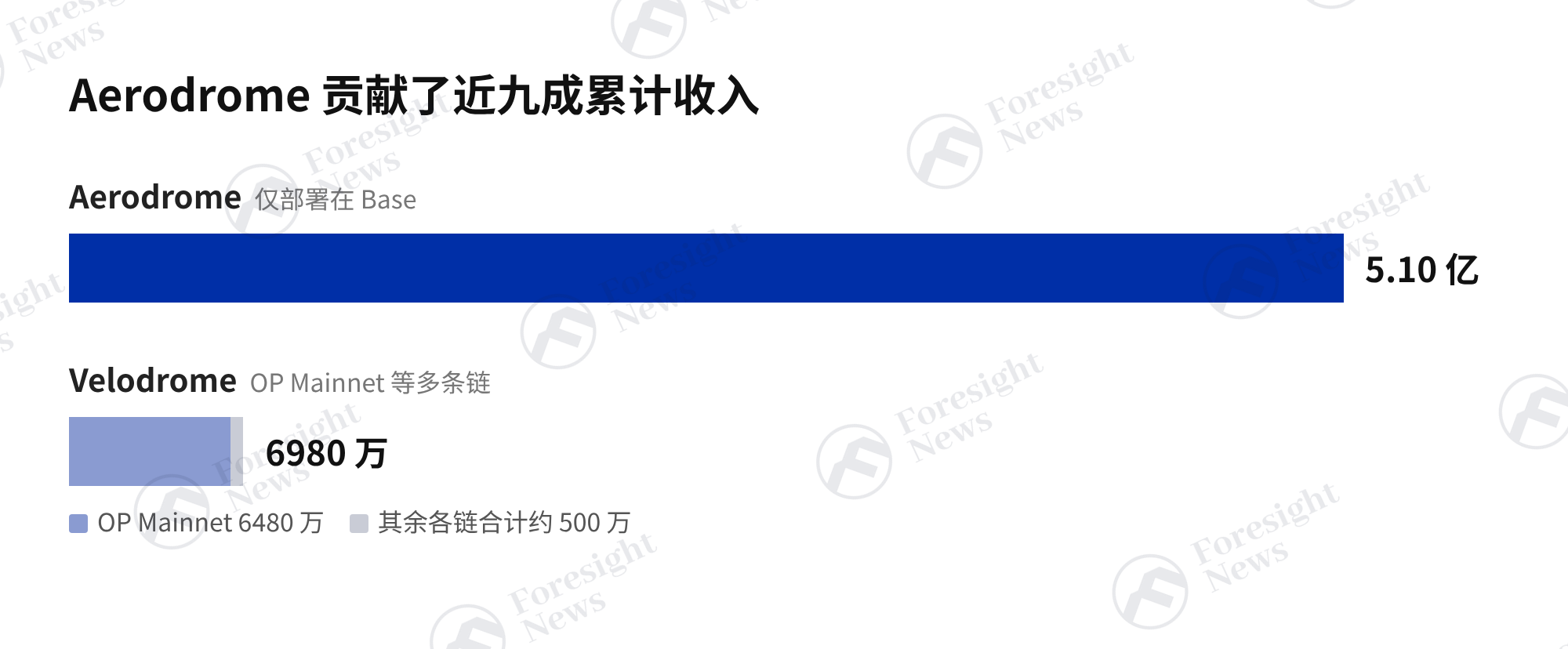
According to Aero’s Dune dashboard, the two protocols had generated about $580 million in cumulative revenue by mid-October 2026. Aerodrome, which is deployed only on Base, accounted for about $510 million. Velodrome generated about $69.8 million across OP Mainnet and other chains, with OP Mainnet alone contributing $64.8 million.
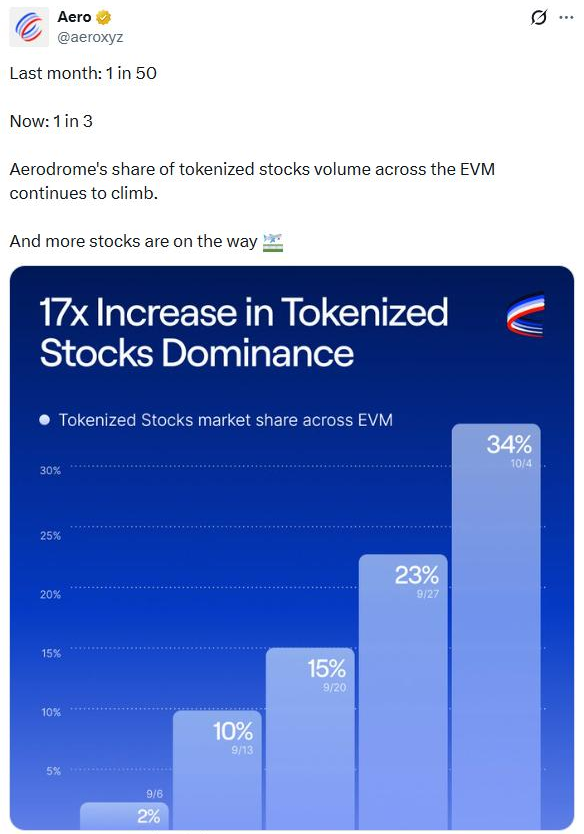
Base has also picked up a new source of trading activity. Tokenized stocks issued by Coinbase went live on Aerodrome on Aug. 24. Aero said its share of EVM tokenized stock trading volume rose from 2% on Sept. 6 to 34% on Oct. 4.
Expansion to seven chains, while some legacy markets remain open
Even with revenue concentrated on one chain, Aero is trying to widen its market share through a seven-chain entry point. The project said the chains used by the two original protocols account for about 17% of EVM spot trading volume, and that share is expected to expand to roughly three times that level once all seven chains are live.
To attract liquidity on new chains, Aero set the platform take rate for unstaked LPs at 0% on Ethereum mainnet, Arbitrum and Robinhood Chain. The other four chains will charge 5%. Metaswaps, a cross-chain swap feature, will launch at the same time, allowing users to swap across supported chains within one application.
Expansion does not fully shut down older supported chains. Pools on Celo, Fraxtal, Soneium and Unichain under Velodrome will remain tradable, but they will no longer receive AERO incentives. Deposits on Lisk must be withdrawn before Oct. 31.
First allocation round starts on Oct. 23
According to Aero’s schedule, the first Predictive Allocation round will take place at 00:00 on Oct. 23. sAERO that has already been staked will begin earning from that round.