
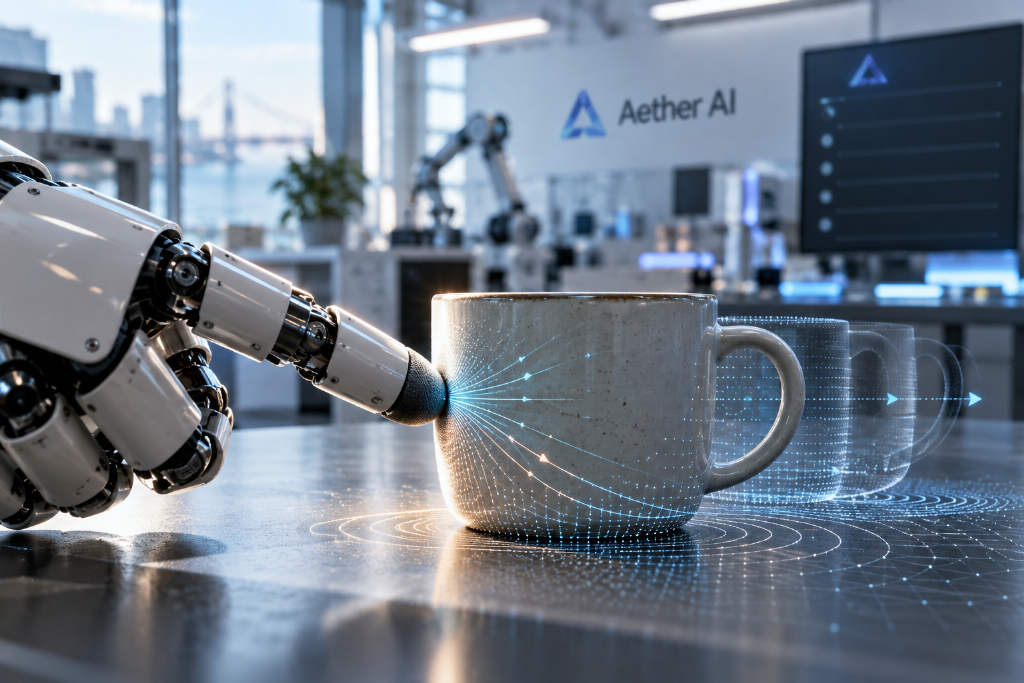
Pushing a cup from the left side of a table to the right feels trivial to a person. Break it down, though, and the future does not simply appear out of nowhere: an arm moves first, contact happens, the cup starts sliding, motion changes positions and spatial relations, and only then does the next frame emerge.
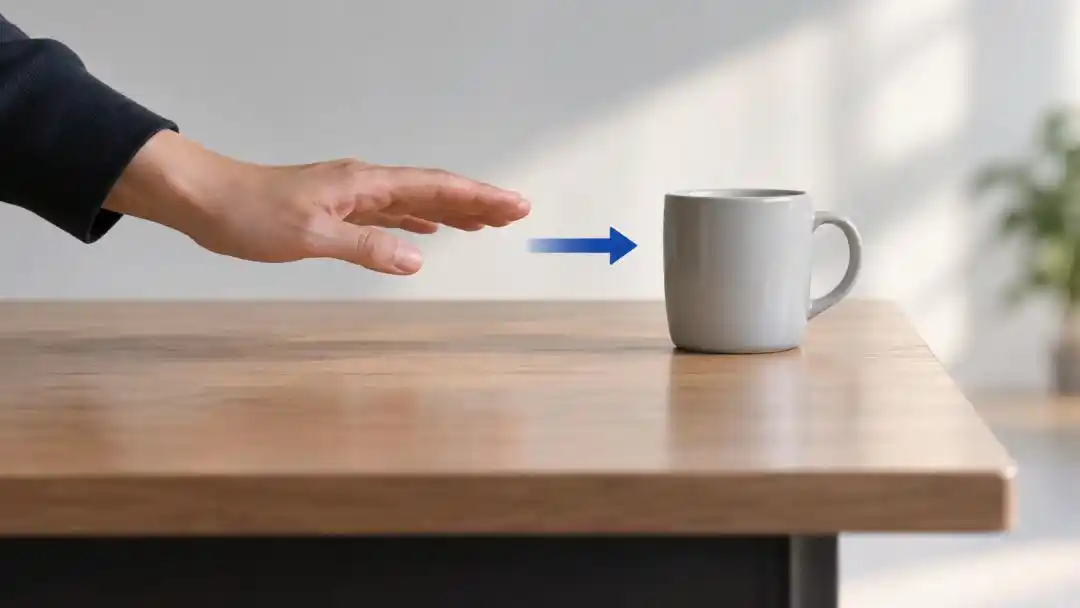
That is the fault line Aether AI is trying to address in world models. Many systems can already generate future frames directly from current observations. But when motion, contact, and geometric change stay hidden inside the model, it is hard to tell whether the system actually understands how the world changes or is only producing a plausible guess from training data.
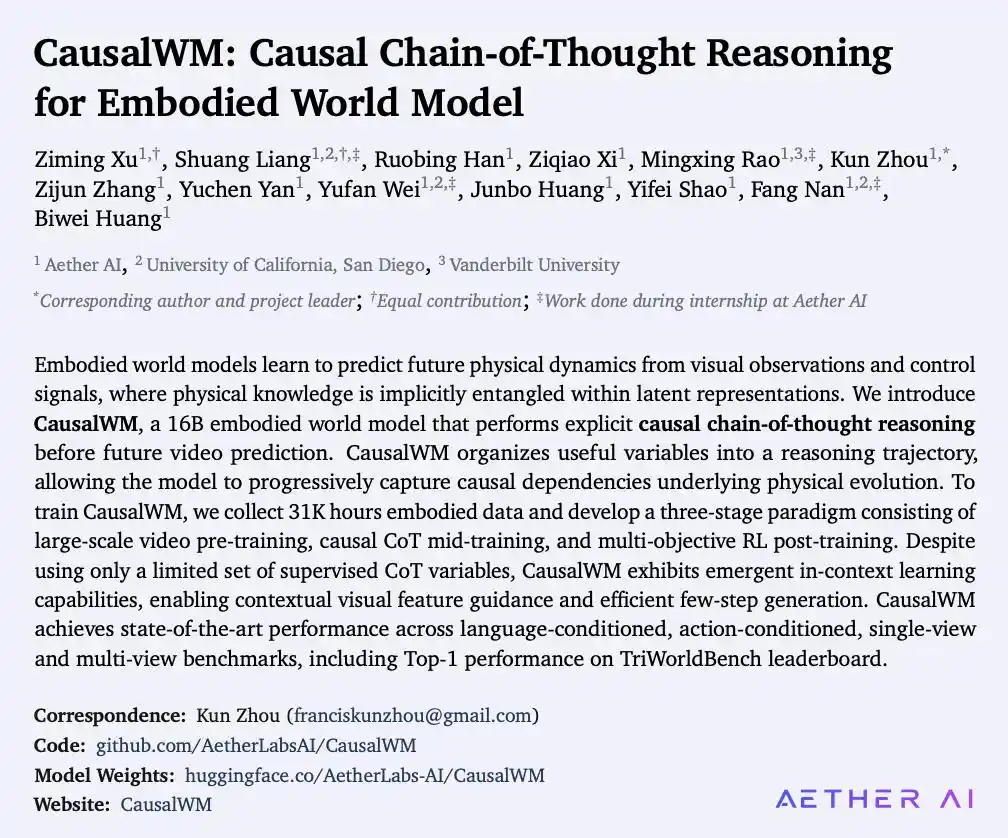
Aether AI has now released the first version of CausalWM, a 16B-parameter causal world model, together with a new framework it calls Causal Chain-of-Thought. The release was cited in the article as coming from Aether AI founder Huang Biwei’s official X account.
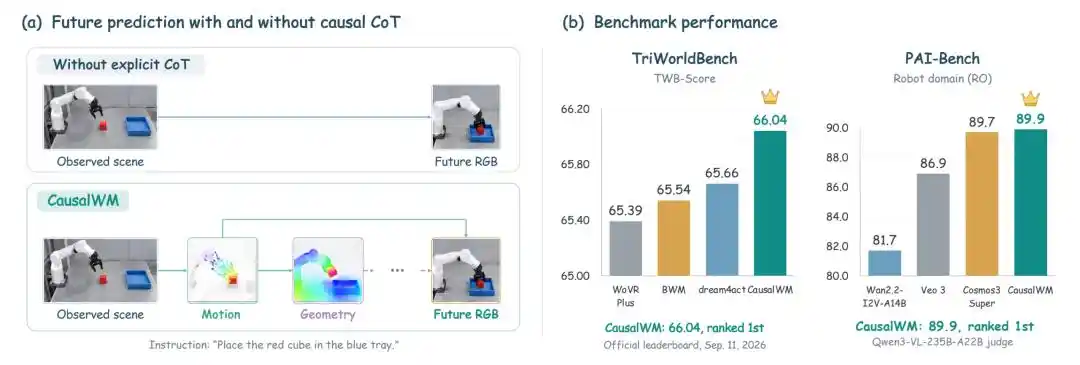
In the team’s framing, CausalWM does not rush to generate the future outright. It first infers how objects move and how 3D geometric relations change, then uses those intermediate results to produce future observations. The question behind the project is straightforward: can a world model move beyond predicting what the future looks like and begin to model how that future happens step by step?
Paper, code, weights, and project page are already public
The article says the approach has already produced early experimental validation. On the latest TriWorldBench leaderboard, CausalWM ranked first. TriWorldBench evaluates predictive ability in robotic tasks, with particular emphasis on consistency across three camera views: head, left wrist, and right wrist. The benchmark includes six evaluation dimensions and 19 specific metrics, making it difficult for a model to score well by generating footage that merely looks convincing.
The article also listed the public materials released alongside the model:
- Paper title: CausalWM: Causal Chain-of-Thought Reasoning for Embodied World Model
- Code: https://github.com/AetherLabsAI/CausalWM
- Model weights: https://huggingface.co/AetherLabs-AI/CausalWM
- Project page: https://aetherlabsai.github.io/CausalWM/
- Paper: https://openreview.net/pdf?id=3pf4d0EEqm
The piece links CausalWM to Aether AI’s earlier RSIAgent work. RSIAgent, according to the article, sends an agent into unfamiliar software, lets it explore and verify the relation between actions and outcomes, and stores that experience in memory. The article says RSIAgent did not update model parameters, yet helped open-source models including Kimi-K3 and GLM-5.3 outperform closed-source models such as GPT-6 Astra on OSWorld 2.0 and Agents’ Last Exam. RSIAgent dealt with causality in digital environments; CausalWM pushes the same line of inquiry into the physical world of robots.
From answer-only prediction to explicit intermediate reasoning
Many current world models follow a direct recipe: take the current frame and an action instruction, then generate a future video. With enough data, that works well. A model that has seen many examples of a hand pushing a cup can infer that the cup will probably move next.
The problem is that motion, contact, and spatial change are compressed into internal representations. Once that happens, it becomes difficult to know whether the model has learned the physical process itself or found a shortcut in the data. The article argues that this weakness becomes easier to spot in more complex scenes. If a robot manipulates several objects over a longer horizon, one mistaken contact judgment in the middle can send later predictions further and further off course.
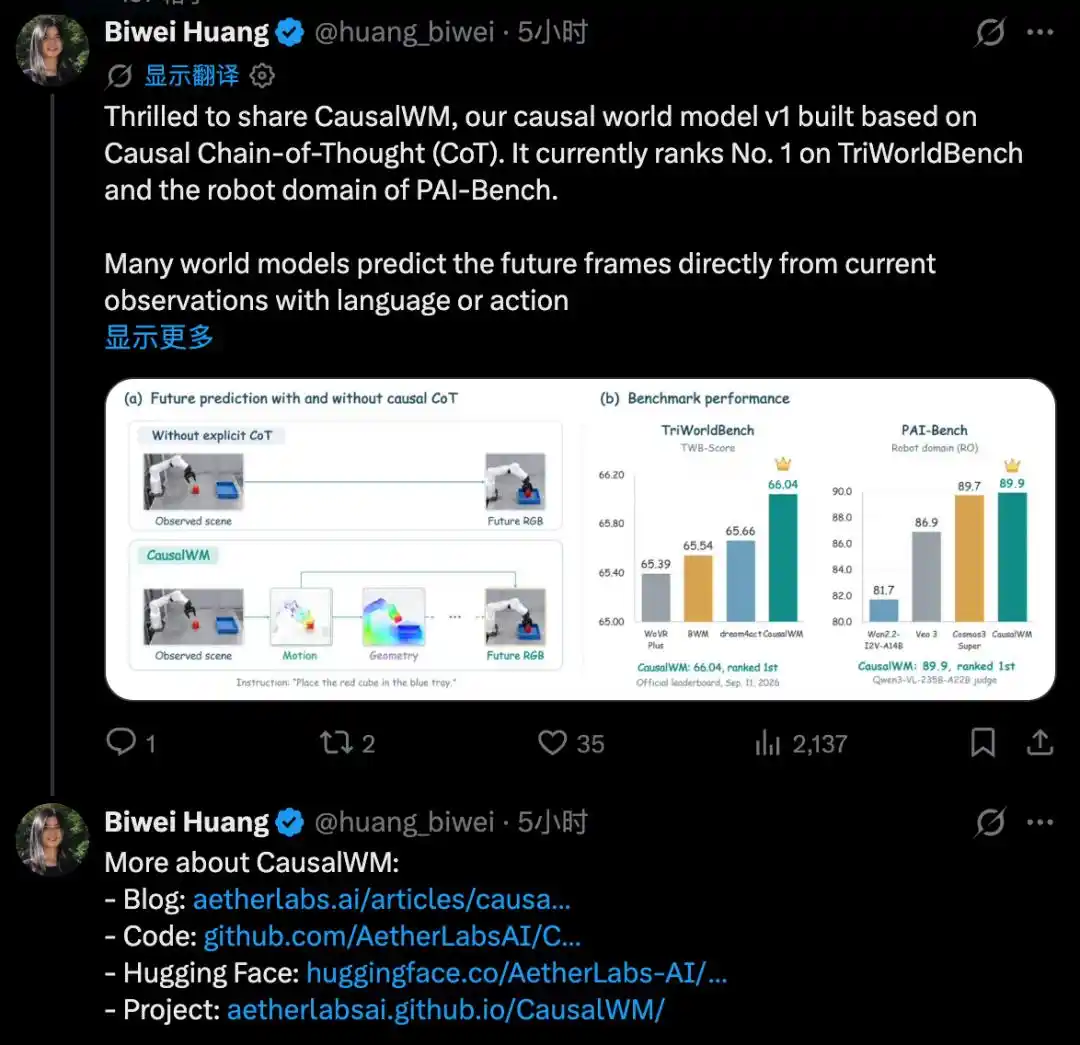
CausalWM is presented as a way to make the model show its work. Rather than jumping from the current frame to the future frame, it explicitly predicts part of the physical change before generating the future video.
The team selected several physical variables that can be extracted automatically from video:
- Optical Flow, which describes where objects in the frame are moving and by how much.
- Depth, which describes the distance between objects and the camera.
- Pointmap, which assigns 3D spatial positions to pixels and gives the model a clearer geometric view of the scene.
The article stresses that the novelty is not the use of flow, depth, or pointmaps by themselves. Those variables have long been used in video prediction and visual understanding, sometimes as auxiliary supervision. What CausalWM changes is the way they are arranged: as an ordered reasoning chain.
Take the cup-pushing example again. The model does not begin by answering where the cup will be a few frames later. It first asks what in the scene is moving and in which direction. That is the Physical Motion stage, represented through optical flow. It then infers what that motion does to 3D spatial relations: the cup’s position changes, the relative distance between the robotic arm and the cup changes, and the scene’s 3D structure changes with it. That is the Geometry stage, represented through variables such as depth and pointmaps. Only after that does the model generate the future observation.
The article summarizes the chain as:
Observation → Physical Motion → Geometry → Future Observation
This is also where CausalWM differs from methods that predict flow, depth, or pointmaps only as auxiliary targets. In those setups, the model can solve the auxiliary task during training and still generate the future video through some other hidden path. In CausalWM, the predicted flow is fed back into the context and used to infer 3D geometry; the resulting pointmap is then fed back again and used in future-frame generation. Each step is both a prediction target and a condition for the next step.
That is why the team calls the method Causal Chain-of-Thought. In the article’s description, it uses motion and geometry that already exist in the real world to build a reasoning trajectory that directly participates in future generation.
A stage-ordered attention mask keeps the chain causal
To stop the model from “looking at the answer” during training, CausalWM adds a stage-ordered attention mask. In practical terms, each reasoning stage gets limited read access. Earlier steps can only see information that has already occurred; they cannot read later pointmaps or future frames in advance. Without that restriction, a model could appear to predict motion and geometry while actually inferring them backward from the final answer, which would strip the causal chain of its meaning.
As described in the article, both training and inference follow the same direction: Motion → Geometry → Future.
Roughly 30,000 hours of video and a three-stage training pipeline
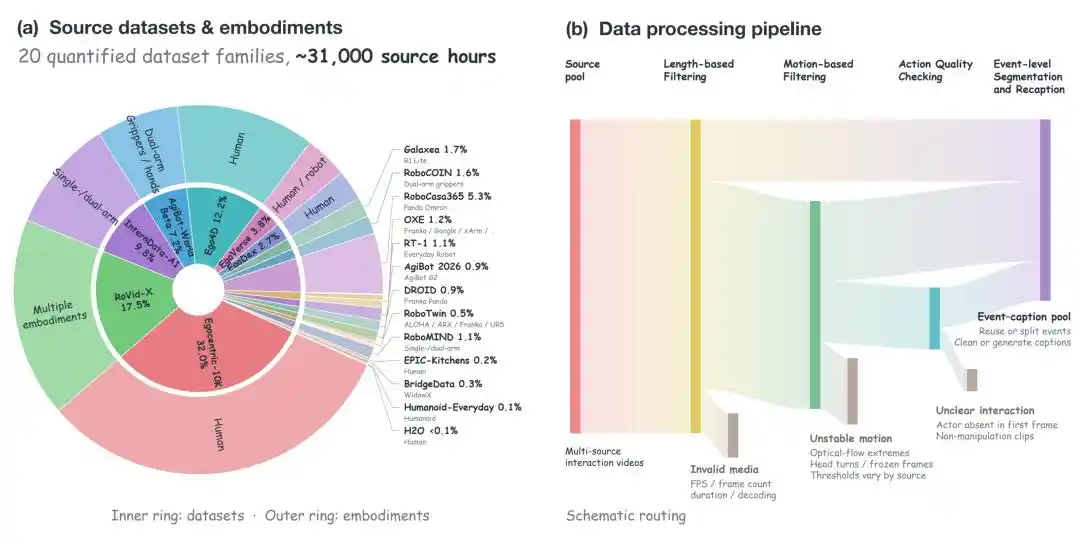
Architecture alone was not enough. Aether AI built a mixed embodied-video dataset of about 30,000 hours for CausalWM, covering robot manipulation, egocentric video, multi-view robot data, and other physical interaction scenes.
The training pipeline has three stages:
- Pixel-level Pre-training
- Causal CoT Mid-training
- Multi-objective RL Post-training
Stage 1: build a strong world-generation base
CausalWM uses LTX-2.3-22B as its base model and learns language-conditioned future prediction on large-scale video. Given a current observation and a task description, the model first has to generate coherent and credible continuation video. The article says that without this foundation, later physical reasoning would have little to build on.
Real-world data creates another problem: many videos do not come with robot action labels. Even when they do, robots differ in joint counts, control schemes, and action spaces, making joint training difficult.
To address that, the team introduced CD-LAM, which extracts a unified latent action from video. It compresses the changes seen in frames into a latent action representation, allowing the model to learn what kind of action caused what kind of change even when explicit control commands are missing. Videos from different robots can then be used together for action-conditioned dynamics modeling through that shared representation.
Because robots often have multiple cameras, including head and wrist cameras, the team also trained a multi-view version at this stage. The model had to observe the same operation from different positions while keeping object states and robot actions consistent across views. That laid the groundwork for the three-view evaluation used in TriWorldBench.
Stage 2: train the Causal CoT itself
In the second stage, the team used optical flow, depth, and pointmaps as intermediate physical variables. These describe motion in the frame, object-to-camera distance, and more explicit 3D spatial relations. Because they can be extracted automatically from raw video, they do not require manual annotation and can scale more easily to large datasets.
During training, the model generates intermediate variables step by step according to predefined physical dependencies. The article gives the typical order as:
Flow → Pointmap → Future RGB
The model first predicts how objects move, then infers how 3D geometry changes, and only then generates the future frame. The output from one step is placed back into the context to guide the next. That makes flow and pointmaps both prediction targets and direct inputs to later reasoning.
Again, the stage-ordered attention mask is what prevents leakage from later answers into earlier steps. Each stage can read only what comes before it. Pointmaps and future video cannot leak backward. Training and inference follow the same order, so the chain is not decorative; it is part of the generation process.
Stage 3: optimize the whole chain from final outcomes
Video generation is open-ended. The same initial scene can lead to multiple reasonable futures, which makes it hard to train the task the way one would train a classification problem with a single correct answer. Supervised learning alone also struggles to balance physical consistency, temporal quality, and task completion.
CausalWM therefore adds multi-objective reinforcement learning. For the same context, the model samples multiple candidate futures, receives rewards across dimensions including physical consistency, visual quality, and task completion, and then compares and optimizes those candidates through group-based optimization.
The optimization target includes the intermediate Causal CoT as well. The model explores which reasoning paths produce better final videos: intermediate processes that lead to plausible futures are reinforced, while paths that distort motion or geometry are suppressed.
In the article’s description, this turns Causal CoT from a fixed supervised chain into a physical reasoning process that can itself be explored and improved. The model is not only learning what the future should look like, but also how to reach that future through a more reasonable sequence of intermediate changes.
The same interface can also be used for control
The article says Causal CoT brings an additional capability. During training, CausalWM repeatedly consumes visual variables such as flow, depth, and pointmaps and uses them to generate the next stage. Over time, the model learns a more general pattern: if a new condition can be represented as visual information, it may also be inserted into the context and used to shape future generation.
That creates an opening for control.
If researchers have already planned a robotic arm’s joint trajectory in a simulator, they can use the robot’s URDF structure and forward kinematics to render that joint data as motion trajectories in the image, encode it as visual tokens, and feed it into CausalWM. After limited fine-tuning, the model can recognize this kind of condition even though it was not originally part of the Causal CoT, then generate future video consistent with the specified trajectory. Hand-drawn object paths and geometric constraints can be injected through the same interface as well.
In that setup, intermediate variables that were first introduced to explain how the future happens become control knobs. The article ties this to the core of causal questions. Ordinary prediction asks what is likely to happen next given the current scene. Adding a trajectory changes one condition on purpose and then observes how the future changes with it. That lets the model handle intervention-like questions such as what happens to the cup if the robotic arm moves in a specified way.
The article also notes that this still falls short of strict counterfactual reasoning. Even so, it moves a world model from merely watching the future toward manipulating conditions and comparing outcomes.
Benchmark results on TriWorldBench and PAI-Bench
Aether AI evaluated CausalWM on several embodied world-model benchmarks covering language-conditioned, action-conditioned, single-view, and multi-view prediction. The article specifically mentions the online benchmark TriWorldBench and the offline benchmark PAI-Bench, and says CausalWM posted leading results across multiple settings.
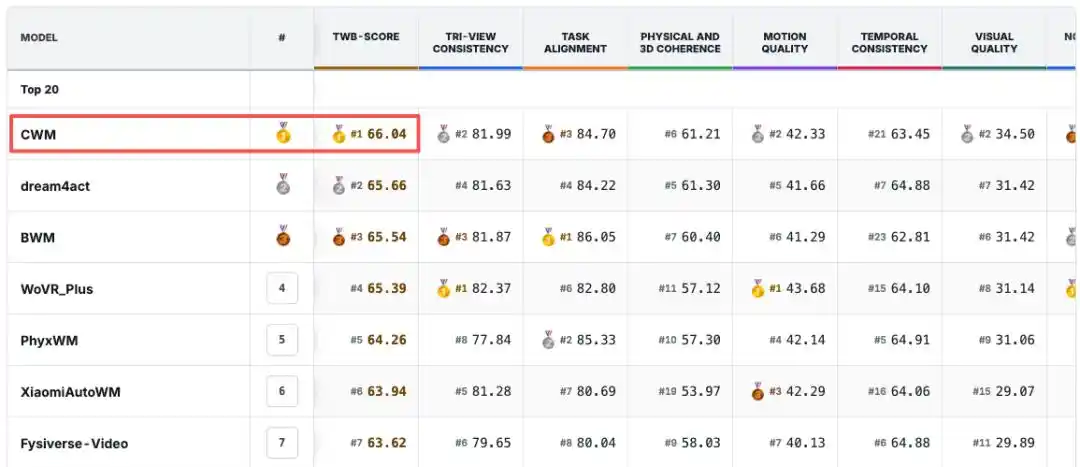
TriWorldBench offers the clearest window into what the model is doing. Unlike many video benchmarks that score only a single external view, it requires simultaneous generation of head, left-wrist, and right-wrist views. That is closer to how robots actually operate: the head camera tracks overall task progress, while wrist cameras focus on local contact and grasping.
As a result, the three videos do not just need to look plausible on their own. They must describe the same physical world. The benchmark checks whether the robot moves at the right time, whether objects are grasped correctly, and whether states line up across views.
On the latest ranking, CausalWM posted a TWB-Score of 66.04 and ranked first. The article says the model placed near the top or led in metrics including three-view consistency, task alignment, motion quality, perspective plausibility, and image quality.
It did not sweep every single sub-metric. The article’s interpretation is narrower: the leading total score suggests that, under this benchmark, CausalWM can handle multi-view consistency, task understanding, physical interaction, and video generation quality at the same time.
Outside TriWorldBench, the team also tested the model on PAI-Bench and other settings, where the article says it also ranked first in the latest standings. PAI-Bench asks a different question. Rather than focusing on robotic multi-view consistency, it probes whether the predicted future obeys physical rules.
According to the article, all PAI-Bench cases come from real-world captures such as dashcams and industrial cameras, spanning autonomous driving, robot manipulation, industrial scenes, human activity, and physical commonsense. Evaluation does not stop at image quality. It also introduces a Domain Score, using multimodal large models as judges to question physical details in generated videos one by one. That makes it harder for a model to score well by producing footage that only looks visually convincing.
The article adds a note of caution: a single leaderboard result can always contain some randomness. But if the same method performs well across multiple task settings, that at least points to a method-level signal. Explicitly modeling Motion and Geometry between Observation and Future may indeed help world models predict changes in the physical world more reliably.
From predicting the world to understanding it
The article places CausalWM within Aether AI’s broader direction. Over the past few years, the main line in world models has been clear: more data, larger models, longer videos, higher resolution. That scaling path teaches models to answer one question—what the future looks like.
Aether AI, by contrast, is focused on a different one: why the future unfolds the way it does, and what actually determines it. The article presents that as the core motivation behind the company’s push toward what it calls Causal Intelligence.
In many existing world models, motion, geometry, and physical knowledge are compressed implicitly into latent representations. A model may generate a future that looks reasonable, yet it remains unclear whether it identified the key causal variables or relied on shortcut correlations in the data to guess the result. As prediction horizons grow longer and object interactions become more complex, the limits of that implicit approach become more visible, with errors accumulating in places that are hard to inspect.
CausalWM is described as Aether AI’s first attempt in causal world models. It makes hidden physical changes explicit by organizing optical flow, depth, and 3D geometry into an ordered Causal CoT, then having the model reason along a Motion → Geometry → Future chain before generating the future frame. Put differently, the model is no longer learning only the correlation between input and output; it is beginning to model which intermediate changes lead to which later outcomes.
The article says experiments support the potential of that route. CausalWM topped TriWorldBench and exceeded SOTA models on multiple PAI-Bench metrics, including some methods with larger parameter counts. Rather than only scaling model size, Aether AI is trying to test another path: improving a world model’s understanding of the physical world by modeling causal variables, causal dependencies, and causal transitions.
The same framework also brings causal reasoning and control onto a shared interface. Intermediate variables that explain the future can be injected back into the model as interventions through in-context learning. One example in the article is a robotic arm trajectory planned in a simulator, rendered as a visual signal, and added to the context so the model generates a future consistent with that intervention. In that sense, the world model starts to move beyond observing what will happen and toward modeling how the world changes when a variable is altered or an action is applied.
The article is explicit that CausalWM is only a starting point. It remains far from full causal discovery and counterfactual reasoning. That gap, however, is also the problem Aether AI says it wants to keep pushing on: from causal representation learning to causal reasoning and causal intervention, step by step. The piece also references Turing Award winner Judea Pearl, who divides intelligence into three layers—association, intervention, and counterfactuals. By Pearl’s ladder of causation, the article says, most mainstream models still remain at the first layer.
Seen in that wider frame, CausalWM is one milestone in a longer program. RSIAgent explored causality in software environments; CausalWM moves the same question into the physical world. One deals with causality in software, the other with causality in embodied interaction.
The article summarizes that direction with Aether AI’s phrase “Towards Real-World Causal Intelligence” — moving AI from predicting correlations toward discovering causality, understanding causality, using causality, and ultimately acting on the world through it.
The original article was from the WeChat public account Machine Heart (ID: almosthuman2014) and edited by Zhang Qian. It was republished by MarsBit.