A Foresight article says the crypto industry may have been focusing on the wrong wedge into the agent economy. Instead of payments, the piece points to on-chain collateral and on-demand risk markets as the more interesting direction.
Written by Lao Bai, the article reflects on a long essay by @Leozayaat and its view of how the agent economy could develop. A widely held idea in crypto has been that blockchains are not really built for humans but for agents, since software can hold wallets easily and small payments fit the model well.
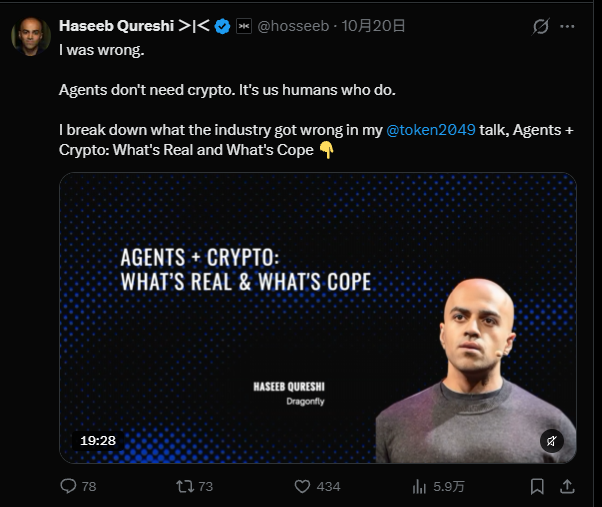
That assumption is now being questioned. Lao Bai notes that DragonFly’s @hosseeb recently said in a tweet that his earlier view was wrong: agents do not need crypto, humans do. In this context, the point was specifically about payments. The article also says Haseeb had made a similar argument at 2049.
The market backdrop is straightforward. Over the past year, companies including Visa and Stripe have been actively building agent payment infrastructure, and most agent payments have been processed through traditional card networks and the broader financial system. By comparison, crypto protocols such as X402 account for only a tiny share. Agents may need payments, the article argues, but that does not mean they need an entirely new payment network.
Three stages for the agent economy
The essay discussed in the article lays out three stages for how the agent economy may evolve.
Stage one: agents buying from humans
At the first stage, agents act on behalf of humans to buy services such as APIs, data, and compute. The central question here is how to let agents pay autonomously.
Stage two: agents buying from agents
Once agents start buying services from other agents, the problem shifts from payment to performance. The issue is no longer just how money moves, but how to make sure the other side actually delivers.
The article says the proposed answer is to use bonds or collateral to constrain agent behavior. If identities can be created without limit, reputation is easy to game. Collateral that can actually be seized is presented as a more reliable form of discipline.
Stage three: disposable markets
This is the part Lao Bai describes as the most imaginative. The example in the article is an agent that temporarily needs 1,000 hours of GPU compute to complete a task but is worried that a supplier may fail to deliver on time. Instead of relying only on trust, the agent could create a market on demand so that other participants can price the specific risk of delayed delivery and commit capital against that risk.
Under that model, the market does not need to be listed in advance, and it does not need market makers lined up beforehand. If there is real demand, the system can try to find capital willing to take the other side. The article’s conclusion is that financial markets themselves could become infrastructure that is called only when needed.
Lao Bai’s take on the framework
Lao Bai then gives three reactions.
First, on payments in stage one, he says X402 now carries some signs of being challenged by reality, which he links to Haseeb’s public admission that his earlier judgment was wrong. Even so, he adds that the sector is still early and it is too soon to declare the path unworkable.
Second, on reputation in stage two, he says this is what ERC8004 is trying to address. Similar to X402, he writes that current data also makes this look like a track facing serious doubts. The article sums up the problem this way: having an on-chain identity does not mean having credible reputation, and having a reputation record does not mean having real transaction history. For agents, the cost of farming reputation is very low.
Third, disposable markets point to a new economic form in which agents can create one-off markets as needed, price a specific risk, and find capital willing to bear it.
Beyond payments
The article argues that this logic makes sense in a world of silicon-based actors because their ways of searching for information, discovering options, making decisions, communicating, and pricing differ sharply from those of human society, with efficiency potentially many orders of magnitude higher.
It also stops short of claiming that this outcome is certain. Lao Bai writes that this remains an extrapolation and nobody knows whether it will actually happen. Still, he says the idea is logically coherent and opens up a wider set of possibilities for the agent economy than payments alone.
The piece closes by mentioning the recent launches of Grok Bot and Meta Muse, saying they may accelerate the evolution of the agent economy and lead to new forms of financial markets that go well beyond payment rails.
The original essay, according to the article, also discusses a range of economics and finance experiments conducted by overseas labs using agents. Lao Bai recommends reading it directly for those interested.
Disclaimer: Markets carry risk, and investment requires caution. This article does not constitute investment advice. Readers should consider whether any opinions, views, or conclusions in the article fit their own circumstances. Any investment decision made on that basis is at the reader’s own responsibility.