


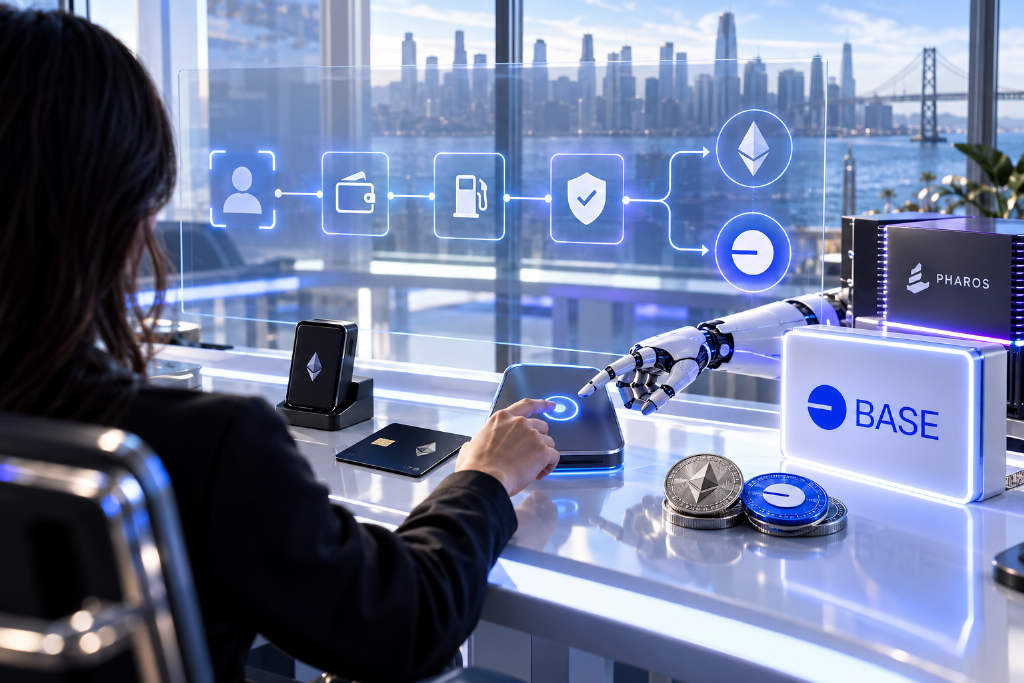
AI agents may already be handling more online and offline spending tasks, but getting them to spend money onchain is still a multi-layer infrastructure problem rather than a simple product feature.
That is the core argument in a long-form report published by Odaily. The piece says that by the fourth quarter of 2026, AI agents had started taking over parts of consumer execution, and the popularity of products such as Muse and Grok Bot showed that agents can perform better once they are given operational control. The harder question comes after that: when an AI agent receives a payment or trading task, what blocks it from actually spending onchain?
Odaily frames the issue around a chain of practical constraints: no private-key wallet, no clear gas payer, no settled approval flow, no spending cap, and no obvious compliance window. A growing group of financial infrastructure providers, public blockchains, and payment teams are now trying to answer that question.
Why the shift is happening in the second half of 2026
According to the report, this timing depends on several conditions that only came together in the second half of 2026.
First, offchain agents have become highly productized. Odaily says OpenClaw’s breakout earlier in the year lowered the user-education barrier, while improvements in large language models pushed AI agents into real-world use cases, including paid API calls and offline task execution. Even so, the demand created by machines needing to pay for services had not yet been matched by a productized onchain settlement layer.
Second, shared infrastructure for machine payments has started to emerge. The article points to the x402 protocol, Tempo’s MPP machine-payment protocol, operational work tied to the Linux Foundation with 40 members, and BNB Chain’s release of Agent Studio in July. In Odaily’s view, payment standards and tooling had to mature before agent payments could move onchain in a practical way.
Third, public blockchains and crypto projects are dealing with growth pressure. The report says narratives such as GameFi, SocialFi, DAOs, the metaverse, and NFTs have run into a dead end under tighter liquidity conditions, while user growth has become harder to sustain. AI agents, whose numbers are still rising quickly, are being viewed as a possible new source of gas consumption and transaction activity.
Odaily separates what it sees as real demand from what it describes as overheated narrative.
- Real demand already validated by the crypto market includes settlement, meaning machines paying for services; authorization, meaning security boundaries and spending limits; identity, meaning verifiable and traceable credentials; and reusable skills that have already been tested offchain.
- Overstated narratives include a fully autonomous AI-agent economy and the idea that agents will replace human accounts at scale. Odaily says that in the short to medium term, humans will still remain the account holders behind payments and trades, while AI agents act as executors.
On that basis, the report argues that the AI-agent economic turn in the second half of 2026 is not just another trend chase. It is also a response by blockchains, protocols, and projects trying to extend their life cycle and improve their competitive position.
The first barrier: what machine payments still cannot solve cleanly
Odaily says the industry pivot is already underway, but the core bottlenecks are structural. Even after nearly a year of broad AI-agent adoption, machine payments still face what the article calls the first major hurdle.
The report breaks onchain autonomous operation into four gates.
Identity access
AI agents cannot complete traditional KYC, open bank accounts, fill in transfer forms, or satisfy anti-money-laundering and counterparty-review requirements on their own. Without identity, they cannot enter the financial system.
Compliant custody
The article asks who should hold the wallet and private key, how leaks can be prevented, and how systems can avoid overspending caused by prompt injection, bad decisions, or endless retries. Without a secure vault, Odaily says, agents remain exposed to operational risk at all times.
Gas friction
Gas is usually priced in a chain’s native asset, which creates friction in multi-chain execution. At the same time, service fees that an AI agent must pay may be denominated differently, creating a mismatch in units of account. Without a more universal environment, the report says, agent transactions cannot run smoothly.
Execution assessment
Machine economies tend to involve high-frequency, low-value activity. Onchain outcomes are often irreversible, while payment execution and fund settlement can be asynchronous. That leaves open questions around liability, compliance review, historical reputation systems, and standards for evaluating whether a task was actually completed.
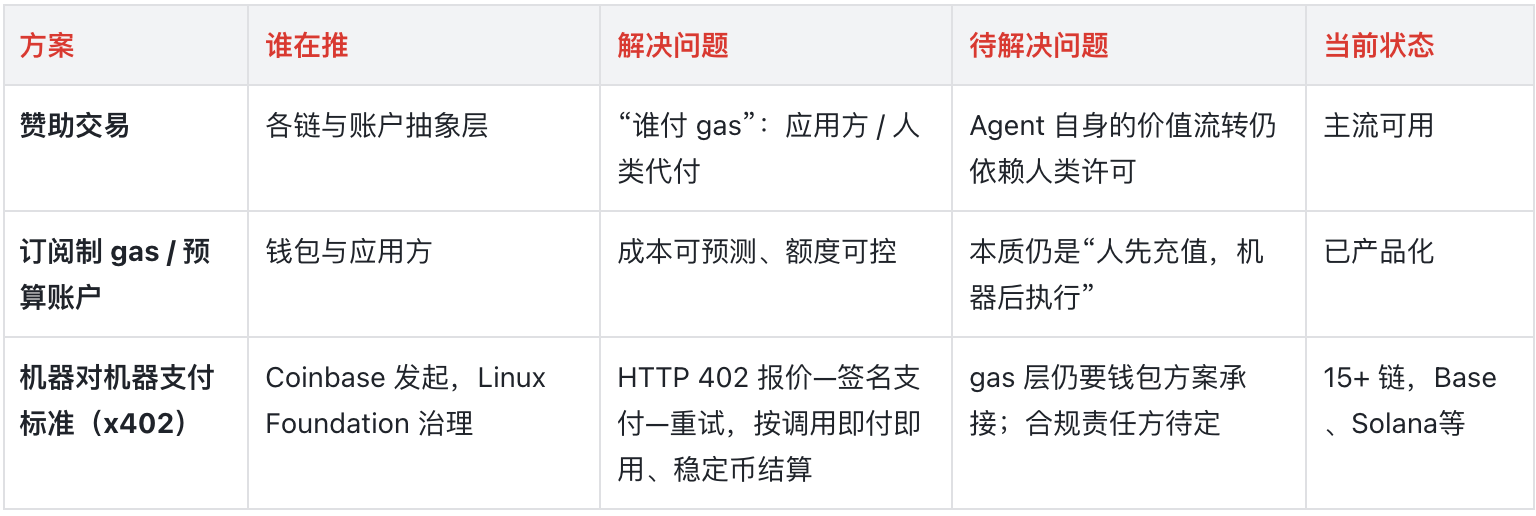
Odaily says the market currently has three mainstream machine-payment approaches, each tied to different protocol standards. The deeper disagreement is whether machine payments should happen at the application layer or at the onchain protocol layer. Whoever controls the pricing layer, the article argues, is close to controlling the distribution gateway for machine payments. That also shapes whether a public blockchain acts only as a pipe or as the checkout counter.
For that reason, Odaily says it is too early to declare the race over even though x402 has captured most of the market’s attention. The report lists several unresolved questions:
- whether the two-layer structure of gas costs plus service fees has been blurred by the machine-economy narrative;
- whether payment-standard competition will end in a universal solution or remain fragmented across different chain ecosystems;
- and who will bear the compliance cost of stablecoin settlement, including KYB and AML requirements — the onchain network, the counterparties, or the protocol builder.
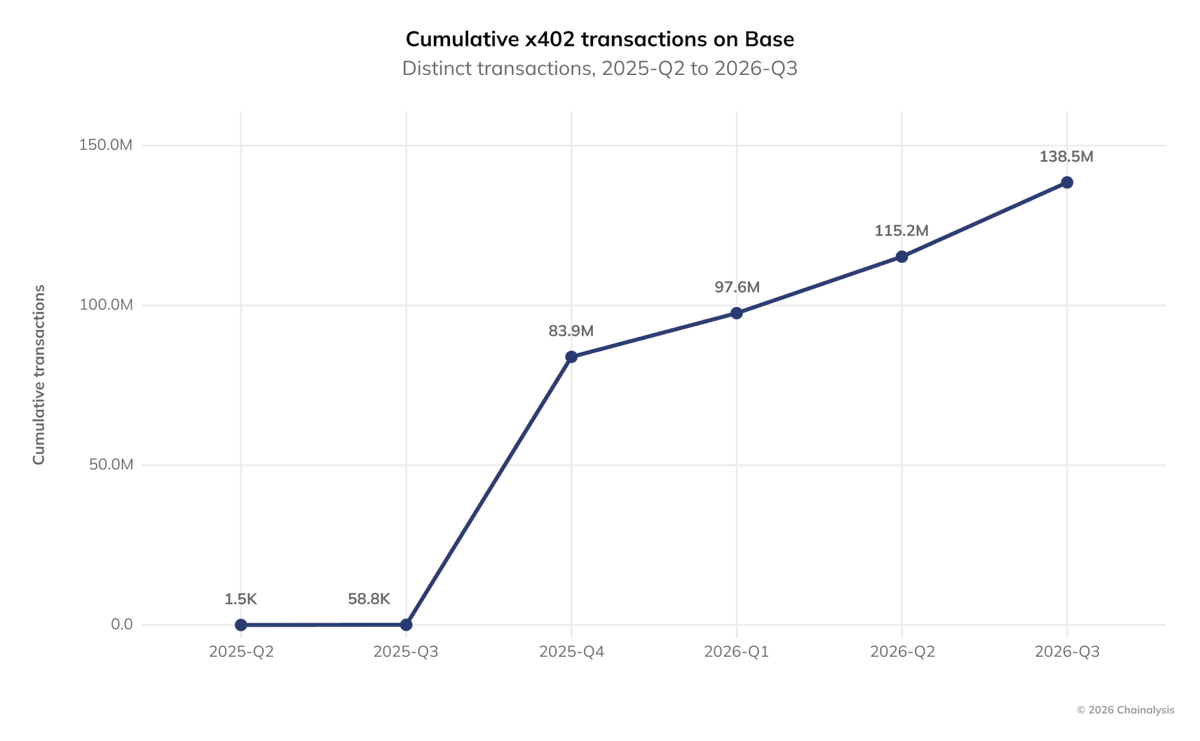
Citing data released by Chainalysis on Oct. 15, Odaily says Coinbase’s x402 payment protocol had processed about 138.5 million transactions on Base by the end of the third quarter of 2026. In Q3 of last year, that figure was only 58,800.
How far agent activity has moved onchain
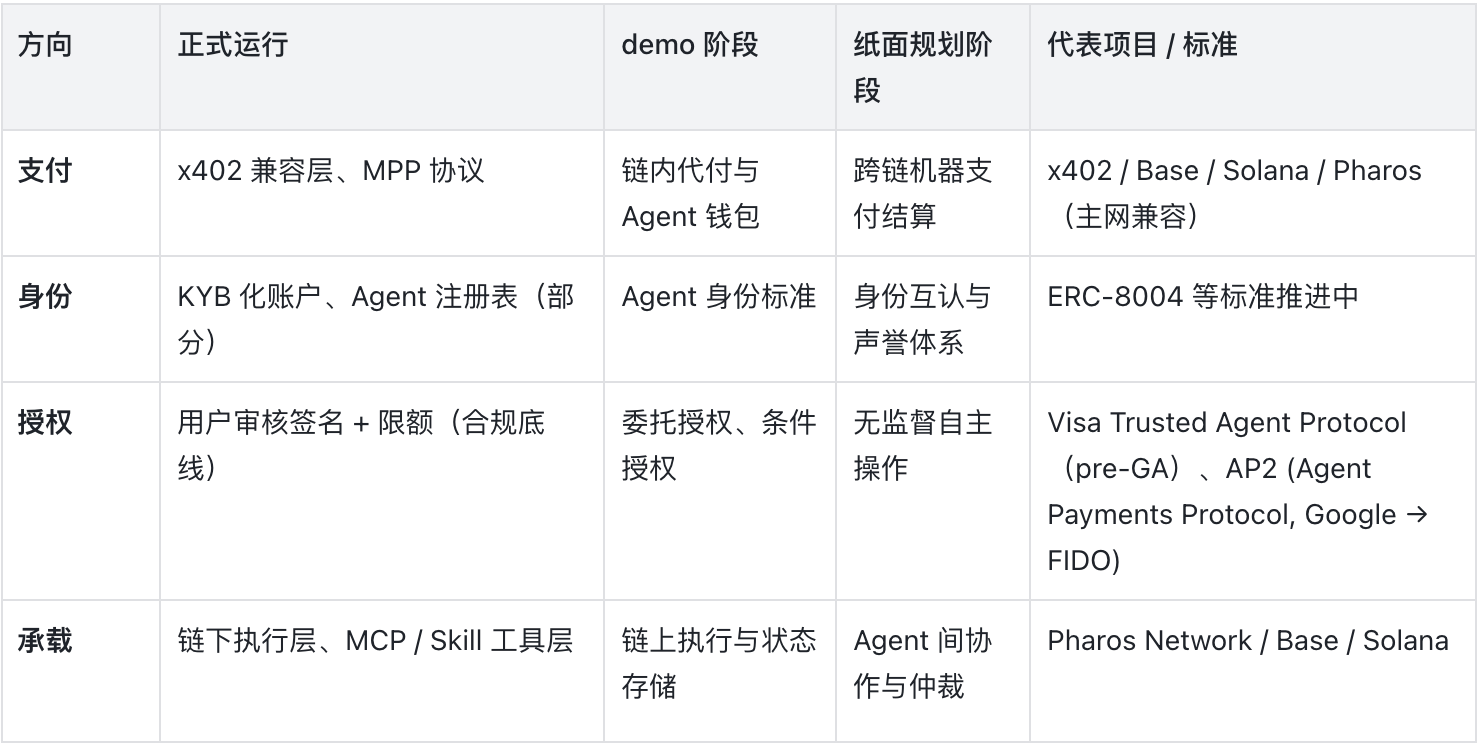
Using x402’s transaction growth as a reference point, the report says the four building blocks of onchain AI-agent activity have all made some progress. Across formal deployment, demo-stage testing, and paper-stage planning, Odaily ranks current industry maturity as payment first, then identity, then execution environment, and finally authorization.
Authorization remains the least mature because it touches security boundaries and user control, which the article describes as red-line issues. In Odaily’s reading, this is also where the narrative of agent autonomy is most likely to break first. For now, the area still depends heavily on demo testing by projects linked to Visa and Mastercard.
On the execution and payment side, the report names Base, Solana, and the Tempo network, then adds Pharos Network as a newer ecosystem that has recently announced an Agent Native upgrade.
Pharos Network’s Agent Native approach
According to the project description cited by Odaily, Pharos Network is built around RealFi, with one of its main bets being an Agent Native architecture. The goal is to let AI agents operate as native onchain economic actors that can hold assets, call tools, collaborate with other agents, and pay for their own actions.
To do that, Pharos is building an Agent Native protocol layer rather than simply adding AI features to applications. The idea is to give agents capabilities around assets, authorization, payments, and identity at the protocol level.
Odaily describes the roadmap as relatively measured. Beyond plans to improve core network capabilities in Q4 2026, agent accounts, agent-facing transaction interfaces, and the State Economy remain in protocol-definition or testing stages. End-to-end workflows are tentatively scheduled for 2028.
The article says Pharos Network’s Pacific Ocean mainnet went live in April this year. It also lists several technical features: deep parallel execution powered by the SALI engine, modular SPN, compatibility with both EVM and WASM, and native compatibility with the x402 standard. Odaily adds that the team includes former Ant Group executives and core engineers, while investors include Sumitomo Corporation, Flow Traders, SNZ, Hack VC, and Faction VC.
The report also names members of the project’s RealFi alliance, including Circle, Chainlink, Anchorage Digital, Centrifuge, and Morpho. To encourage developers and ecosystem projects, Pharos has launched a $10 million builder incubation program.
Capabilities Pharos says it is building for AI-agent activity
- Sponsored Transactions (already live on testnet): separates the transaction initiator from the gas payer. Applications or sponsors pay gas while the initiator keeps attribution and control. Odaily says this lowers sybil and abuse risk and supports large-scale agent activity.
- Gas Abstraction / Substitution: lets AI agents avoid buying gas in the middle of a workflow and supports uninterrupted multi-step execution.
- Agent Accounts & KYA (2027): combines account abstraction with a permissions framework so humans retain sovereignty over assets while machine execution stays controlled.
- AEA, or Agentic Economic Activity: measures more than the number of agents or transactions. The framework looks at meaningful actions triggered by agents, end-to-end delivery, signal-to-noise ratio, pipeline continuity, security and self-healing, and sybil resistance.
- High-performance support for micropayments: official figures cited in the article put the network at about 30,000 TPS with sub-second finality. Odaily says that setup is designed to support x402-style high-frequency, low-value payments and protocol operations, while remaining compatible with ERC-20 and EVM and including compliance-related modules.
- Developer and user tools: these include PharosMCP for onchain data and operations, SkillEngine, an official llms.txt file, Port Agent Widget for natural-language RealFi interaction while keeping final execution control with the user, and the ai.pharos.xyz website.
Odaily’s broader point is that no single protocol, project, or application can build a complete agent ecosystem on its own. In its reading, Pharos is trying to assemble a full-cycle environment that can also work with existing machine-payment networks and standards.
What may endure, and what may not
The report then sketches out which parts of the AI-agent economy are more likely to keep developing and which are more likely to be exposed as narrative.
Odaily says the areas with a higher probability of success are:
- machine-payment standards and settlement layers, because real paid use cases already exist in APIs, data, and compute;
- reusable skills and tool layers that have already been validated offchain;
- and KYB-based agent identity, because compliance remains a hard requirement.
The article says three ideas are more likely to be disproved or reduced to marketing:
- a fully autonomous, unsupervised agent economy, because user control cannot be handed over in the near term;
- agents replacing human accounts at scale, because humans are still expected to remain the decision-makers behind economic accounts in both the short and longer term;
- and the idea of a public-chain “AI agent” as a standalone role, which Odaily says currently has more marketing value than practical value and lacks real application support.
Based on the information available now, the report lays out a rough timeline:
- 2026 to 2027: AI-agent payments and identity begin to land in practice;
- 2027 to 2028: authorization and collaboration mechanisms gradually take shape;
- 2028: as authorization flows and compliance oversight improve, end-to-end AI-agent workflows may become more complete and start to form part of the broader social and economic system.
Odaily says this is one reason Pharos Network’s roadmap points to 2028 as a key implementation window for its Agent Native strategy.
The report also lists several risks that could slow or derail the process: stalled x402 adoption, deeper fragmentation in machine-payment standards, liquidity splits across chain ecosystems, a sharp drop in AI-agent transaction volume, regulators halting unsupervised onchain agent trading, or major blockchain ecosystems shifting to a different narrative.
The real contest is over the gateway
Odaily ends where it began: how should an agent spend money onchain? Its answer is that the decisive issue may not be any single technical design, but who owns the gateway — the public blockchain, the HTTP-layer payment standard, or the onchain wallet.
From that perspective, the report presents Pharos Network’s approach as ecosystem-level preparation. In the transition from offchain task execution to onchain economic participation, Odaily argues that a full stack covering identity, authorization, payments, and execution environment is a stronger answer than a standalone tool. The stated goal is to move real-world value onchain through a system built for agent activity.