
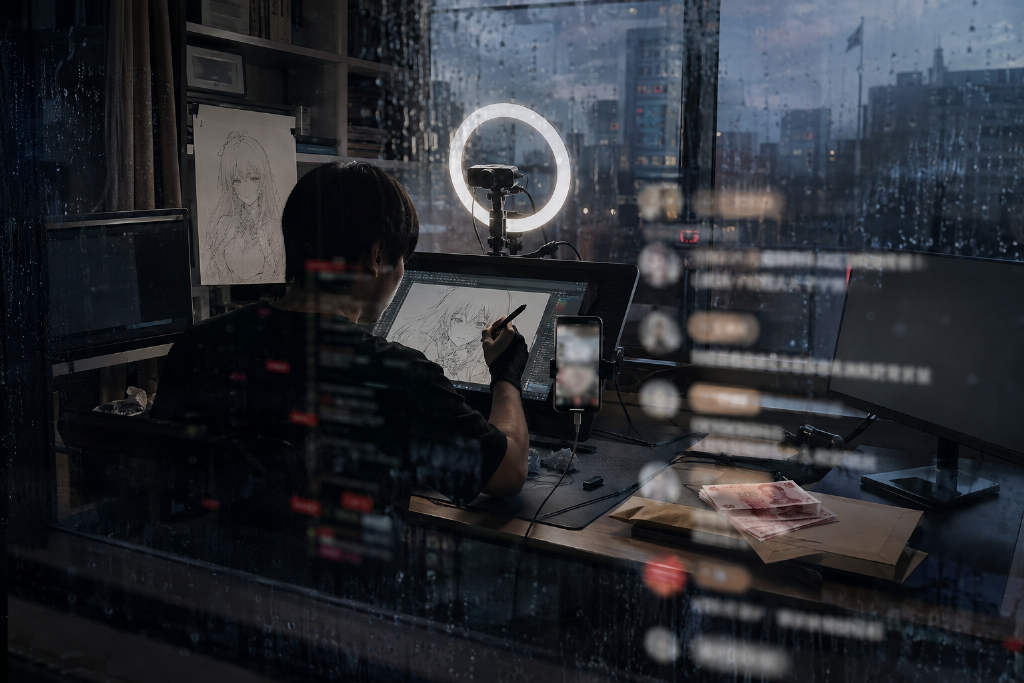
4,100 yuan, six hours, and a livestream watched by thousands.
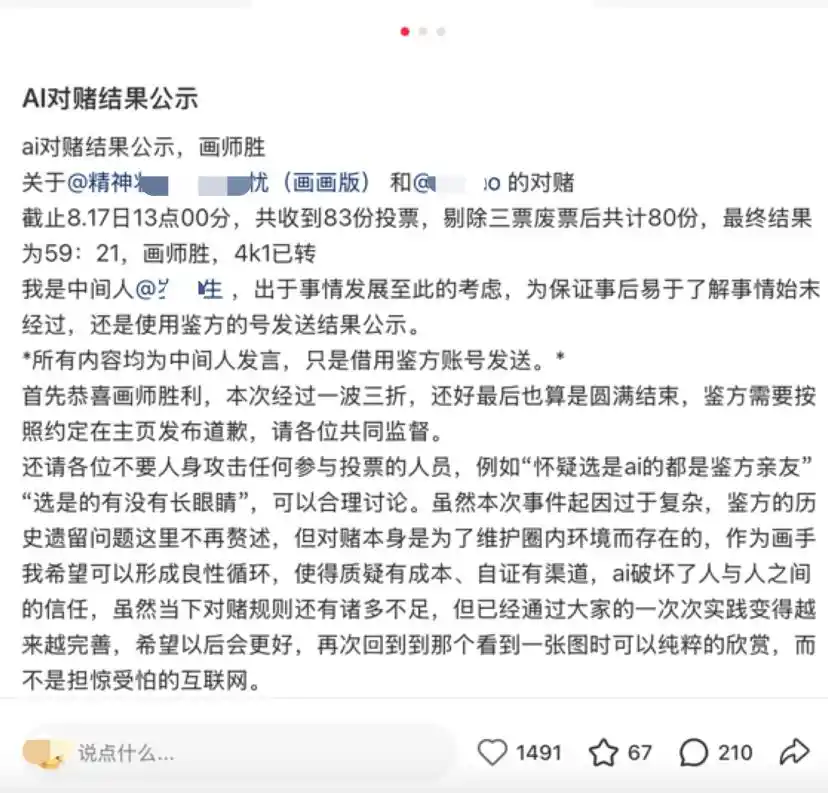
MarsBit published an article built around the case of illustrator Xiaolin, who was pushed into a live redraw session after one of his works was accused of being AI-generated. The rules were blunt: if he could repaint the piece live, the accuser would pay; if he could not, he would have to pay, apologize, and face the reputational fallout.
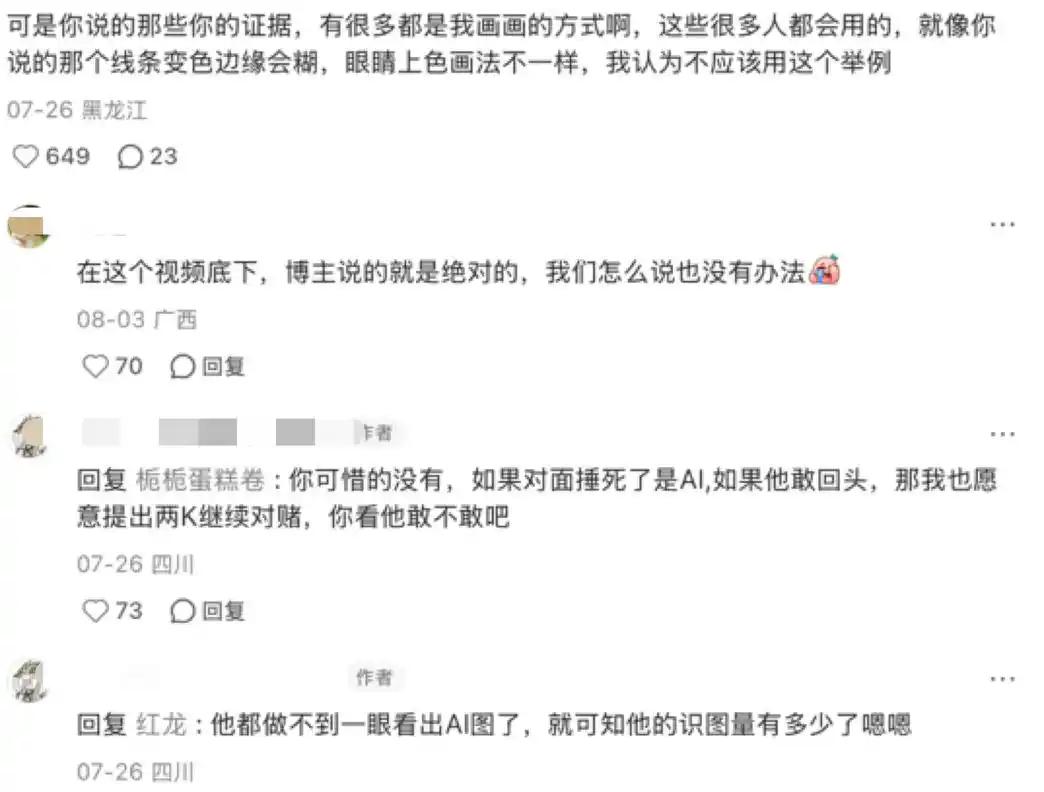
According to the article, the dispute began with a post on social media that laid out 10 pages of what the poster called evidence. The claims focused on inconsistent rendering of hands, changes in hair brushwork, and lighting logic that did not line up. The poster then proposed an "AI bet": Xiaolin would prove himself by redrawing the work on a livestream, with 4,100 yuan put up as the stake.
After the post was shared more than 10,000 times, Xiaolin’s direct messages filled with pressure from both sides. Some urged him to "shut them up." Others said that refusing the challenge would amount to admitting guilt.
The article describes this arrangement as a now familiar structure: an accused artist, an accuser who presents the analysis, and a middleman who holds the wager. Once that is combined with stakes ranging from several thousand yuan to tens of thousands, a personal dispute turns into a very public test.
Creators pushed into the arena
MarsBit says Xiaolin is far from the only case. Since AI tools entered illustration and writing circles, similar accusations have appeared again and again. Community groups now pin and circulate guides on how to identify AI-made work, from visual cues in drawn hands to supposed verbal patterns in writing.
In Xiaolin’s livestream, the article says, the comments came in waves: "You’re nervous, right," "You can’t draw it," and "Waiting for the collapse." Every pause could be read as stalling for AI output. Every moment of hesitation could be screenshotted and archived as fresh evidence. Over six hours, from sketch to coloring, he stayed at his tablet almost the entire time except for bathroom breaks.
At the end came a vote. The article states that the artist and the accusing side finished at 59:21, with the result favoring "human creation." Only then, it says, did Xiaolin realize his palms were soaked with sweat.
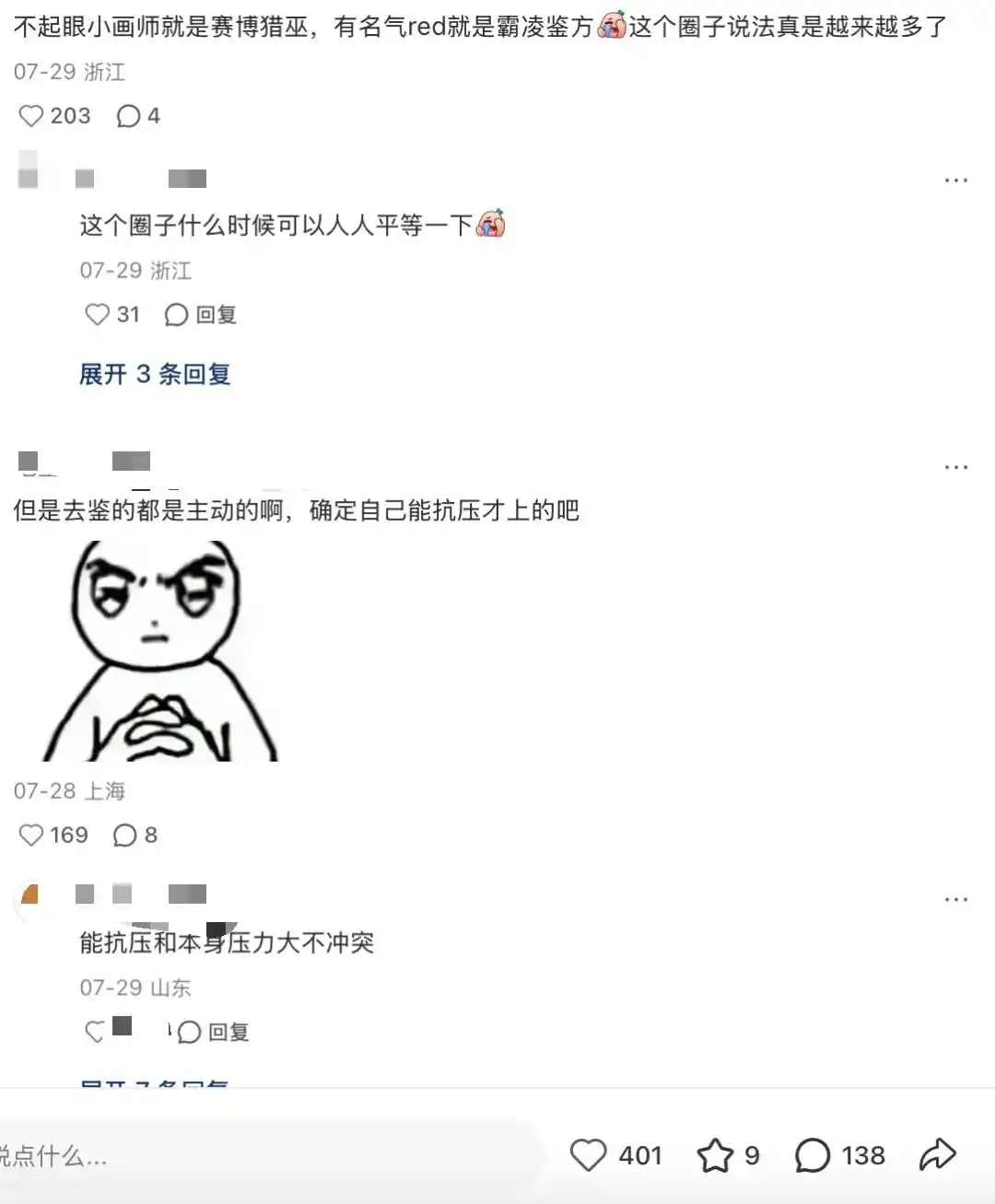
The piece adds that searches for "AI betting" on Xiaohongshu return many similar posts. It describes a maturing form of what it calls a grassroots trial system: the artist under suspicion, the person bringing the accusation, and the custodian holding the wager, each with a fixed role.
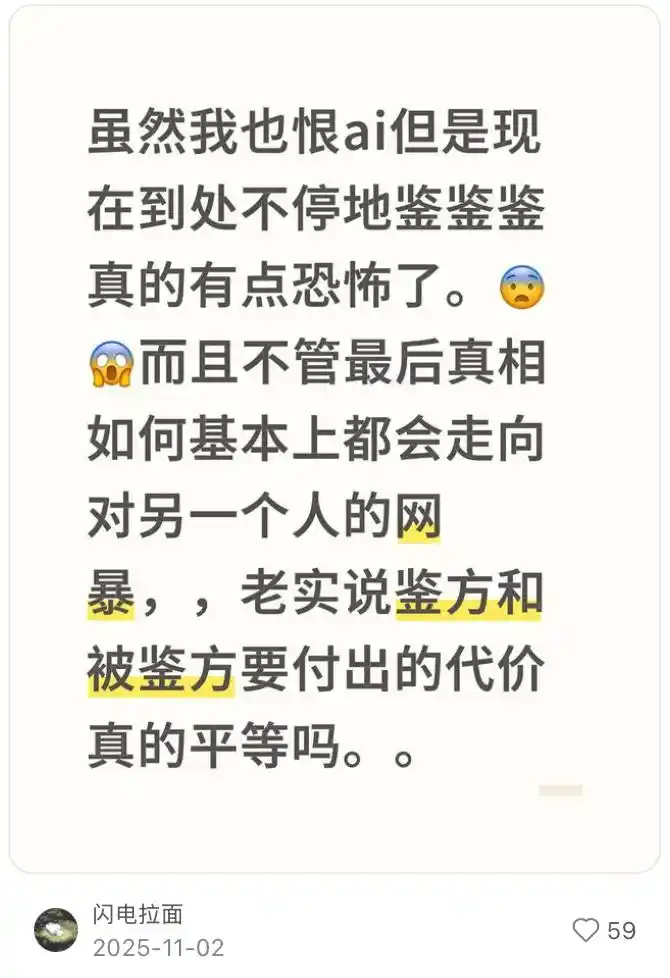
A middleman identified as Ziran said in the article that these bets were originally meant to offer a way to clear doubts, but in practice they have increasingly turned into open hunts. Whatever the result, someone becomes the target of a burst of online abuse. If the artist wins, the accuser gets attacked. If the accuser wins, the artist takes the blow.
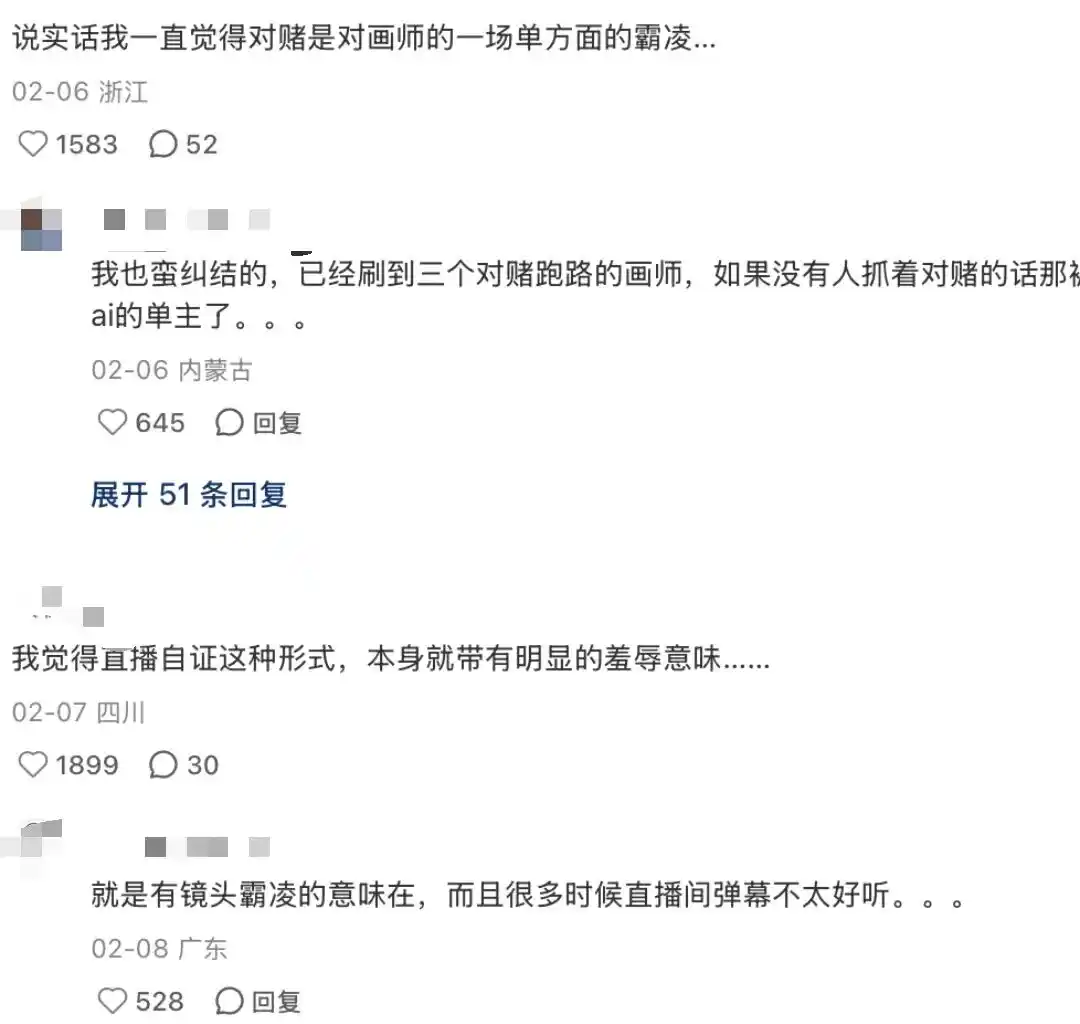
The article quotes artists as saying that refusing such a challenge can be read as an admission of AI use, which may trigger hostile comments, harassment in private messages, and abuse directed at family members. Accepting the challenge is not much easier. It means trying to maintain a normal creative standard under the gaze of thousands, while art itself often depends on a moment of inspiration that cannot be reproduced one-to-one on command.
Some artists told the author that this sort of scrutiny used to be concentrated in commercial commission work. Now, as more amateur AI detectors emerge, any image posted on social media can be taken apart, whether it was made for income or out of personal interest. For many of them, the article says, refusing is hardly an option.
The article also notes that some accusers see themselves as defending originality and protecting space for human-made art. They, too, put up money and can face online attacks if their accusations fail. In that account, they are doing something thankless in order to preserve more room for human work in art communities.
Still, the author argues that these identification efforts have moved beyond case-by-case doubt and into a broad atmosphere of suspicion. Today it is Xiaolin in front of the camera. Tomorrow it could be any creator.
When suspicion becomes a witch hunt
The article asks why resistance to AI has become so intense. Its answer is not that participants are simply irrational. Many of them believe they are defending originality and exposing deception. The problem, in the author’s view, is that a strong sense of moral legitimacy can turn volatile inside a crowd, where skepticism hardens into ritualized condemnation.
To explain that shift, the piece draws on social psychology and theories of collective behavior. It first turns to Gustave Le Bon’s account of crowd psychology in The Crowd, arguing that once people are absorbed into a group, independent judgment weakens and thinking becomes simpler and more extreme.
Under that lens, people who might otherwise discuss the boundary between AI assistance and AI plagiarism in a measured way can lose that balance inside a livestream with hundreds of viewers or a wager post with tens of thousands of interactions. In that setting, a question that should admit gray areas — whether a work is AI-made — gets flattened into a binary: fraud or proof. Any middle position risks being branded as excuse-making.
The article then moves from crowd psychology to social identity theory. It argues that part of a person’s self-worth comes from group membership, and people often preserve a positive sense of that membership by devaluing an outside group. In the context of AI betting, manual creators become the in-group, while AI users are cast as the out-group.
In that frame, exposing someone as an AI user is not only presented as a matter of justice. It also reinforces the moral boundary of the in-group. Humiliating comments aimed at alleged AI users function as a collective way of confirming who belongs and who does not.
The article says a witch hunt requires more than hostility. It needs a visible scapegoat. AI itself is abstract. It cannot stand trial on a livestream, and it cannot publicly fail to redraw an image. So the crowd looks for a person and a specific work onto which that abstract threat can be projected.
The redraw livestream becomes the ritual. A specific artist is tested in public, and viewers get a temporary sense that the superiority of human creation has been reaffirmed. But the author argues that the relief does not last. As soon as the next suspicious work appears, the anxiety returns, followed by another bet, another target, and another public hearing.
Why the detection logic does not hold
The MarsBit article says the deeper problem lies in the logic of AI detection itself. Even if emotion is taken out of the picture, it argues, these disputes rest on an unfalsifiable proposition. The mechanism of AI generation and the way humans judge output do not line up cleanly enough to allow reliable conclusions from a finished image or text alone.
On the technical side, the piece describes AI image models as systems trained on statistical distributions across massive numbers of images. Their output is generated through high-dimensional probabilistic sampling of learned patterns. That means a human artist who has spent years studying a well-known painter’s style may produce brushwork or composition that looks statistically close to AI output trained on similar material.
Under those conditions, seeing that a hand is drawn one way in one part of an image and another way elsewhere can show inconsistency, but not prove AI use. Yet the wager format demands exactly that: proof of the source of a specific act of creation from noisy statistical traces. The author argues that this is not epistemologically possible.
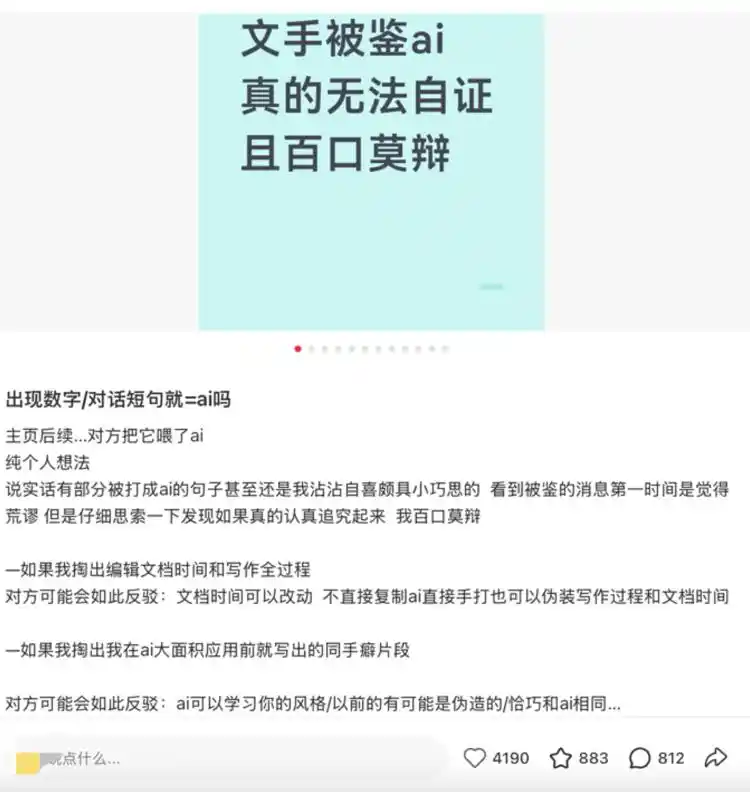
The same criticism is applied to text. Whether detection relies on so-called AI-style wording or visual consistency in an illustration, the article says current methods often begin with a conclusion and then search for details that fit it. Once a group assumes that a work is suspicious, almost any detail can be treated as something that looks like AI.
The article cites research saying that even fully original human-written text can be falsely labeled as AI-generated at rates of 15% to 20%. It also mentions online users claiming that works by Eileen Chang and essays by Zhu Ziqing can score above 90% on some AI detectors. Another example in the piece says a text written by a netizen may score below 30% on a first submission, then jump to 50% or even 80% after repeated submissions without any change.
According to the author, that suggests many text detection methods may be influenced more by whether material resembles a training corpus or previously received text than by grammar and logic alone. As a result, artists or writers whose style resembles a recognized master may face a higher chance of being tagged as AI.
From that perspective, the core tension is not simply whether one work is AI-made. It is the attempt to use pre-AI verification tools to solve a post-AI knowledge problem. Once a work can no longer be reliably attributed to either a human or an AI system, communities can slip into a presumption of guilt. The article says that is the soil in which online witch hunts grow.
Three levels of discussion the author calls for
The article does not present the answer as banning AI from creative circles, nor as building a better detector. Instead, it argues for a more mature public framework to replace crowd-led trials.
It says a new social consensus is needed on at least three levels.
- Legal: how originality in AI-generated content should be assessed, and where the line sits between AI-assisted work and fully AI-generated work. The piece notes that current judicial practice includes cases recognizing text-to-image output as a protected work when it reflects the user’s intellectual input, while other cases reject claims tied only to simple prompts. In the author’s view, case-by-case treatment does not provide the certainty that wager disputes demand.
- Ethical: where the irreplaceable human part of creation still lies when AI can reach the extreme end of technical execution. The article quotes commentary saying that emotion rooted in bodily perception, understanding built through social interaction, and reflection shaped by the finiteness of life remain deep sources of human creativity. Rather than asking whether a work is AI-made, it suggests asking whether the work moves the viewer.
- Public discussion: how communities can turn witch hunts into dialogue. The author says the current frenzy around AI betting is driven in part by anxiety that has no institutional outlet. More rational disclosure rules and more transparent ways to show a creative process, rather than humiliating livestream trials, could push discussion in a more constructive direction.
The article closes by describing AI betting agreements as a crisis of trust. If technology has weakened the old idea that seeing is believing, then the task now is to rethink the relationship between technology and the person, and to rebuild a framework in which AI keeps its value and human creators keep theirs.
The piece was originally published from the WeChat public account "Naojiti" (ID: unity007) and written by Shanhu, then carried by MarsBit.