

Big Tech’s AI arms race is running into a limit: investor patience. As Microsoft, Meta and Amazon report earnings this week, the market is looking past top-line growth and asking a more basic question — when will rising capital spending start producing visible returns?
That tension was on display last week with Alphabet. The company posted a record quarterly profit of $112.1 billion, yet its stock still fell more than 7% after investors reacted to a $15 billion increase in its 2026 capital expenditure forecast.
Wall Street expects Alphabet, Microsoft, Meta and Amazon to spend a combined $700 billion this year. Forecasts point to that number exceeding $1 trillion in 2027.
The mood has turned more fragile heading into this week’s results. According to Bloomberg, UBS Global Wealth Management said limited visibility on capital spending beyond 2027, combined with a higher investor focus on spending discipline, could keep risk appetite under pressure. At the same time, Moody’s, under Fitch Ratings as cited in the source, warned last week that continued capex plans could threaten credit quality. The six large technology companies in focus have roughly $460 billion in direct debt combined.
Microsoft: Azure momentum and a new phase of Copilot monetization
Among the three companies, Microsoft may face the clearest set of expectations. Analysts expect its capital spending to rise 74% from a year earlier this quarter. The market is also looking for another strong showing from Azure.
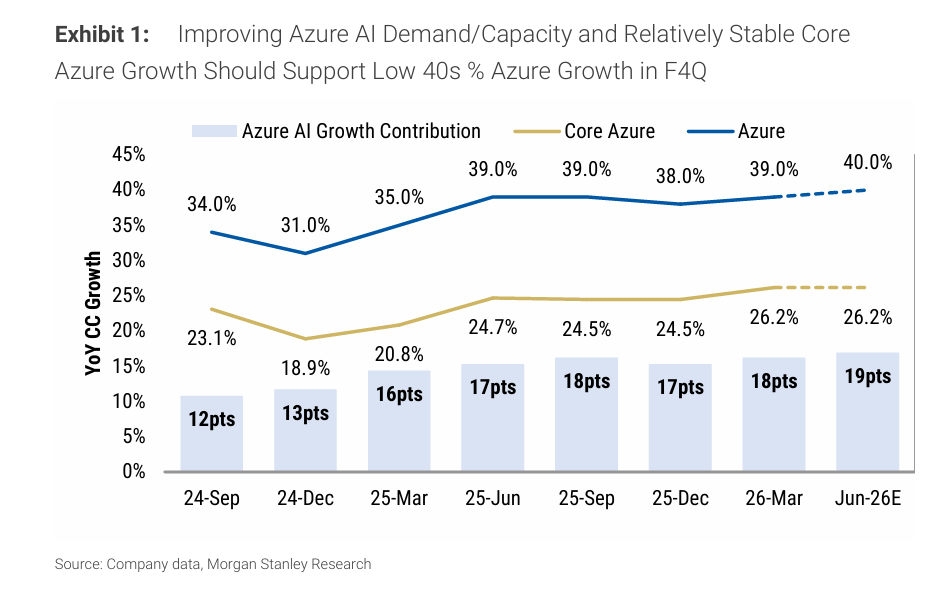
Morgan Stanley said in a research note that its analysts are confident Microsoft can deliver roughly 41% Azure growth in constant currency in the fourth fiscal quarter. That would be about 1 percentage point above management’s 39% to 40% guidance range. The bank pointed to positive channel feedback, improving GPU supply, and its own survey work with chief information officers.
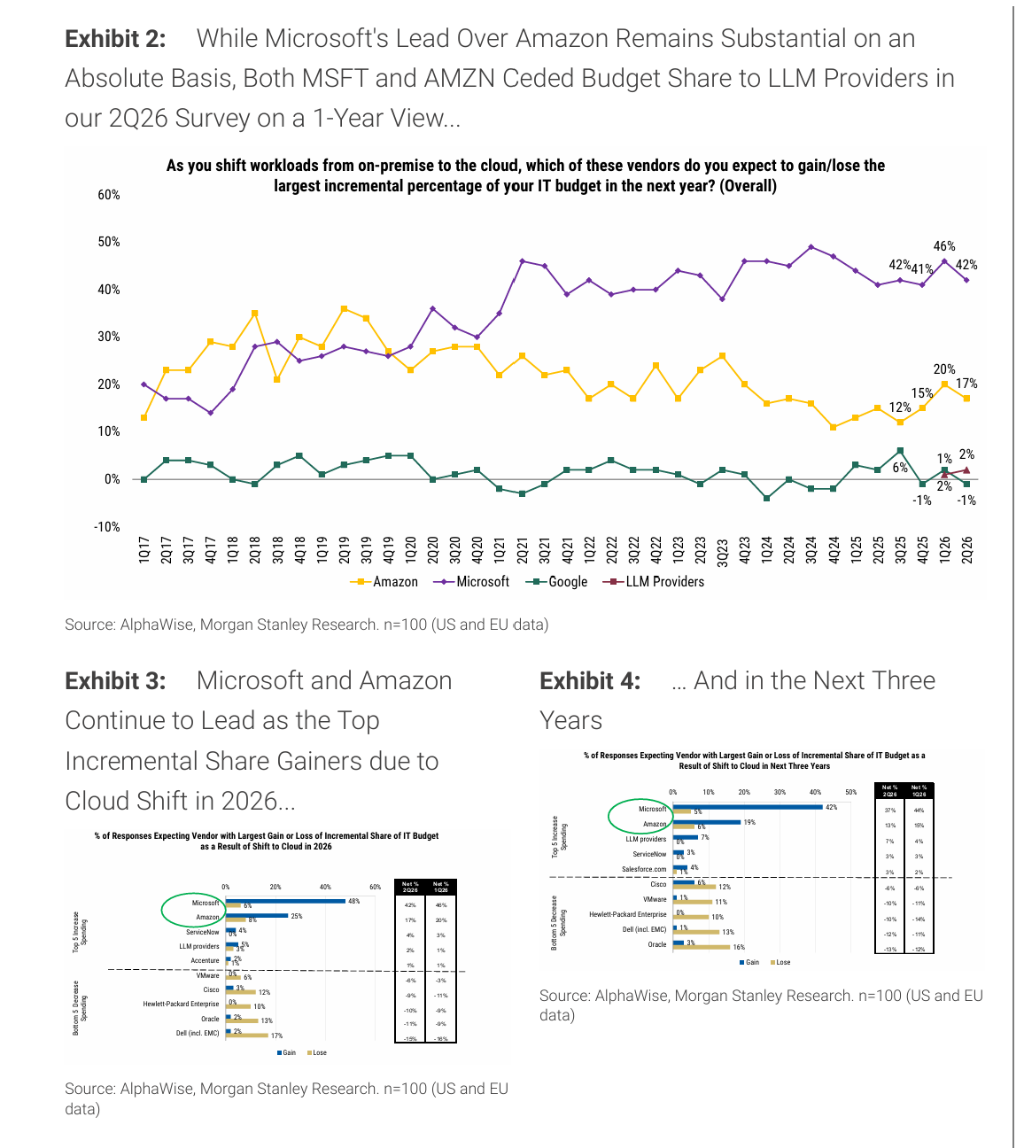
In cloud migration scenarios, 72% of CIOs said they expect to increase spending on Microsoft solutions over the next year. Morgan Stanley said Microsoft leads peers in expected share gains from incremental IT budgets.
Copilot monetization is another central issue. In the third fiscal quarter, paid M365 Copilot seats rose from 15 million to 20 million. Management has indicated that net paid seat additions should continue to improve on a sequential basis. Morgan Stanley said the monetization path is developing along three parallel lines:
- direct paid-seat sales,
- migration into the higher-value E7 subscription bundle,
- usage-based pricing for AI services.
Microsoft’s price increase for commercial M365 took effect for new customers on July 1, 2026. Morgan Stanley estimates that change will contribute about $2 billion, $4 billion and $6 billion in incremental revenue in FY27, FY28 and FY29, respectively.
Capex remains at the center of the valuation debate. Morgan Stanley argued that consensus estimates are still conservative and could move higher. Management previously said calendar-year 2026 capex would be about $190 billion, with roughly $25 billion tied to higher component costs. The bank kept its Overweight rating and $600 price target, saying the stock at around 16x FY28 estimated earnings is too cheap relative to Microsoft’s growth profile.
Meta: spending may rise again as user growth faces added pressure
Meta’s setup looks more complicated. Bloomberg, citing Bloomberg Intelligence, said Meta may raise its capex guidance sharply to deal with higher component costs. That is the same issue that triggered the selloff in Alphabet shares last week.
User growth is also under a new layer of pressure from regulation. As regulators in multiple places push legislation to limit teenagers’ use of social media, Meta’s growth outlook is facing more constraints. Its “family daily active people” metric, which tracks daily active users across its four core apps, is expected to post its weakest growth rate since 2021.
Amazon: AWS growth may hit its fastest pace since 2022
Expectations for Amazon are more upbeat. Bloomberg, citing Truist, said the company’s overall revenue growth could reach 17%, the strongest in nearly five years. Amazon Web Services may grow more than 30%, which would mark its fastest pace since 2022.
Strong demand for AI-related services is seen as the main driver behind AWS growth.
Still, the capex question hangs over Amazon as well. After Alphabet’s stock dropped on its higher spending outlook, investors are watching closely to see whether Amazon, Microsoft and Meta will also lift their forecasts for 2027 and beyond.
Moody’s warning: balance sheets are under pressure as the model gets heavier
A Moody’s research report published last week set a tougher tone heading into earnings. The agency said Alphabet, Microsoft, Amazon, Meta, Oracle and CoreWeave are shifting from asset-light models built around software, intellectual property and cloud services toward a far more asset-heavy structure that requires “unprecedented levels of investment.” That shift, it said, could pressure credit metrics.
Kevin McNeil, a vice president at Moody’s, said on the firm’s podcast: “These are all large companies with established market positions, and in many cases near-perfect balance sheets, but they are launching almost unprecedented levels of capital investment. Higher capital intensity could push some companies into negative free cash flow, or at least cause meaningful contraction.”
He added that debt financing “could raise leverage and create additional risk for the balance sheet.”
Among the six companies under scrutiny, Oracle appears the most vulnerable. Moody’s revised its rating outlook to negative, and its Baa2 rating sits just two notches above junk. Last month, S&P Global also cut Oracle to only one notch above the lower bound of investment grade. By contrast, Alphabet, Amazon, Meta and Microsoft still have strong balance sheets, with no near-term threat to their investment-grade ratings.
Bulls and bears are arguing over the same issue: timing
The split on AI investment is now clear. The bullish case is built on one idea: demand is real, and supply is the constraint.
On Azure, Morgan Stanley said Microsoft CFO Amy Hood made that point explicitly on the prior quarter’s earnings call. Azure guidance, she said, is effectively “allocated capacity guidance,” meaning growth is limited by the pace of data center construction and GPU deployment, not by weak customer demand. Microsoft plans to double total data center capacity over the next two years, which could ease that bottleneck over time.
The bearish case centers on the lack of visibility into returns. UBS Global Wealth Management said limited visibility on capex beyond 2027 is a key reason risk appetite is under pressure. Moody’s framed it in even starker terms: the move from asset-light to asset-heavy operations is eroding the high free-cash-flow advantage these companies historically enjoyed.
UBS still recommends staying invested for long-term holders. “For long-term investors with diversified portfolios, remaining invested is the most effective strategy for dealing with current uncertainty. Given strong earnings growth and an improving cyclical backdrop, attractive equity opportunities exist across sectors and regions,” the firm said.
Even so, Alphabet has already shown how the market is judging this cycle. Strong earnings alone are no longer enough. Investors also want proof that spending is under control.