
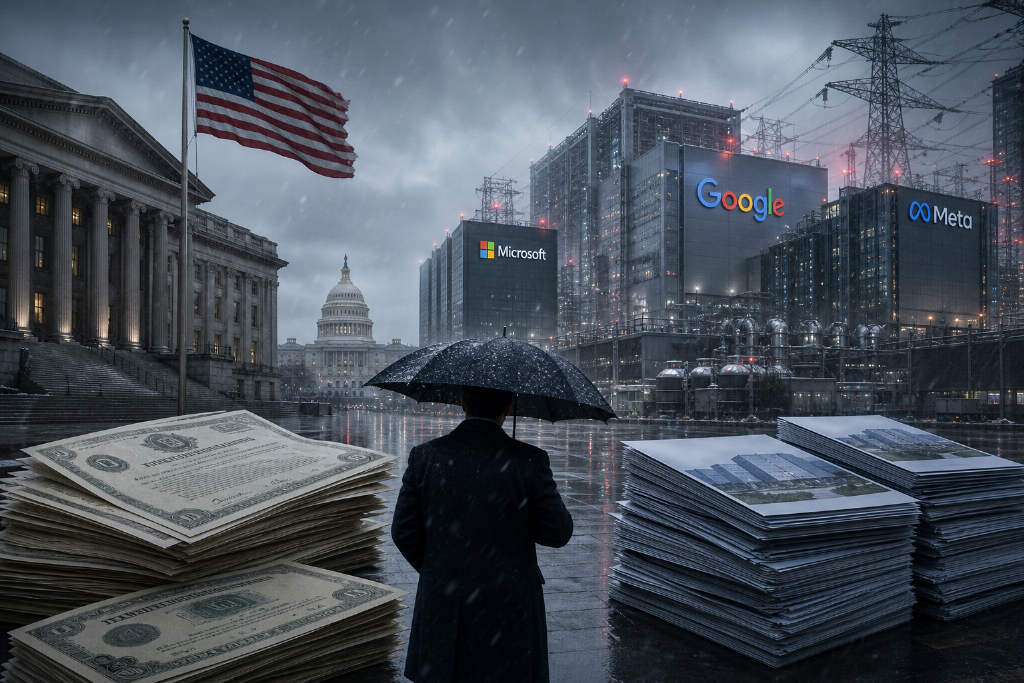
U.S. Treasury yields have been rising repeatedly in recent weeks, drawing close attention across global capital markets. The standard explanation has focused on sticky inflation or the sheer size of the U.S. fiscal deficit. ABMedia, however, cited Taiwanese macroeconomist Wu Jialong as offering a different framework: this may not be just a fiscal story, but a capital crowding-out effect driven by the investment demands of the AI industry revolution.
AI infrastructure spending and competition for capital
Wu said the main force behind the recent jump in Treasury yields comes from large technology companies that are highly bullish on the future. In the wave of the AI industry revolution, companies such as Microsoft, Google and Meta are racing to build AI infrastructure on an unprecedented scale, including data centers and computing capacity.
According to his argument, those projects require enormous amounts of funding, and the companies are raising that money by issuing large volumes of corporate bonds. Because the market remains confident about AI’s prospects, issuers are willing to offer higher interest rates to draw in capital, which pushes corporate bond yields higher. Corporate bonds and government bonds compete for the same pool of money. Once corporate yields move up sharply, investors also ask for higher returns from U.S. Treasuries, and that lifts Treasury yields as well.
Wu’s point is that the causal chain runs in the opposite direction from a common market assumption. In his reading, higher Treasury yields are not what first pushed corporate borrowing costs higher. Instead, heavy corporate bond issuance came first and helped drive Treasury yields upward.
A comparison with the IT revolution 30 years ago
To explain why he believes this interpretation is plausible and where it could lead, Wu compared the current AI boom with the IT revolution about 30 years ago. He described the present shift not as a normal business cycle, but as a structural change led by technological innovation.
He pointed to the 1990s under Bill Clinton, when the IT revolution boosted labor productivity and returns on capital. Corporate investment was also strong in that period, and interest rates moved higher. But rapid economic growth generated abundant tax revenue, which not only erased fiscal deficits but also produced the rare outcome of a U.S. budget surplus.
Based on that historical comparison, Wu argued that if the AI revolution can translate into real productivity gains, stronger growth and future tax revenue could help the United States repeat part of that earlier experience and ease today’s fiscal pressure at the root.
Bessent’s near-term response: buying back long-dated debt
The report added that technological progress may offer a favorable long-term narrative, but it does not solve today’s financing strain. With U.S. national debt already above $40 trillion and annual interest costs above $1.4 trillion, Treasury Secretary Scott Bessent needs measures that can work more quickly.
With long-dated Treasury yields staying elevated, Bessent has been pushing an active bond buyback strategy. ABMedia described that approach as issuing shorter-dated Treasuries, where rates are relatively more controllable, and using the proceeds to repurchase longer-dated Treasuries in the market. The report also mentioned recent talk of using the Treasury General Account, or TGA, to buy back long-dated government bonds.
By retiring part of the long-term debt stock, the Treasury could reduce interest burdens locked in for longer periods and shift that pressure into shorter-term rolling liabilities. In Wu’s framing, that would buy time for the federal government and help stabilize the bond market before any AI-driven tax windfall arrives.
Cathie Wood offers a different end point for rates
ABMedia also highlighted a very different rate outlook from Ark Invest founder Cathie Wood, even though she is also strongly optimistic about AI and the productivity gains it may bring.
Wood’s theory is that AI, robotics and other disruptive technologies require up-front investment, but the productivity jump they create will sharply lower operating and production costs for businesses. That drop in costs, in her model, would produce a powerful deflationary effect across the wider economy. If prices and costs fall over time, the Federal Reserve would eventually be forced into a large rate-cutting cycle, which would mean materially lower market rates and Treasury yields over the longer term.
As presented by ABMedia, the current surge in U.S. Treasury yields sits at the intersection of macroeconomics and technological change. Wu’s argument suggests that high yields do not necessarily signal economic breakdown or runaway inflation. They may instead reflect the natural byproduct of intense competition for capital in the early phase of the AI buildout. Before any productivity gains from AI feed through into stronger public finances, the questions are whether Bessent’s market operations can act as a buffer and when the deflationary forces described by Wood might actually emerge. Those issues, the report said, will remain central to how global capital markets are priced.