


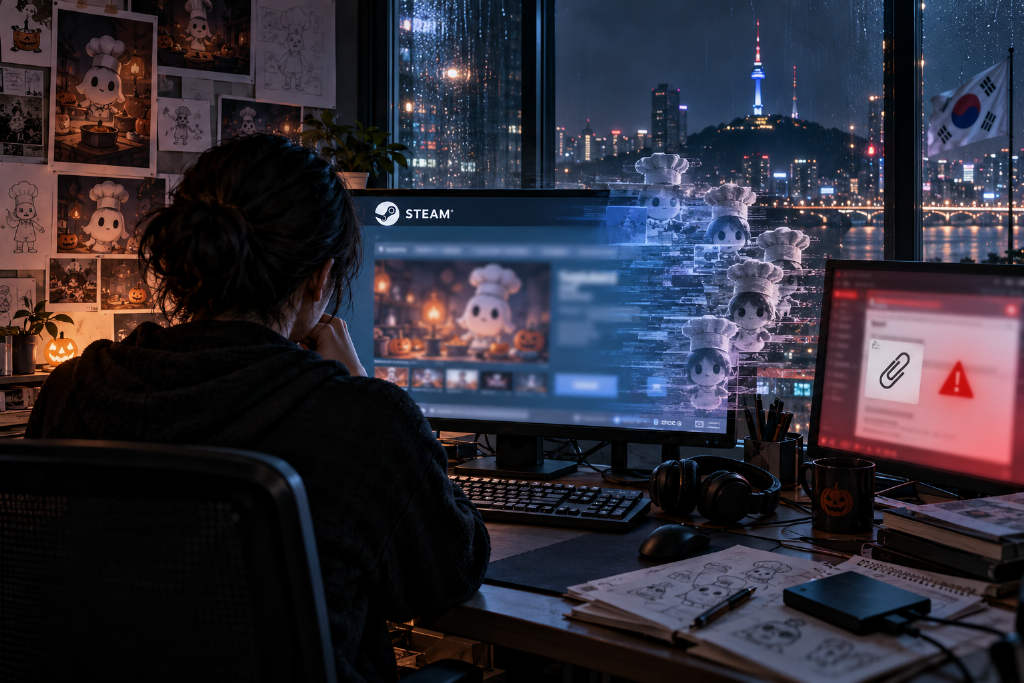
Korean indie studio YNOT pulled the Steam demo for its Halloween cooking management game Spookitchen on Oct. 20 after the developers said they had been contacted about someone using AI to copy the game.
On Oct. 17, the developers wrote on X that they had received word that "someone is copying our game with AI." South Korean outlet ThisIsGame later confirmed that two different people had contacted the team. The demo had been available since March 2026, and its removal came one day after Steam Next Fest began on Oct. 19.
Similar threats have surfaced in other countries
The case is not an isolated one. Over the past month, indie developers in Japan and elsewhere have reported receiving threatening emails that followed the same basic formula: pay up, or an AI-generated clone of the game will be published on Steam first. Some teams said they had not received such messages themselves, but still chose to take down demos out of concern.
In its X post, the YNOT developer said: "We will close distribution in two days. We received a message saying someone is copying our game with AI. We felt anxious that a game we spent a long time making could be copied in its entirety, so we decided to close the demo. We hope creators' rights are respected, and that people can develop games they poured their passion into with peace of mind."
Emails demanded $200 and set a 24-hour deadline
On Sept. 29, Iron Pilgrim developer Weasel Pit posted on X that someone had recreated the game with AI and was threatening to publish it on Steam unless he paid $200. He said he would not pay and shared a comparison between footage of the real game and the AI-generated clone.
On Oct. 1, the team behind Circusar, Psicodart Games, also posted the message it had received. According to AUTOMATON, the email sent to Psicodart was identical to the one sent to Weasel Pit except for the game title, and it came from the same sender address.
On Oct. 17, Japanese developer Takashi Mochibe said he had received a similar message while working on the hardcore strategy RPG Dragon’s Chronicles. The wording differed from the Circusar email, but the structure was the same: Steam items worth $200 instead of cash, a 24-hour deadline, no negotiation, and a final line that said, "The choice is yours."
No payments had been reported
As of the report, no developer had said they paid. AUTOMATON described the wave of emails as "probably a bluff, but nasty," and warned developers not to open attachments that might contain malware.
Mochibe said he believed the campaign looked like mass spam sent broadly rather than a targeted operation. He replied that if the sender really made a version better than his own game, he would be willing to spend $200 to buy it.
On Oct. 20, Mochibe said his game’s daily wishlist figure had jumped 38,400% from the previous day, turning the threat into unexpected publicity.
Can AI really copy a game?
The report says the concern is not entirely unfounded. In July, a clone called Scribble Hunt appeared on Steam after the popularity of the hide-and-seek party game Meccha Chameleon. AUTOMATON said the clone was nearly identical in its 3D models, gameplay and interface, and even used the Korean store name "메챠 카멜레온."
Another title, Needle in a Haystack Simulator, had not yet launched when similar games with related names and mechanics had already appeared, forcing the original creator to keep stressing which version was the real one.
Some overseas media outlets have tied the recent cloning wave to a specific AI model. Kotaku attributed a string of decompilation and copycat incidents to Anthropic’s Claude Opus 5.5. The report explained decompilation as the process of turning packaged game files back into human-readable code. According to Kotaku, work that once took highly skilled people months or even years can now be followed by recompilation through modern models.
Game Developer also reported that, over the past month, a number of indie developers on Reddit described people feeding demos and trailers into generative AI systems and quickly rebuilding the basic gameplay. That outlet said gameplay itself has long been difficult to protect under copyright law, and that stronger models such as Claude and ChatGPT have made copying easier.
Not every game is equally vulnerable
Still, the article says not every game can be copied easily. An anonymous developer told ThisIsGame that even gameplay videos can now be enough for AI to produce a similar title, but complex games remain hard to analyze and reproduce. Small games with simple mechanics and distinctive ideas are the easiest targets.
Mochibe also said he does not believe his strategy RPG can be easily replicated by AI.
The original source text was cut off at the point where it began discussing the attachments included with the threatening emails, and did not provide further detail.