Concern over whether AI could help break modern cryptography has flared up across the crypto sector, but the argument laid out by imToken is narrower and more practical: Web3 should prepare for long-term cryptographic change without pushing users into hasty asset migrations.
The discussion was sparked after Justin Drake said on X on Oct. 7 that the blockchain industry should calmly begin planning a "Bunker Mode" response to possible future cryptographic threats. His concern is that as AI improves in mathematical research, elliptic curve cryptography, which is widely used across networks such as Bitcoin and Ethereum, could face new mathematical attack methods before a quantum computer with real code-breaking capability arrives.
In the worst-case scenario described by Drake, such a breakthrough could be measured in months rather than years. On that basis, he suggested that large holders and institutions should be the first to consider an orderly migration of assets and reduce the potential risk tied to already exposed public keys.
Vitalik Buterin later joined the conversation. According to the article, he did not reject the idea that AI could accelerate cryptographic research. He went a step further, saying that some schemes commonly viewed as resistant to quantum attacks could also be affected by future mathematical breakthroughs. But on the question of whether ordinary users should move assets right away, his emphasis was different: losses caused by rushed upgrades and migrations may be more pressing today than cryptographic attacks that have not happened.
That framing brings an old industry problem back into focus. If the cryptographic assumptions protecting onchain assets begin to face new challenges, how early should public blockchains prepare, and when should ordinary users act?
Why addresses and public keys matter
The article starts with the account and signature model used by public blockchains. In a non-custodial wallet, the private key is the credential that controls assets. A wallet uses digital signature algorithms to prove that a transaction was authorized by the key holder without revealing the private key itself.
The most familiar example is elliptic curve cryptography, or ECC. On Ethereum, externally owned accounts, or EOAs, use ECDSA to generate transaction signatures. Bitcoin's traditional signature system also widely uses ECDSA, while Taproot uses Schnorr signatures built on the same elliptic curve.
These systems rely on a basic mathematical assumption: deriving a public key from a private key is easy, but deriving the private key from the public key is considered practically infeasible under known classical computing methods. The article describes this as a math problem that is easy to verify but extremely hard to reverse. Anyone on the network can use the public key to verify a signature, but that does not let them easily recover the signer's private key.
That asymmetry is a core part of blockchain asset ownership. But the article stresses an often-missed detail: the wallet address users see every day is not always the full public key.
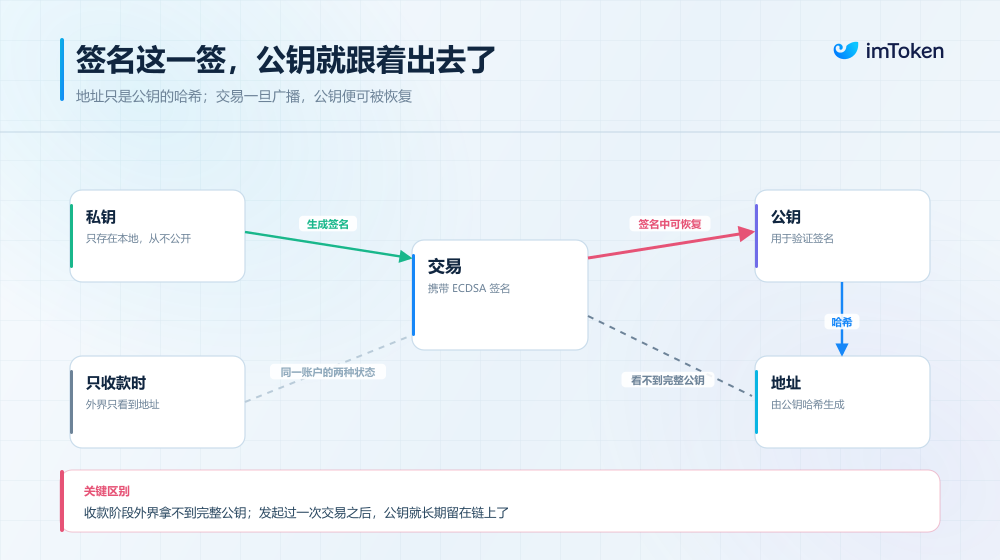
For a standard Ethereum EOA, the address is an identifier generated by taking the public key, hashing it with Keccak-256, and truncating part of the result. In Bitcoin, common address types such as P2PKH and P2WPKH also use public-key-hash designs.
That creates a meaningful security distinction. For an Ethereum account that has never sent an onchain transaction and has not revealed its public key through other means, outside observers usually see only the hashed address. Because current methods cannot easily reconstruct the full public key from that hash, the public key effectively has an extra layer of protection.
Once the account sends a transaction and submits an ECDSA signature, however, nodes can recover the corresponding public key from the signature data. Since onchain transaction records remain public over time, that information stays exposed.
As a result, for accounts that use public-key-hash addresses, an unexposed public key and an exposed public key may carry different levels of risk under some future cryptographic attack scenarios.
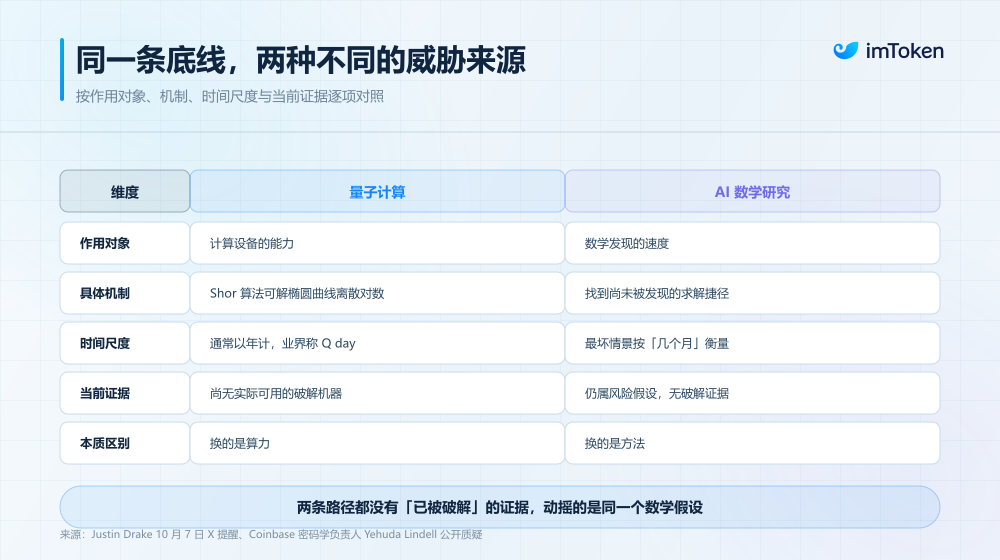
The article also notes that not every chain follows the same rules. A Bitcoin Taproot output itself contains a visible elliptic curve public key, so even if a Taproot address has never spent funds, it cannot simply be treated as if its public key were still hidden behind a hash function. Public key information may also be exposed early through address reuse, public signatures, extended public keys, or other channels.
So "never moved funds out" does not automatically mean "the public key has not been exposed," and a fresh address is not inherently quantum-safe.
AI risk and quantum risk point to the same assumption
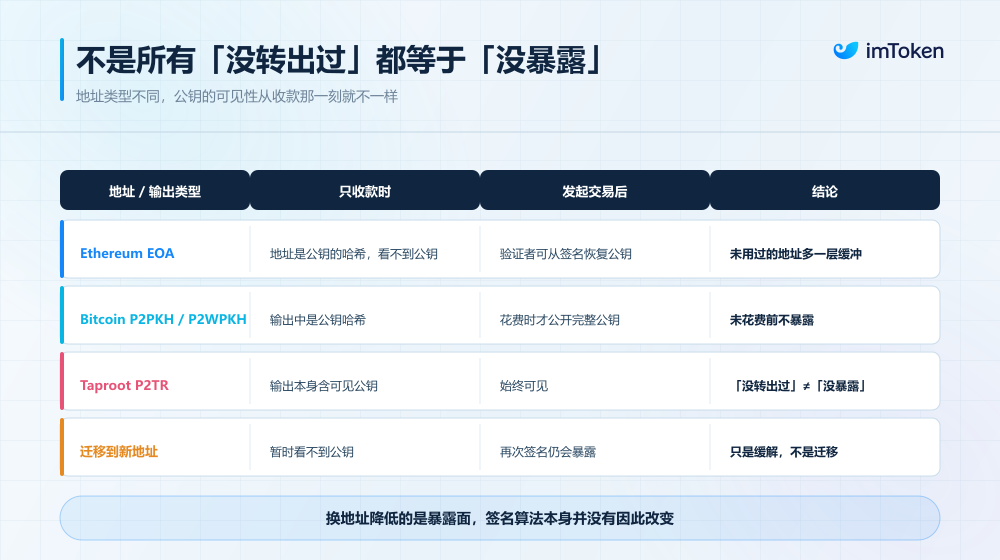
In theory, a sufficiently large and fault-tolerant quantum computer could use the relevant algorithm to solve the elliptic curve discrete logarithm problem efficiently, derive a private key from a public key, and threaten signature systems such as ECDSA and Schnorr.
At the same time, the article says there is still no evidence that a quantum computer exists today that can practically break the main signature systems used by Bitcoin or Ethereum.
Drake's concern in this round of discussion goes beyond quantum hardware itself. He is focused on whether AI could help researchers discover shortcuts that existing mathematical methods have not found. With AI making progress over the past year in mathematical reasoning, algorithm search and formal proof, some researchers have begun to revisit whether computational hardness assumptions that have held up for decades may need to be reassessed if new mathematics emerges.
Justin Drake and Vitalik Buterin are not arguing about the same priority
The article argues that once the technical logic is clear, the positions of Drake and Buterin look less like a direct clash and more like a difference in priority.
Cryptographic transitions are usually slow. Identifying a risk, setting standards, building engineering implementations, and coordinating compatibility across blockchains, wallets, exchanges, custodians and hardware devices can take years or longer. For decentralized networks as large as Bitcoin and Ethereum, a base-layer upgrade cannot be completed the way ordinary software is updated in a single release.
Drake's concern is that this long upgrade cycle may not keep pace with future breakthroughs in mathematics. If AI really helps researchers find a new attack path, elliptic curve signature systems could come under pressure before quantum computers become practically useful for code-breaking. If that happens, the migration window for blockchains and wallet ecosystems could be much shorter than expected.
That is why his position is centered on preparation. He argues that exchanges, large institutions and users with substantial holdings should start thinking now about future risk-reduction paths. That includes identifying addresses with exposed public keys, moving some long-term holdings in an orderly way to fresh addresses whose public keys have not yet been exposed, and reducing unnecessary signing activity and address reuse going forward.
Technically, the article says, that advice has logic behind it. If a future attack depends on deriving private keys from public keys, then reducing the surface area of public key exposure in advance could buy more defensive time under certain conditions.
But moving funds to a fresh address with an unexposed public key is not the same as completing a real post-quantum migration. As long as the new address still uses a traditional signature scheme such as ECDSA, the underlying security assumption has not fundamentally changed. Once that address sends a transaction, the public key may be exposed again. If attack capability becomes strong enough, even the short window between transaction broadcast and confirmation could become a new point of risk.
In other words, this is a transitional mitigation step, not a permanent solution. More importantly, reducing theoretical cryptographic risk does not automatically make asset management safer in practice.
That is the point Buterin highlighted. Under current known technical conditions, there is still no practical attack method for directly recovering an ECDSA private key from a public key. By contrast, losses during asset migration caused by wrong addresses, backup mistakes, malicious approvals or other operational errors are a real and recurring risk.
The article says Buterin even noted that he has lost more from migration configuration mistakes than from hacker attacks.
For a user holding a small amount of ETH, migration may mean creating a new address, backing up keys and sending a few transfers. For users deeply involved in DeFi, staking, cross-chain activity or multisig treasury management, the situation is much more complicated. Assets may be spread across different networks, some funds may still be locked in staking or lending protocols, and an old address may still hold smart contract admin rights, withdrawal permissions or other critical roles.
If users react to headlines about AI breaking wallets by rushing into large-scale migrations, they may end up sending funds to the wrong network, misusing a bridge, signing a malicious transaction or making a multisig mistake that causes irreversible loss.
The article also warns that if panic spreads around the idea that wallets are about to be broken, fake official links for quantum-resistant upgrades, asset protection tools and migration services may quickly appear.
But Buterin's caution does not mean he is opposed to upgrading the cryptographic base layer. The article says he also sees AI-driven mathematical progress as something the industry should study seriously. He has also urged the sector to reexamine some post-quantum schemes based on lattice cryptography and avoid assuming that a scheme labeled "quantum-resistant" can withstand every future mathematical breakthrough.
Where conditions allow, he is said to favor giving more consideration to hash-based cryptographic structures and using more conservative security parameters for other approaches. On that basis, the article argues that it is too simplistic to cast Drake as aggressive and Buterin as conservative. Their deeper views are not fundamentally at odds.
Post-quantum readiness goes far beyond a wallet app update
The article then turns to a question many users may ask: if long-term cryptographic risk exists, can a wallet simply upgrade itself into a "quantum-resistant wallet"? Its answer is no. Updating the app alone is not enough.
For a blockchain, a cryptographic upgrade affects how private keys are generated and how transactions are signed, but it also affects whether the network can recognize and verify new signatures and whether existing accounts can transition smoothly.
Even before this AI-driven debate, major public chains and cryptography research groups had already started preparing for a post-quantum era.
Ethereum is one example. The article says its preparation spans several layers. Beyond ECDSA for ordinary accounts, Ethereum also relies on BLS signatures in validator consensus, KZG commitments tied to data availability, and some zero-knowledge proof systems, all of which may need to be reevaluated or upgraded in the future.
To address that, the Ethereum Foundation has set up a dedicated Post-Quantum Security research team and is exploring technologies such as leanXMSS and leanVM to provide new signature and proof schemes for the consensus layer.
At the user account layer, account abstraction is presented as another path worth watching. Unlike traditional EOAs, whose signature verification is tightly bound to the base protocol, account abstraction and replaceable signature verification mechanisms could eventually let user accounts adopt different signature algorithms and preserve more flexibility for post-quantum upgrades.
The article points to EIP-8141, which is still under discussion and is related to Ethereum native account abstraction. It could become an important foundation for more flexible signature verification in the future, though its deployment timeline and final implementation still require more community discussion and testing.
Bitcoin faces a different set of problems. Because it uses the UTXO model, has a complex history of address types, and includes early coins that have remained dormant for long periods, Bitcoin must think not only about new signature algorithms and output structures but also about how a large stock of existing assets could migrate. The article says related community drafts are still in the proposal and coordination stage.
Other chains have started trying more direct engineering implementations. The article cites NEAR, which announced in July 2026 that a mainnet upgrade had added support for post-quantum ML-DSA signatures based on FIPS 204, giving accounts the ability to add quantum-secure keys.
Even so, support for one post-quantum signature scheme does not mean an entire chain, all of its accounts, applications and infrastructure have completed a quantum-resistant transition.
Viewed together, these developments show how broad the challenge really is. New cryptographic schemes must be secure in theory, but they also have to account for signature size, onchain verification cost, node performance, hardware compatibility and whether large numbers of existing accounts can move over smoothly.
Wallets must adapt to protocol changes, and users still need a workable path
Those protocol-level changes eventually land in the wallets people use every day. For a multi-chain non-custodial wallet such as imToken, the article says, future cryptographic upgrades cannot be reduced to a simple version release.
On one side, wallets will need to adapt to new account and address types, key management methods, transaction signing flows and verification mechanisms as different chains upgrade. That may also involve compatibility with hardware wallets, smart contract accounts and multisig systems.
On the other side, wallets will need to turn complex low-level changes into actions ordinary users can understand. If a public chain eventually supports a new post-quantum signature scheme, users will care about practical questions: whether their old address can still be used, whether they need a new account, whether their existing seed phrase and hardware device remain compatible, and what happens to the tokens, NFTs, staked assets and DeFi positions they already hold.
Some of those issues can be addressed gradually through wallet product design. Others depend on support from chain protocols, smart contracts and the wider ecosystem. That is why, the article argues, the more complex the security upgrade is at the base layer, the more thoroughly the user migration process needs to be tested, rather than being pushed out as a temporary "one-click post-quantum" feature.
What ordinary users should do now
The article closes with a practical view of what users should do at this stage.
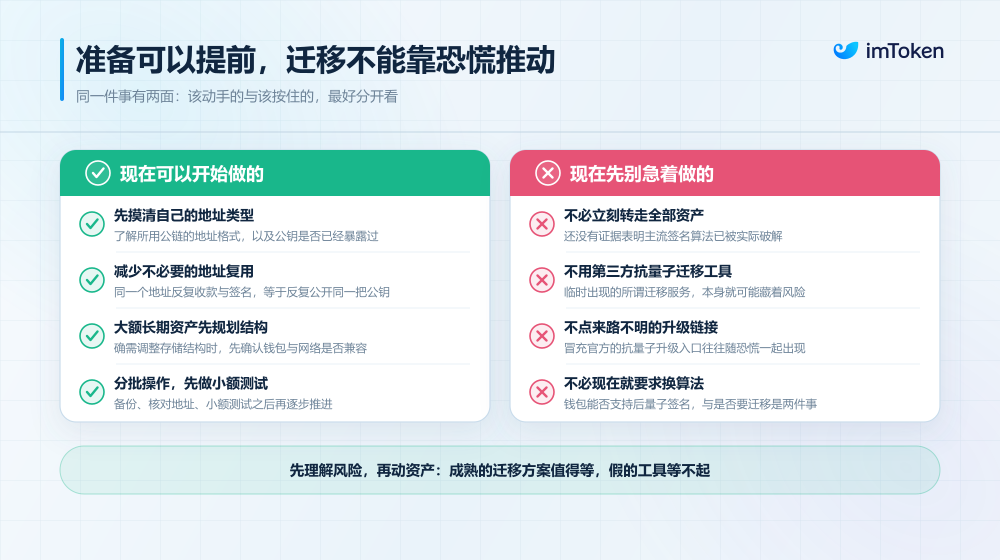
- Users do not need to move all assets immediately just because this debate has surfaced. There is still no evidence that the signature algorithms used by major public chains have been practically broken.
- They should be especially cautious about unfamiliar links and migration tools promoted in the name of a "post-quantum upgrade." Any request to import a seed phrase or private key, or to sign an unclear transaction, should be treated with high suspicion.
- For large, long-term holdings, users can begin improving address management habits. That includes understanding the chains and address types they use and reducing unnecessary address reuse and signing activity for high-value holdings.
- If they do need to adjust how assets are stored, they should first confirm wallet and network compatibility, back up keys properly, verify receiving addresses, and reduce migration risk through small test transactions and phased transfers.
- Whether a wallet may support post-quantum signatures in the future is a different question from whether a user needs to migrate assets today.
The article ends by saying that trust in blockchain systems is built on mathematics and code. For an open financial network that aims to carry trillions of dollars in assets over the long run, no one can guarantee that a cryptographic scheme considered safe today will never need adjustment over the coming decades.
That still does not mean every research breakthrough should trigger an immediate reshuffling of user funds. In the article's view, cryptography researchers need to think about worst-case possibilities, public-chain developers need to design new security mechanisms early, wallet teams need to support future upgrades and migrations reliably, and ordinary users need to avoid rushed decisions based on unverified claims.
The original article also includes a disclaimer stating that markets carry risk, investment requires caution, and the piece does not constitute investment advice.