
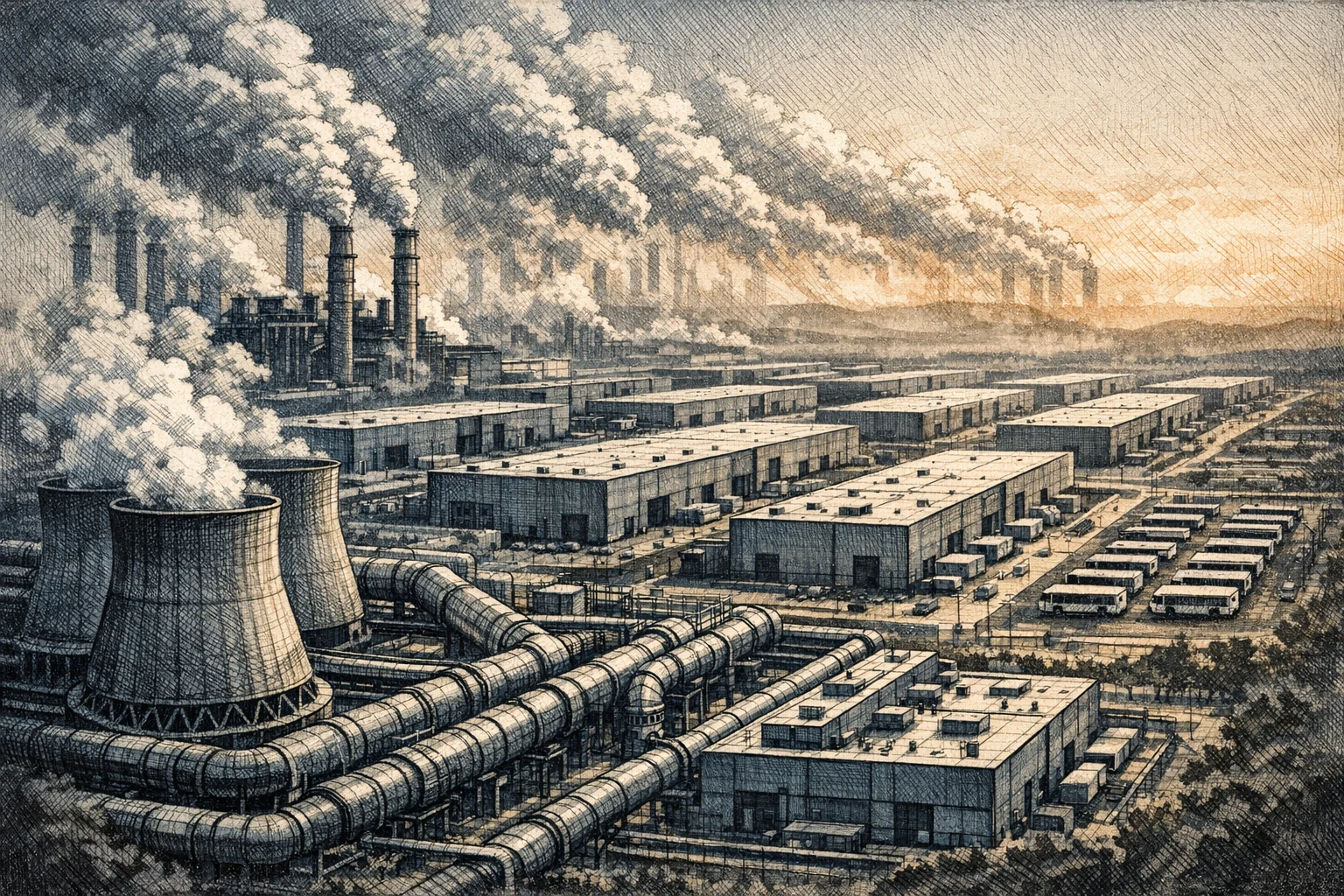
Eleven data center campuses. 129 million metric tons of greenhouse gases annually. That is the opening estimate of the climate bill from AI compute expansion in 2026 — and it covers only gas projects in the U.S. that are under construction or already permitted.
Permit filings obtained by WIRED show that natural gas plants built to power facilities for OpenAI, Meta, Microsoft, xAI and others can emit more greenhouse gases each year than all of Morocco did in 2024. Even if actual emissions are half the permitted maximum — the most optimistic industry scenario — the total would still exceed Norway's 2024 output. Natural gas produces roughly 40–50% less CO2 than coal, but the sheer scale of these projects magnifies the impact.
At the heart of this new infrastructure is the behind-the-meter (BTM) model: data centers skip the public grid and build their own gas-fired power plants. Power flows directly to the user, with excess sent back to the grid only occasionally.
4 GW to 100 GW: A Two-Year Emissions Leap
In early 2024, BTM gas capacity dedicated to U.S. data centers stood at just 4 GW. By early 2026, that figure had jumped to nearly 100 GW — an exponential surge. The non-profit Global Energy Monitor tracked the shift in a January 2026 report. The driver is straightforward: AI companies cannot wait years for traditional grid connections and fear public backlash over rising electricity bills. Building their own plants lets them bypass both regulators and the grid, leaving emissions as mere numbers on air-permit applications.
Michael Thomas, founder of the clean-energy research firm Cleanview and a long-time tracker of data-center gas permits, calls the BTM boom an “insane acceleration of emissions.” Even more troubling: a global shortage of high-efficiency gas turbines — partly caused by the data-center race itself — is pushing some developers toward less efficient models that emit more per unit of electricity.
Energy researcher Jon Koomey adds that data centers run nearly full-time, unlike grid plants designed for peak shaving, so actual emissions are likely to hit the upper end of permit limits.
Stargate, xAI, Fermi: Headline-Grabbing Projects Top the List
The Stargate initiative led by OpenAI, with three related gas projects in Abilene, Texas and Project Jupiter in New Mexico, has a combined annual emissions potential exceeding 24 million tons. xAI's Colossus 1 in Memphis and Colossus 2 in Southaven, Mississippi each carry permits for over 6.4 million tons per campus — equivalent to 30 medium-sized gas plants and enough electricity for 1.5 million homes.
Bigger still is Fermi in Amarillo, Texas: its two gas projects have a combined annual potential of over 40.3 million tons, more than all electricity-related emissions in Connecticut. Near Fort Stockton, Pacifico Energy's GW Ranch single-project permit tops 33 million tons, which the developer bills as the largest single energy project in the U.S.
Microsoft's Chevron-backed gas project in West Texas has a potential annual output of over 11.5 million tons, exceeding Jamaica's entire yearly emissions. Meta's three BTM projects in Ohio total 5.5 million tons — equivalent to more than 10% of the 23.8 million tons the company claimed to have cut over the previous four years.
Climate Pledges Under Siege
The numbers in these permits clash with Big Tech's public sustainability pledges. Standard responses vary: Williams Companies calls the permit figures a “conservative theoretical ceiling, not actual projections”; Microsoft says it pursues a “diverse energy portfolio”; Fermi describes gas as a “bridge to nuclear.” None are lying, but none address the key point: the BTM structure means these plants bypass the grid regulatory framework designed to cut greenhouse gas emissions.
As the AI compute arms race ticks forward on a quarterly cadence and nuclear and renewable projects take a decade to materialize, the gap in between is being filled by the numbers on those permit applications.