
Liquid Death has gone viral with an ad featuring former Philadelphia Eagles star Jason Kelce, joking that people should donate their urine to help cool water-intensive AI data centers. The premise is ridiculous by design. The water issue behind it is not.
After speaking with three experts who have worked for years on water resources and data center infrastructure, TechCrunch reported that using treated, recycled wastewater to cool server facilities has long been standard practice in the industry, even if it is rarely discussed in public.
The joke points to an existing industry practice
Michael Obradovitch, vice president of global data center customers at water treatment company Ecolab, told TechCrunch that the Liquid Death campaign is intentionally funny and provocative. Even so, he said a substantial share of data centers already use alternative water sources for cooling, and they do so at meaningful scale.
Bruno Pigott, executive director of the WateReuse Association and a former acting assistant administrator for water at the U.S. Environmental Protection Agency, made the distinction more plainly: nobody is taking raw urine and pumping it into a cooling system. What the sector has pushed for over time is the treatment and reuse of wastewater as a practical water source.
That distinction matters because urine contains salts, urea, bacteria, and organic material that can leave mineral deposits behind. Put directly into a cooling tower, it would clog equipment and force frequent cleaning. One common data center method is evaporative cooling, where hot air passes over water and heat is removed as the water evaporates.
What data centers actually use is reclaimed water
Technically, urine can be purified into drinking water. Astronauts on space stations rely on that kind of closed-loop treatment because water carried into orbit is limited. But scaling that process to industrial volumes is not economical, and no one can simply source millions of gallons of urine on demand. In practice, the water that goes down household toilets enters sewers, becomes wastewater and sewage, and only then starts the path toward possible reuse by data centers.
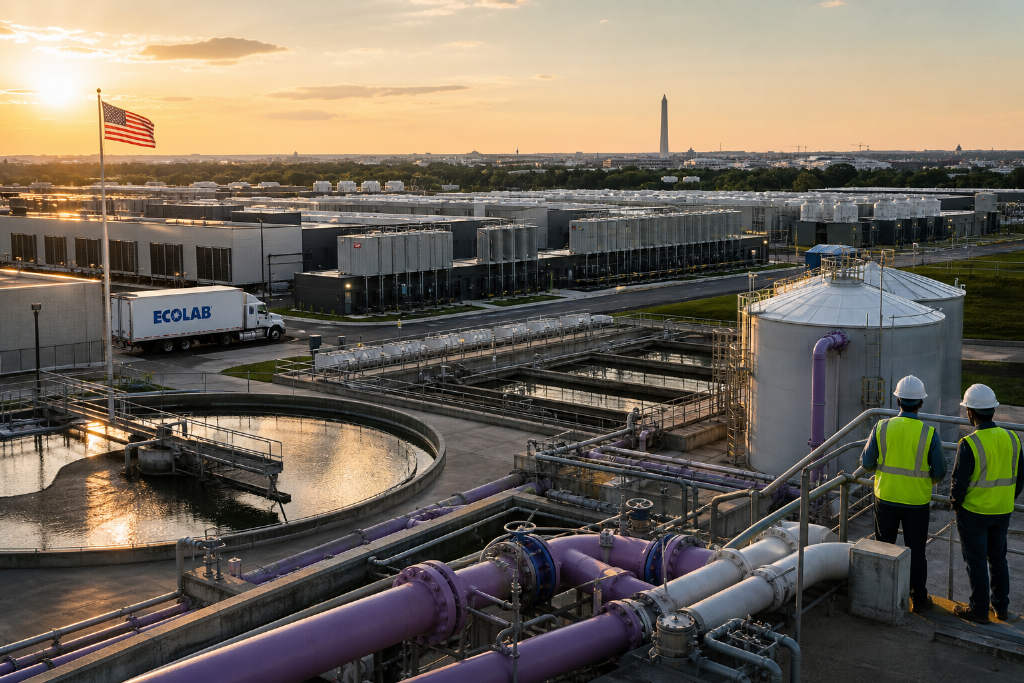
At treatment plants, that water moves through multiple stages, including membrane bioreactors, reverse osmosis, and ultraviolet disinfection, until it meets industrial water standards. In some cases, the output can even be treated to potable quality.
A membrane bioreactor replaces the traditional settling basin with a very fine membrane that filters out impurities and microorganisms. Reverse osmosis uses pressure to force water molecules through a membrane that allows water through while blocking salts and other contaminants. The resulting product is what the industry calls reclaimed water: wastewater that has been cleaned and put back into use.
Demand from data centers has grown sharply
Greta Zornes, Ph.D., who leads water reuse business work at engineering consulting firm CDM Smith, said reclaimed water has been used for cooling across industries for decades. Data centers are only one application. But in recent years, she said, demand tied to data center cooling has risen dramatically.
Zornes, who has spent more than 20 years working on water reuse technology, said her day-to-day work has shifted alongside data center expansion. She now handles data center reclaimed-water projects almost every day.
The main bottleneck is buildout time
Using more reclaimed water reduces pressure on local drinking water systems. That shift only works, however, when a large enough wastewater treatment plant is close by. Zornes said data centers need to be located near treatment facilities, and those plants must be able to supply enough water. When a project is built in a rural area, the local plant is often too small to process the needed volume, leaving little room for reuse.
Loudoun County, Virginia, on the outskirts of Washington, D.C., offers a clear example. The county already has more than 250 data centers, with at least 24 more planned. According to public information from Loudoun Water, reclaimed water accounts for only 43% of routine data center water use there. The other 57% still comes from the public water system.
Zornes said the real constraint is time. A large amount of infrastructure has to be built, much of it does not yet exist, and getting those facilities in place can take years.
Corporate funding and tax policy are part of the push
Obradovitch sees another force at work: AI capital may help finance water infrastructure expansion. He pointed to Meta, which has said it will invest at least $270 million in wastewater treatment infrastructure around its data centers, even as its Reality Labs division continues to lose about $4 billion per quarter.
In his view, data centers can serve as an anchor for water infrastructure projects, with companies committing capital to help local governments address supply and treatment constraints.
On the policy side, Pigott is backing legislation that would offer a 30% tax credit to accelerate reclaimed-water infrastructure buildout.
Public opinion is now part of the story
A Gallup poll found that seven in 10 Americans oppose having data centers built near their homes. The popularity of the satirical ad reflects something larger: the environmental cost of data centers is no longer just a technical issue inside the industry. It has become a mainstream public concern.
Pigott said he is glad more people are paying attention to water. In his view, anything that raises awareness of water resources, no matter how crude the method, can be useful because it creates an opening for the industry to explain what it is already doing.