
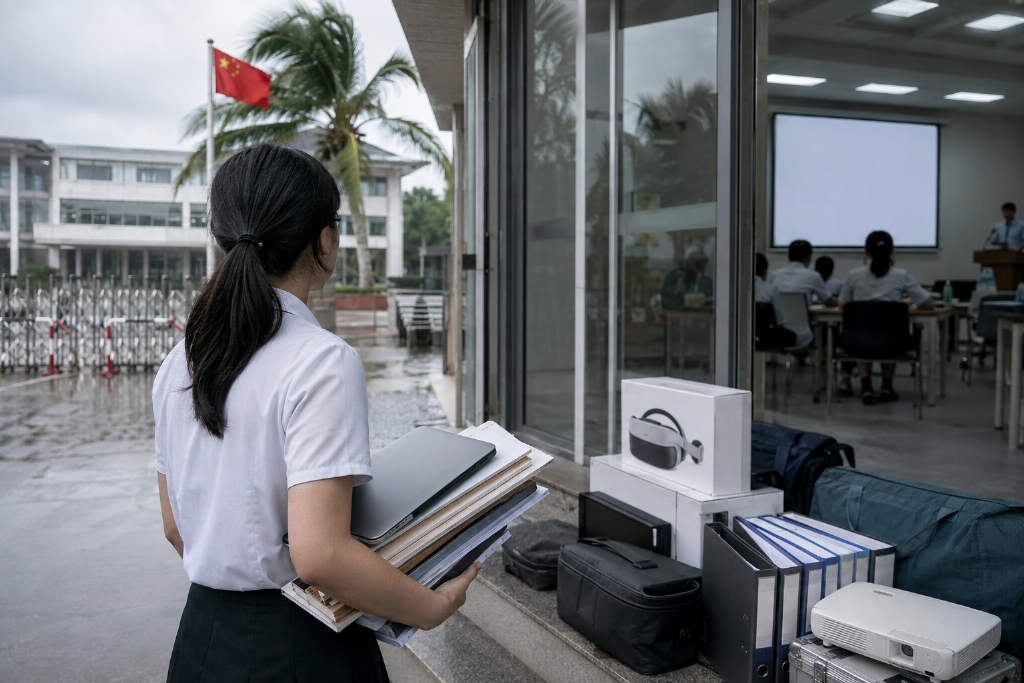
China's push to bring artificial intelligence into education is creating a new service economy around teaching contests, public classes, and school showcase events.
According to a feature by the WeChat account Wenduji, republished by MarsBit, entrepreneur Gao Shan first noticed the opening when ChatGPT appeared. What began as copywriting work turned into an education business. His company has expanded from two people to 30, with three main lines of business over the past year: customized AI-enabled courseware, digital literacy classes, and VR equipment sales to schools. Based in his hometown in Shandong, a fourth-tier city where average monthly pay is about 7,000 yuan, his staff now earn roughly 15,000 yuan per month on average.
The report says the growth has less to do with advanced technology than with a shared source of pressure among China's estimated 18 million frontline teachers.
AI classes become the visible form of policy rollout
The article points to a tragedy on May 28, 2026, when a 26-year-old female teacher in Haikou collapsed on the stage during a teaching contest. The case quickly drew attention on social media and revived debate over the physical and mental burden tied to performance-heavy public lessons.
Frontline teachers then shared their own experiences online. Some described illness after district-level contests, including chronic atrophic gastritis. Others said provincial competitions were followed by severe depression and somatic symptoms. The report argues that formalism in public classes has been normalized over the past decade, but the Haikou incident forced broader attention back onto what teachers carry behind the scenes.
At the policy level, AI has become a central theme in education digitization. The Ministry of Education held a 2026 deployment meeting in March for the national digital education strategy and called for a comprehensive push for "AI + education." In April, it released an action plan under the same banner. In schools, one of the most direct results has been the rise of "AI-enabled" classes built for observation and competition.
From teaching aid to contest performance
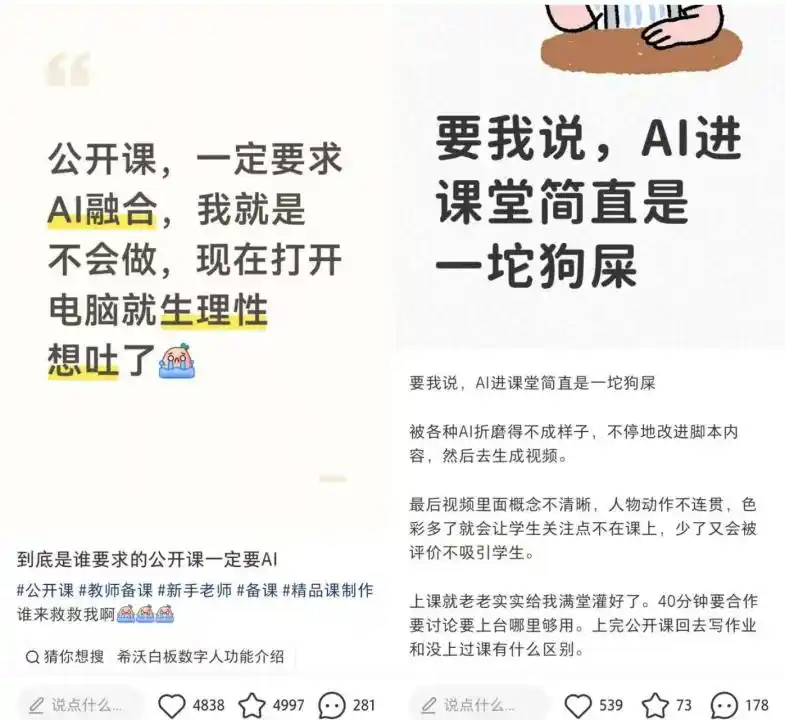
Wang Zai'an, a Gen-Z middle-school teacher in a third-tier city in Liaoning, says he supports introducing AI early if it can help deliver more personalized education. What he has actually seen, though, looks very different.
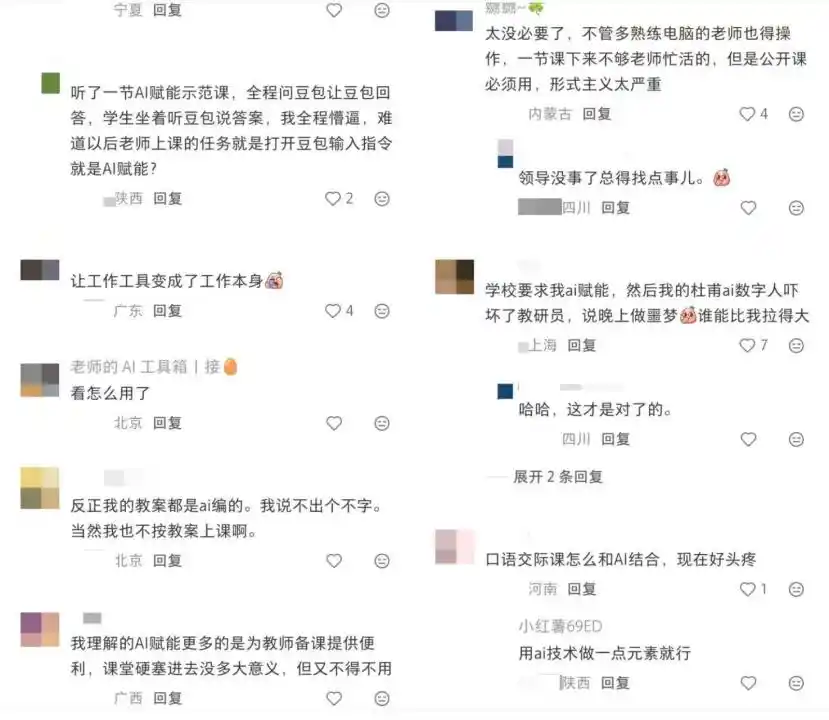
In many public classes, he says, teachers take a PowerPoint deck, apply an AI-style template, add a few animated pop-up effects, and call it AI empowerment. One recurring demand is to insert digital-human interaction into almost any subject. Chinese classes may have students call Li Bai. History classes may chat with Qin Shi Huang. Even geography lessons have been told to add an AI character, despite having little to do with the topic being taught.
"It is purely there to show that this class contains AI," Wang says in the report. Judges want to see that teachers are following hot trends, so the AI element becomes mandatory even when it has no deep link to the lesson itself.
The article describes public classes as increasingly turning into technical showcases: AI-generated images and video, Doubao-built agents, embedded HTML pages, and digital avatars replacing teachers in story-based segments. Before a contest, teachers may rehearse the lesson over and over while judges, experts, and even students give feedback on teaching design, slide layout, pacing, and every line of the script. After seven or eight rounds of revision, they finally go on stage.
Training exists, but usefulness is uneven
Schools have also organized AI training sessions under policy requirements, but Wang says practical value has been mixed. In one event he attended, the speaker mistook the ChatGPT logo for DeepSeek's, which deepened his doubts.
Still, demand for training is real. Wang notes that a colleague 10 years older than him was excited about the opportunity because he had wanted to learn AI for a long time but had no time and no structured entry point.
At Wang's school, only a few younger teachers are truly able to apply AI in teaching among a faculty of more than 50. For that reason, the school has not made AI use mandatory in everyday classes. Contests are different. Whether AI is used has now become a hard scoring item.
That forces teachers to carve out time from an already packed schedule to learn tools, tweak prompts, generate digital humans, and build interactive materials, only to stage an "AI-enabled" lesson that wins sparse applause from the audience. Students remain mostly spectators, sometimes pulled onto the stage to interact with an avatar and energize the room.
A business grows around the requirement
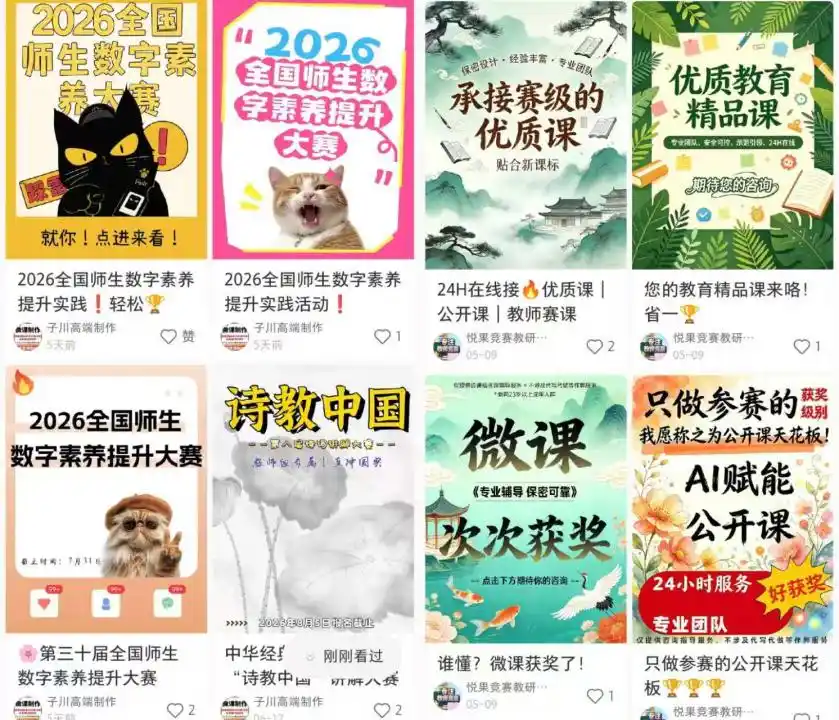
Once AI integration in public classes became a hard requirement in some settings, service providers moved in.
Gao Shan's company focuses on three categories: AI courseware development, AI tool training, and the promotion of VR devices and AI courses for schools and education institutions. He chose to keep the company in Shandong rather than a major city because rent and labor costs are far lower there.
The busiest periods are the contest seasons from March to May and from September to November. Orders come in quickly and cover subjects from Chinese to geography and grade levels from primary to junior secondary school. Over three years, the team has customized AI teaching materials for 2,000 to 3,000 teachers. Prices range from 800 yuan to 10,000 yuan per order.
The report highlights one case from last year. A teacher from a township under a first-tier city paid 5,000 yuan for an AI PowerPoint package that included digital-human interaction, 3D scenes, and animated data charts. She later won an award in a teaching contest, transferred from a township school to the county seat, and then moved into a good school in the city proper.
Gao says, "This wasn't really our achievement. We only added something on top, because she herself was already a very hardworking and capable teacher." Even so, the case shows why teachers are willing to pay. Contest results are directly linked to title evaluation and career advancement.
The article cites examples from several regions. In Linhai, Zhejiang, a provincial first prize in a quality-class competition adds 5 points. In Jiyang district of Jinan, Shandong, business competitions can account for as much as 20% of the supporting score in recommendation totals. In Tianjin, two or more municipal-level public classes are a hard threshold in evaluations for senior titles.
Courseware, training, and VR hardware form a chain
Direct courseware production is only part of the business. The same demand also supports training products and hardware sales.
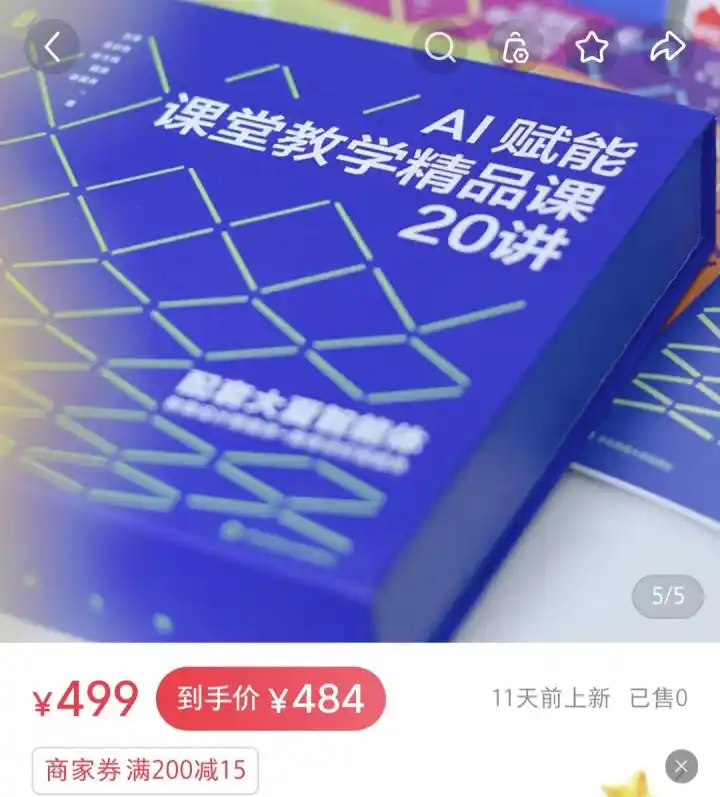
Gao says packaged AI courseware and teaching-material bundles are common on social media. His own product is a one-week AI digital literacy course that introduces the tools and methods used in lesson production. Several hundred teachers have bought it, but many stop after the first two lessons and eventually return to him for customized slides instead.
Time is the core constraint. The report cites a 2026 survey by Educator magazine covering 81,387 primary and secondary school teachers. It found that 96.71% sleep less than eight hours. Non-teaching tasks consume so much time that many teachers cannot systematically learn new tools. When contest assignments arrive on short notice, outsourcing becomes the easiest answer.
AI-themed education also extends to the hardware side. Academic papers have argued that immersive courses built with VR and AI can outperform traditional classroom methods. The article cites a 2023 empirical study involving 12 middle schools in Zhejiang, where VR-based teaching reduced students' operational error rates by 62% and improved the completeness of lab reports by 38%.
But the upfront cost remains high. A full set of VR equipment can cost tens of thousands of yuan, and outfitting a class with 30 sets pushes the bill into the hundreds of thousands. At the same time, many teachers have not received systematic VR or AI training, so purchased devices often end up unused. After visiting more than 30 schools, Gao found idle equipment to be common.
His team has tried to sell VR hardware and matching courses to schools. Initial interest is often strong, but projects tend to stall when the spending decision arrives. The customers that actually close are mostly universities in Guangdong. In one case, his company built a simulation course for a mechanical and electrical engineering college so students could practice in virtual reality and reduce the risk of injury during experiments.
Why AI still struggles in daily teaching
Teachers quoted in the article say the slide into formalism is not simply an individual choice. It is tied to hardware limits, family attitudes, assessment systems, and technical barriers.
One problem is the lack of student devices. At Wang's school, students hand in their phones before entering class. Without terminals on the student side, there is no real interaction and little chance for AI to become part of everyday instruction. In Gao's hometown in Shandong, some parents still call for a return to blackboards because they instinctively resist smart screens and worry about eye strain and addiction.
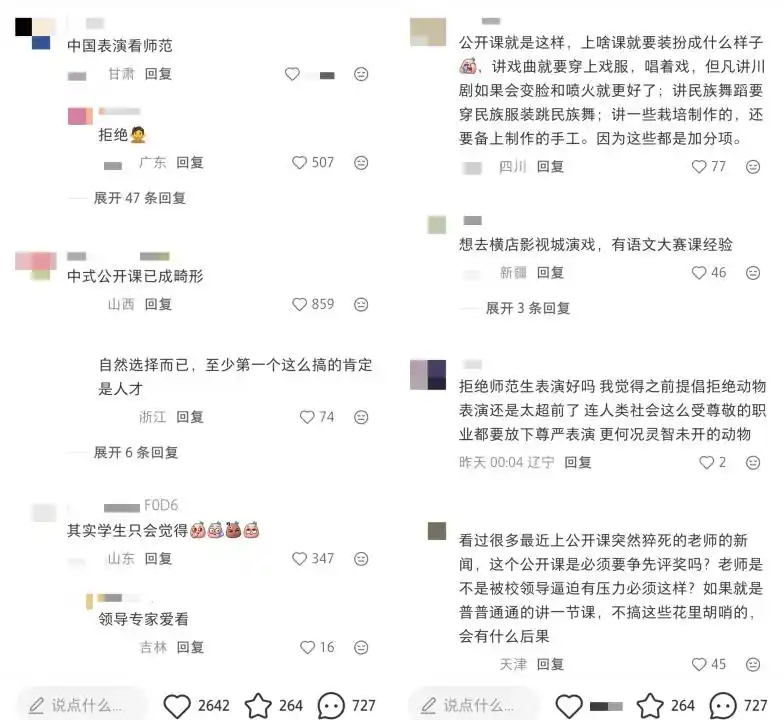
Without hardware, many AI classes become little more than upgraded PowerPoint presentations, and the teacher remains the main performer at the front of the room.
The assessment system is another constraint. Wang says he hopes AI will eventually support a shift away from rote testing and toward open-ended questions that build thinking skills, so he tries to include scenarios and open prompts in lesson preparation.
But the system he faces still centers on memorization. Students must memorize place names, climate types, and tables. That creates a basic contradiction: a teacher may put great effort into building an interactive class that develops thought, but the exam still tests fill-in-the-blank knowledge. In that setting, the value of an open-ended activity becomes hard to sustain.
Gao says many people believe the evaluation system in teaching contests itself produces formalism. Judges focus on whether AI is present, not on whether the class genuinely helps students understand the subject. He recalls telling one teacher that the lesson was already strong and did not need forced AI content. The teacher replied that it was impossible to leave it out because "the requirement came from above."
Technical barriers remain high
The tools themselves also create friction.
Wang once tried using Claude to build a small program to assist teaching. He spent a full week constructing a simple question bank system and getting the code to run, only to find that the content still had to be entered manually one item at a time. "Importing the question bank took more time than writing the code," he says. Updates would also depend entirely on him, while textbooks and current events change often enough that one teacher cannot keep a system like that maintained for long.
Gao's conclusion is similar. Most AI products on the market were not designed for the education scene in the first place. Teachers who try to build contest-ready materials on their own run into a chain of hurdles: downloading software, creating accounts, configuring environments, and writing prompts. Each step takes time, and the final result may still fall short.
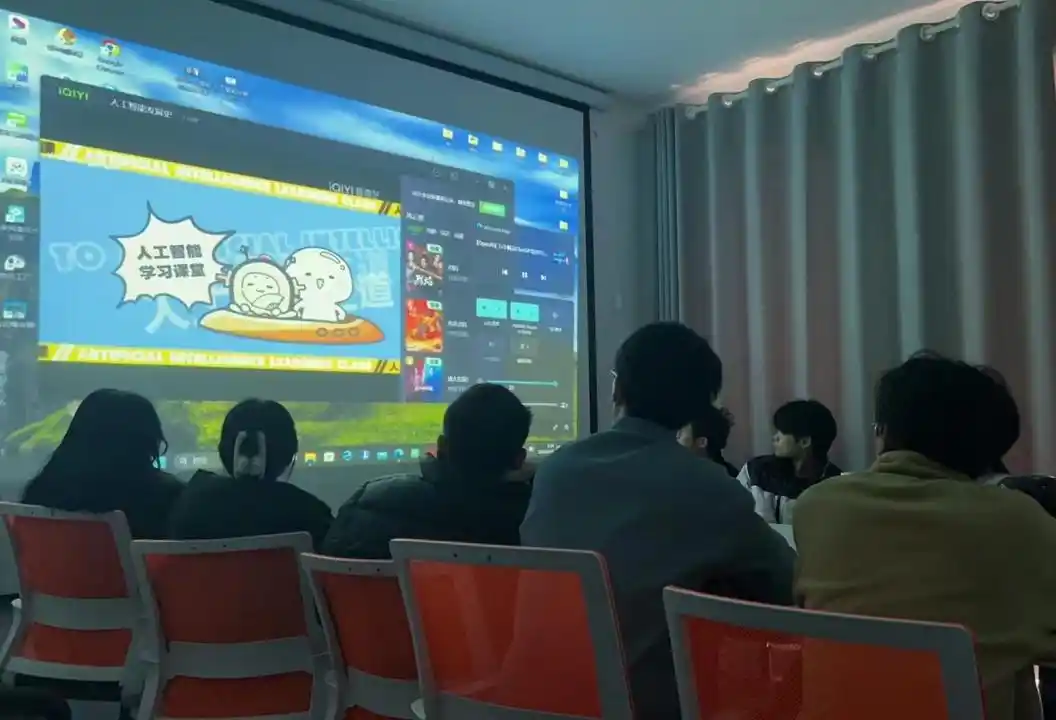
Put together, the report says, these constraints leave AI-powered education looking more like an attractive promise than a fully working classroom reality.
What AI does not replace in the classroom
The article ends with a question about the teacher's place in a room where a digital Qin Shi Huang can explain the unification of the six states and standardized weights and measures on his own.
Wang says he once felt, six months ago, that AI was unbeatable. He no longer thinks that way. "If you ask it to write an official document, it can produce something pretty polished. But if you ask it to design a lesson with real depth, that is still difficult," he says.
For him, the emotional exchange between people and the sparks that come from human thinking still sit outside what AI can do. In one lesson on water scarcity in West Asia, he asked an open question: "Most countries there are endorheic. What should those countries do?" One student answered that they might launch a war. The answer clearly needed guidance, but Wang says it reflected a genuine thought process and carried more meaning than a standard answer.
That kind of thinking, the report argues, does not need stage performance or polished packaging. It needs someone who can guide a question, and students who still want to search for an answer.
The original article was published by the WeChat account Wenduji and written by Wenduji.