
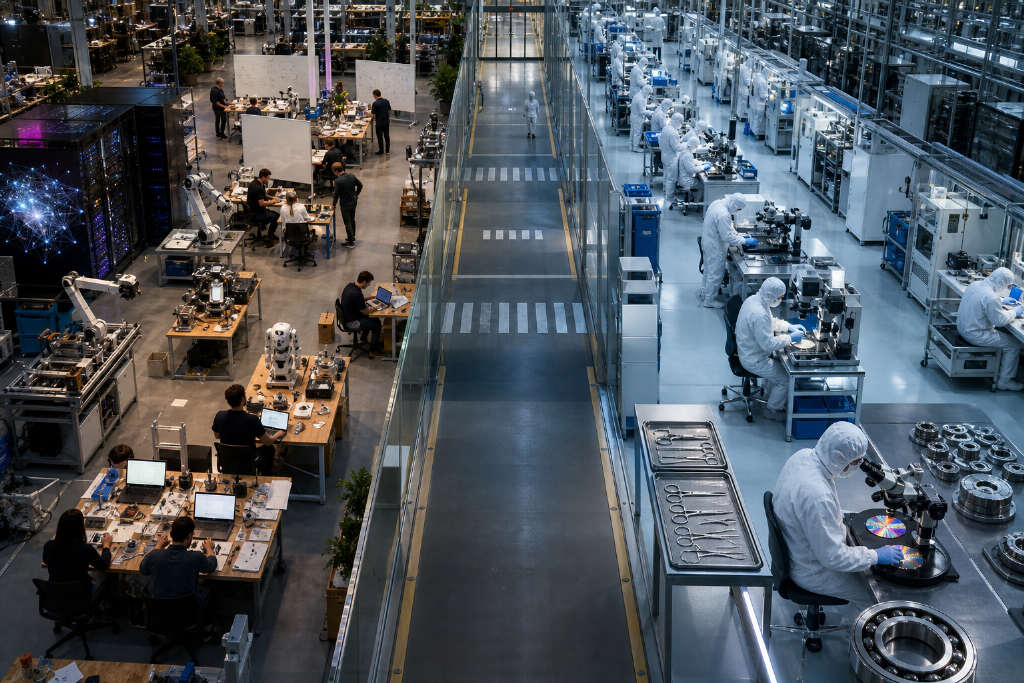
Two production logics are playing out at the same time in the AI era.
One group of founders uses large models to run market research, write code, and build product prototypes within days, then launches several directions at once and lets user feedback decide which one survives. Another group is still focused on a single dish, a single knife, or a single bearing, spending years shaving off tiny errors and improving the experience bit by bit.
The first side values speed. The second values precision. For decades, precision held the moral high ground. Patience, focus, and relentless refinement were treated as default ingredients of great companies. But the article argues that this view always hid an assumption that was rarely examined closely: the direction itself was correct.
Once the direction changes, all that patience has to be repriced. Working harder on the wrong track can push a company farther away from the market, and the time and expertise it accumulated can turn into a liability. In that sense, craftsmanship has not expired, but it cannot be judged in isolation from industrial direction, technology cycles, and market demand. The question now is not whether refinement still matters. It is where refinement should be applied.
When products disappear, quality alone stops being enough
The article says most industrial-era progress happened inside the same product frame. A car remained a car, only the engine became more efficient. A camera remained a camera, only the lens became sharper. A television remained a television, only the screen became larger and more vivid. That kind of world gave craftsmanship ideal conditions. Product cycles were long, skills stayed useful for decades, and companies could justify spending years training senior technicians.
Artificial intelligence is not limited to making tools easier to use. It can change whether a product needs to exist at all. A software suite’s functions can collapse into a single prompt inside a large model. A service once delivered by a professional team can turn into one natural-language conversation. In many cases, a company’s real competitor is no longer another firm making the same product more elegantly. It is the possibility that customers no longer need that category in the first place.
That is why quality cannot be separated from direction. The piece points to mechanical typewriters, film, and internal-combustion engines. Their buttons, colors, pistons, and gearboxes could all be refined to an extreme degree, but once the market shifted toward digital documents, smartphones, and electric vehicles, the stage for those forms of precision shrank fast. Nokia had durable hardware. Sony’s Walkman once set the standard for portable music. Kodak held world-class film technology. The article argues that what these companies lacked was not quality or engineering talent, but the willingness to admit in time that the foundation of the product system had already changed.
In that reading, many companies die not because they fail to solve a problem well, but because they solve a problem that is losing relevance with remarkable elegance. The most fragile part of craftsmanship is often the part that receives the most praise. The deeper the investment, the harder it becomes to turn back. A team that spends 20 years refining a technology will naturally want to believe it still has a future. To admit obsolescence means repricing years of equipment, processes, and professional identity, and few organizations volunteer to book that loss.
The result is that refinement can become a shield for sunk costs. Companies keep polishing products that no longer have room to grow and call it a commitment to quality. The article’s position is that mature craftsmanship includes not only the ability to do something well, but the judgment to decide whether the thing is still worth doing. In stable times, keeping your head down may be enough. In turbulent technology cycles, you have to look up first.
MVP over perfection — but not at the expense of honesty and reliability
The article then turns to MVP, or the minimum viable product. In its description, MVP does not ask a company to deliver a fully mature product on day one. It asks for the most basic workable version, placed in front of real users to test the most critical commercial assumption.
Traditional product development follows a straighter line: planning first, then R&D, then long testing before launch. That model assumes the company already has a strong grasp of user demand and that the product will not be overturned after release. MVP makes a different bet. Build a low-cost prototype first, watch the market react, then decide whether the idea deserves more capital and time. What matters most is how quickly a company finds out where it is wrong, not how polished version one looks.
Artificial intelligence has pushed trial-and-error costs much lower, which gives this approach more force. In the past, a software product might require months of work by product managers, developers, designers, testers, and marketing teams. Today, the article says, a skilled founder with large models, automated coding tools, and ready-made cloud services can assemble a usable first version within days.
Once development costs fall, companies no longer need to stake everything on one carefully modeled plan. They can test several directions at the same time and let real users, not internal meetings, cast the deciding vote. Many products fail because nobody needs them. Whether the buttons look good, whether the system feels fast, and whether every feature is already included are often not the first questions that matter. Spending a year refining details can simply delay the moment when the market says no.
The article also argues that AI shortens the window for new ideas. A product concept that feels fresh today may become a standard feature inside a general-purpose large model a few months later. The more a company tries to make the first release complete, the greater the chance it discovers on launch day that the market has already moved on. In areas where technology changes quickly, demand remains unclear, and experimentation is affordable, the value of MVP usually outweighs traditional craftsmanship. Confirm the direction first. Commit major resources later. Prove that someone wants the product before debating how to perfect it.
That said, the article is clear that MVP does not mean cutting corners on truthfulness or core quality. Users may accept fewer features, but not fake ones. They may accept a rough interface, but not data that disappears without warning. They may accept a testing phase, but not risks quietly pushed onto them. A good MVP subtracts at the level of nonessential functions and adds at the level of core value. It strips out decoration that can wait and preserves honesty, reliability, and baseline quality.
On this view, MVP and craftsmanship are not opposites. They belong to different stages of the product lifecycle. MVP finds direction by answering whether anyone needs the product. Craftsmanship builds the moat by answering whether others can copy it easily. Before a direction is validated, extra polishing mostly increases waste. After validation, too little polishing makes it hard to build lasting barriers. In the AI era, the product logic that tends to work is to launch, learn, and move closer to a better answer in repeated rounds. Waiting to get everything perfect in one shot usually means never arriving.
Why Germany and Japan have had a slower turn
The article presents Germany and Japan as two classic models of craftsmanship and then examines why each has found adjustment harder under a new technology cycle.
Germany has a large number of small and midsize firms deeply embedded in niche markets. A company may make only one kind of pump, valve, bearing, or sensor and still hold a major share of the global market. These businesses are not built on traffic or trend-chasing. They rely on decades of technical accumulation, customer relationships, and engineering experience. Together they form much of the structural backbone of German manufacturing.
Yet specialization brings path dependence along with expertise. Germany’s auto industry was built on mechanical engineering, precision manufacturing, engines, transmissions, and a full chain of complex components. A combustion vehicle supports a vast supplier network, and each link can sustain a company that spent years mastering a narrow specialty. Electric vehicles remove much of that foundation. The powertrain shifts from complex mechanical systems toward batteries, motors, power semiconductors, and software. The issue is no longer whether the old parts can be machined with enough accuracy. In many cases, automakers simply no longer need to buy them.
The article does not attribute all of the pressure on Germany’s car industry to craftsmanship. It explicitly mentions energy prices, labor costs, regulatory burdens, and international competition. Even so, it says long-formed technical inertia has made many firms better at optimizing inside the old structure than at switching to an entirely new product system. That can turn yesterday’s advantage into a mistaken assumption about tomorrow.
As electric vehicles and AI rely more on software, data, chips, and ecosystems, the basic unit of competition expands from a single component or machine to the entire platform. Details still matter, but the decisive details move. Yesterday they were the engine and transmission. Tomorrow they are more likely to be the operating system, intelligent-driving algorithms, chip architecture, and data feedback loops. Refining old parts to the limit does not automatically create leverage inside the new system.
Japan’s situation differs from Germany’s, but the article sees a similar cultural inertia beneath it. Japanese society has long admired the idea of spending a lifetime doing one thing well. From sushi, knives, and ceramics to cars, cameras, and consumer electronics, that ideal can produce extremely stable processes and give ordinary goods the feel of crafted objects. In industries where demand is stable, this kind of long focus has real value. Apprenticeship passes down not only technical parameters, but also tacit knowledge that never fits cleanly into a manual.
At the same time, Japan’s companies, while well known for televisions, Walkman devices, digital cameras, and home appliances, lost leadership in internet platforms, mobile operating systems, and software ecosystems. The article notes that corporate governance, capital markets, and demographic structure all played roles. Still, placing too much value on existing processes weakened organizational self-negation. Individual parts of the system remained carefully managed, but the system as a whole fell further behind the new competitive rhythm.
It also argues that Jiro Ono’s sushi story may stand as a symbol of personal mastery, yet it does not map neatly onto technology competition. A restaurant can spend decades refining one flavor because that time and concentration are part of what diners are buying. Technology markets do not wait the same way. Consumers may replace a tool within months, and platform rules may change overnight.
For the article, the real challenge facing Germany and Japan is how to carry accumulated precision manufacturing capability and long-built expertise into a new industrial structure. The problem is not that they have too many craftsmen or products that are too good. The problem begins when craftsmanship is interpreted as defending old technology and rejecting fast experimentation. At that point, a former advantage can harden into a cultural burden. The qualities worth keeping are focus, quality, and responsibility. The ones worth discarding are blind faith in a specific old product or process.
Some tracks still demand deep precision
The article warns against another lazy conclusion: if traditional industries are under pressure, then the AI era must be about speed alone. It rejects that outright.
As AI advances, it places even higher demands on computing power, chips, manufacturing equipment, and material stability. The faster algorithms iterate, the higher the precision threshold often becomes for the physical layer underneath them.
Japan’s semiconductor materials sector is one example. The article names Shin-Etsu Chemical, Tokyo Ohka Kogyo, and JSR as companies that have spent decades in silicon wafers, photoresists, and high-purity chemical materials. Their products may look unremarkable, but they directly shape chip-making precision, yield, and stability. A trace amount of impurity can be enough to ruin an entire wafer batch. Capabilities like these do not emerge on command. The article says they are built from decades of experimental data, equipment experience, and customer validation.
Ajinomoto is another case. The company, originally known for seasonings, redirected its amino-acid chemistry base and developed ABF insulating film used in advanced chip packaging. As AI servers, GPUs, and advanced chips run faster, the article says these seemingly peripheral materials can become key bottlenecks.
Germany’s Zeiss serves as a different example. Narrow focus does not mean backwardness. Zeiss has spent decades in high-end optics and supplies core optical systems for advanced lithography equipment. Lens surface errors must be controlled within an extremely small range. This is not the kind of product that can be launched first and fixed later. A tiny deviation can drag down the entire machine and the full chip production line attached to it.
These companies are also highly specialized. The difference is that they sit at bottlenecks inside the new industrial stack. AI, in the article’s telling, does not reduce the value of such products. It magnifies demand for them. As model parameters rise and chip processes go deeper, the stack still comes back to material purity, equipment precision, and manufacturing yield.
That leads to a broader test for whether craftsmanship still carries high value. It is not enough to ask whether a company works in a narrow niche. You also have to ask where that niche sits in the supply chain. A traditional engine component can be world class while the underlying route is shrinking. A sheet of chip-insulating film may look trivial while remaining impossible to bypass in advanced packaging. Track determines demand. Bottlenecks determine profit. Craftsmanship turns the bottleneck into a moat.
The same logic extends beyond semiconductor materials and advanced equipment. The article names aviation engines, medical devices, nuclear-power equipment, and food safety as areas where MVP cannot be treated as a universal answer. When human life, safety, and high-value assets are involved, companies are not entitled to put rough versions into real environments and fix them only after accidents happen.
Luxury goods, fine dining, art, and traditional handicrafts belong to another category. There, consumers are not paying only for function. They are also paying for time, skill, and story. AI may imitate the outward form, but it struggles to replace the cultural value created by years of human dedication.
So craftsmanship has not disappeared. Its zone of highest value is being redrawn. Where demand is highly uncertain and trial-and-error is cheap, speed and MVP matter more. Where the cost of failure is high, or where value rests on extreme precision, long trust, and hard-to-copy accumulation, craftsmanship remains irreplaceable. The key is not whether fast or slow is morally superior. The key is which link should move fast and which one must move slowly.
A new form of craftsmanship
The article closes by arguing that AI is not the opponent of craftsmanship. Large models are themselves highly complex engineering products. Data cleaning, algorithm design, chip clusters, model training, inference optimization, and safety testing all depend on long accumulation and dense layers of detail.
The largest difference between AI companies and traditional craftsmen, it says, is that AI firms do not treat a single generation of product as an endpoint. Models are updated continuously. Errors are corrected through feedback. What these firms pursue is the ability to keep evolving, not the ability to get everything perfect once.
That may be the most important change in what craftsmanship means today. In the past, craftsmanship relied heavily on repetition, spending a lifetime refining the same task. Today it also requires selection, transfer, and self-negation. It is no longer enough to know how to make a product better. A company or individual also has to know when to change tools, change methods, or even replace the product being made. Real long-term thinking does not mean defending one concrete method forever. What deserves long-term commitment is problem solving, value creation, and capability building. Product forms are only temporary containers.
The article puts the danger plainly. The most vulnerable craftsman in the AI era is the one who treats skill as identity and path as belief. Such a person may be highly capable, yet unwilling to admit that the market is asking a new question.
It outlines a three-step product logic that better fits the present cycle. First, use MVP to confirm direction early: does the product solve a real problem, do users want it, and can the business model stand up. Second, concentrate resources on the links that truly decide the outcome. Not every button and not every component deserves the same intensity of effort. Companies need to identify the part users care about most and rivals will find hardest to copy. Third, preserve the ability to turn quickly. Even after success, the current product form cannot be treated as a permanent answer.
The article then distills the framework into three abilities. Direction judgment determines whether effort is effective at all. Iteration speed determines whether a company can catch the window. Execution precision determines whether the product can hold a durable barrier. Craftsmanship solves only the third of those tasks. Without direction judgment, higher precision can mean greater waste. Without iteration speed, the opportunity may be gone before the product is finished. Without execution precision, even a correct direction remains stuck at a layer that is easy to imitate.
Its final point is that the strongest companies in the AI era neither worship speed nor treat slowness as a virtue in itself. They know when to push out a prototype quickly, when to turn decisively, and when to concentrate resources on the few links that truly shape the outcome. Craftsmanship does not become outdated, but it does need to shift from an abstract moral compliment to a clearer discipline of resource allocation.
The article was originally published by the WeChat account Tencent Research Institute (ID: cyberlawrc) and written by Zhu Zhaoyi. MarsBit republished the piece.