
Industry event spotlights China’s accelerating AI hardware startup cycle
On June 28, 2026, an event titled “New Opportunities in AI Smart Hardware: The Battle for Interaction Entry Points Begins” was held in Beijing. The event was organized by ITJuzi and co-hosted by Yuwei Capital and Zhongguancun Science City Company. Executives and senior representatives from ITJuzi, Yuwei Capital, Shengzhi Technology, Ling Universe, and Zhongbo Juli attended the gathering, which focused on funding trends, product direction, and commercialization challenges across China’s AI hardware market.
At the opening session, ITJuzi senior analyst Wu Meimei presented the firm’s report on emerging companies in the AI hardware and smart hardware sector. The report reviewed startups founded after 2023 and concluded that the sector is going through a dense new wave of entrepreneurship, backed by unusually strong investor participation and a broadening range of hardware categories.
Report data: 431 startups tracked, 327 already funded
According to the report, 431 startup companies were identified in the sector, and 327 of them have already completed financing rounds, producing a funding rate of 75.9%. ITJuzi noted that this is a rare level of capital concentration for an emerging category. In the first half of 2026 alone, 179 companies in the sample received investment, reinforcing the idea that AI hardware has become one of the most closely watched themes in China’s primary market.
The report framed this surge as one of the clearest signs that investors see long-term opportunity in hardware products rebuilt around AI capabilities. Rather than a single-product boom, the market appears to be expanding through multiple categories at once, with both general-purpose and scenario-specific devices attracting early-stage capital.
Embodied robotics leads funding, but wearables are gaining speed
In terms of funding structure, embodied intelligent robots stand out as the most prominent and capital-intensive segment. The report described robotics as the category with the strongest fundraising pull at present. At the same time, smaller wearable segments, including smart rings, AI glasses, and sports and health devices, are showing visible growth and expanding market imagination despite their still modest base.
ITJuzi also said more than half of the financings remain concentrated in angel rounds, indicating that the market is still early and far from structurally settled. In other words, major winners have not yet been determined, barriers are still forming, and the window for new entrants remains open. That early-stage profile was echoed throughout the event by speakers who argued that most companies are still searching for repeatable product-market fit rather than scaling mature business models.
Geographic split points to a Shenzhen-Beijing dual core
The report’s geographic breakdown showed Shenzhen in first place with 95 companies, or 22% of the sample. Shanghai followed with 50 companies, and Beijing with 44. ITJuzi attributed Shenzhen’s lead to its globally competitive hardware supply chain, which continues to offer unique advantages in prototyping, manufacturing, component sourcing, and iteration speed.
Panelists later reinforced this view. They argued that Shenzhen remains the preferred location for supply chain execution, including hardware selection, mold development, and module procurement, because it significantly lowers trial-and-error costs. Beijing, by contrast, retains strengths in capital access, branding, and resource coordination. Together, those advantages are pushing the industry toward a clear two-center pattern in which hardware execution and strategic financing are distributed across different cities.
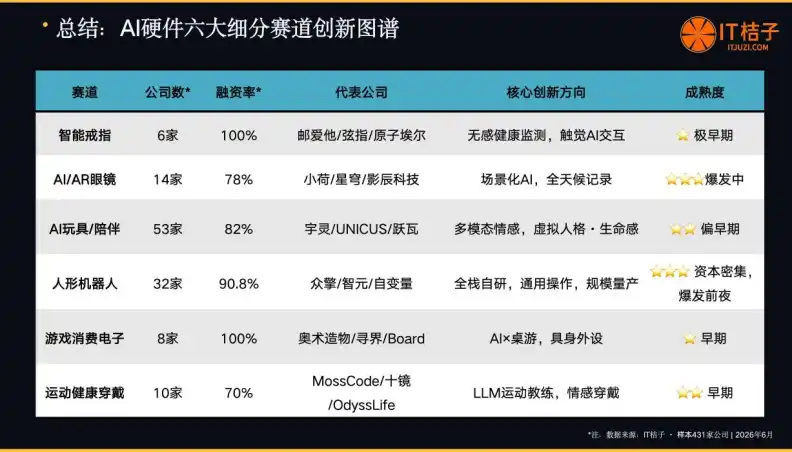
Micro-innovation across six subsegments defines the market’s current phase
One of the report’s central conclusions is that the sector is not being built mainly through radical new categories, but through AI-enabled reinvention of existing product types. Smart rings, for example, are evolving from health-monitoring tools toward tactile AI interaction devices. AI glasses are branching into niche verticals such as museum and cultural tourism guidance, as well as outdoor imaging. AI toys are introducing emotional engines and virtual persona systems to strengthen companionship use cases.
In humanoid robotics, the report pointed to the coexistence of multiple technical routes, including interaction-led, body-led, and brain-led approaches. Zhiyuan was cited as an early mover in mass production and commercialization, suggesting that competition in humanoid hardware is already intensifying. ITJuzi summarized the broader pattern by saying the market is wide open, and as technology continues to move down the stack, founders no longer need to reinvent the wheel. Instead, they can build defensibility around narrow user groups and highly specific scenarios.
Shengzhi Technology: many founders still have a “hammer looking for a nail” problem
During a themed presentation, Shengzhi Technology Chief Product Officer Huang Yunhe said AI hardware startups often face what she described as a “hammer looking for a nail” dilemma. In her view, many teams possess technology but have not yet found a hardware carrier suitable for mass production and large-scale user adoption. She argued that product innovation must balance technical capability with market acceptance, and that short-term success depends more on matching current technological thresholds, user demand, cost control, and moderate form-factor innovation than on chasing disruptive concepts for their own sake.
Huang also said today’s voice interaction still depends heavily on wake-up commands and that truly natural multi-turn conversation has not yet arrived in mainstream hardware. For AI devices to evolve from passive response to proactive perception, she said, the industry still needs sensor upgrades and advances in physical AI. She added that Chinese companies should focus on localized needs and original product definition rather than simply replicating overseas paths, with the goal of creating a next-generation AI terminal rooted in domestic demand.
Roundtable: the future interaction layer will likely be fragmented, not singular
In the roundtable session, Yuwei Capital director Wang Simeng asked whether the AI era would still converge around a single “super device” as the main interaction entry point, or instead fragment into more scenario-specific, specialized hardware. Huang said unified terminals will continue to matter, but vertical carriers designed for specific contexts will also keep emerging. She outlined two broad development paths for AI terminals: building hardware around AI from the ground up, or adding AI capability to hardware already tied to existing scenarios.
From her perspective, founders do not need to wait for technology to become perfect if demand is clear and users are willing to pay. Entering the market early can provide product validation that is otherwise impossible to obtain in theory. That position reflected a wider tone at the event: iteration speed and scenario validation may matter more than technical completeness in the sector’s current stage.
Startups should target narrow users first, especially in categories dominated by incumbents
Ling Universe senior product lead Liu Cuitao argued that startup teams should initially choose narrower use cases and more vertical target groups, then use data from those users to improve products over time. She said founders need to assess whether a category has already been mentally claimed by leading brands. If they enter product shapes such as watches or rings, where users already have strong expectations for basic performance, they must first match the baseline experience before layering on AI as a differentiator.
That means AI cannot be the only selling point in categories with entrenched incumbents. Instead, teams must build a reliable product first, then use intelligence features to create additional value. This approach, Liu suggested, is especially important in consumer hardware, where disappointment on fundamentals often leads to return risk and weak repeat purchase behavior.
Commercialization depends on software-hardware coordination, not just technical novelty
Zhongbo Juli brand strategy head Liu Hongyan said the future AI hardware market is likely to develop into a multi-layered ecosystem. Large companies have obvious advantages in ecosystems, supply chains, and aggregated resources, but that does not mean they can cover every vertical. Startups that understand their own resource endowment and focus on medium- to long-term strategy still have a real chance to break out, especially if they can deepen coordination between software and hardware and execute clearly against commercial targets.
On the question of whether the competitive moat in AI hardware sits more in software or hardware, Liu Cuitao said many of today’s founders come from major enterprises, state-linked institutions, or the ByteDance ecosystem, but they still face two shared challenges once they move into execution. The first is achieving a deep understanding of AI model capability. The second is mastering practical hardware engineering, including product selection, cost differences, and other non-transparent supply chain variables. In her view, both are necessary for successful productization.
Subscription models are possible, but only if BOM and inference costs are controlled
Liu Cuitao added that AI hardware could explore a model in which hardware itself is not the profit center and recurring subscriptions become the main source of revenue. But she stressed that such a model only works if teams can control both hardware BOM costs and model inference costs at the same time. If either side remains too expensive, companies risk losing money on every layer of the stack.
Liu Hongyan made a related point from the investment side. She said investors are ultimately testing whether AI technology can be matched with a viable hardware carrier and a real application scenario. Product perfection matters less than whether the market accepts the product, whether sales can scale, and whether cash flow can be sustained. In a market where AI firms are still burning heavily, the decisive issue is whether they can close the loop from technology to product to commercialization.
Return rates remain a major pressure point for consumer AI devices
Wang Simeng raised the issue of return rates and asked what would count as a healthy benchmark for a successful hardware product. Huang Yunhe replied that, based on what Shengzhi Technology has observed, AI earphones currently have average return rates of roughly 30% to 50%. She added that return rates may actually be lower in overseas markets because users there face higher return frictions and costs.
This data point underscores a broader issue in AI consumer hardware: many products still struggle to consistently deliver on user expectations after purchase. That gap may come from limited functionality, unstable experience, weak onboarding, or unclear value communication. Regardless of the cause, high return rates can quickly undermine channel confidence and make scaling more difficult.
Proactive interaction is a key long-term direction, but technical constraints remain heavy
As the discussion turned to the next two to three years, Wang asked which new hardware categories could emerge as large models continue moving onto devices and local hardware shifts from passive response toward proactive user perception. Huang said proactive interaction is still not mature in practice because of model hallucinations, weak physical constraints, and insufficient environmental awareness. For now, she said, health wearables are among the few categories able to deliver limited proactive reminders in a useful way.
Her advice to founders was to take lessons from the early internet era: find a specific user group, amplify existing strengths, and do not become overly fixated on technical limitations that affect the entire industry. In her view, Chinese founders still hold advantages in marketing and product definition. The immediate goal should be to find target users, build coherent usage experiences, and validate a market first while waiting for a larger technology inflection point.
Timing and long-term memory are central to truly useful proactive AI hardware
Liu Cuitao described proactive interaction as one of the most important evolutionary directions for AI hardware. She said such devices must use multimodal perception, including vision, audio, and physiological signals, to identify the right time to initiate meaningful interaction and build understanding and emotional links with users. To achieve that, two core problems must be solved. The first is timing: devices need to know when to speak and when not to interrupt. The second is long-term memory: they need to accumulate user preferences and interaction history so that engagement becomes more natural over time.
She also pointed out that engineering implementation remains difficult, especially when teams try to balance edge inference capability with privacy protection. Product form factors, she added, will vary by user segment rather than converge into one universal answer. For example, female users may place greater emphasis on aesthetics, while devices for children need to be lighter and easier to operate. That reinforces the panel’s broader conclusion that AI hardware categories are likely to diversify rather than collapse into a single standard device.
Shared takeaway: validate a scenario first, then scale
Across both the report and the roundtable, a clear consensus emerged. Funding remains hot, especially in robotics, AI glasses, smart rings, toys, and health wearables. But the projects most likely to survive will be those that can close the loop from technology to product to commercialization. For startups, entering the market, validating user need, and refining experience may be more important than building a “perfect” product before launch.
That logic also explains why Shenzhen’s supply chain strength, Beijing’s financing and resource advantages, and the rise of micro-innovation in narrowly defined scenarios are becoming the main structural drivers of China’s AI smart hardware market. As large models continue to move closer to the edge, competition over interaction entry points is likely to expand far beyond device design alone and into operating systems, interaction algorithms, data accumulation, cost structure, and long-term business models.