
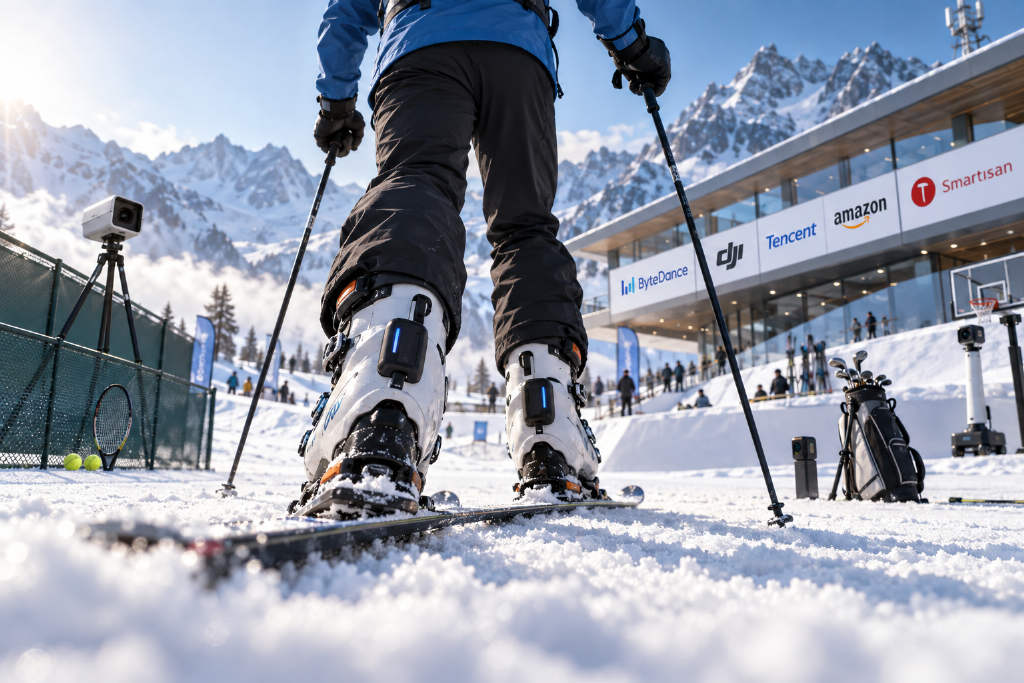
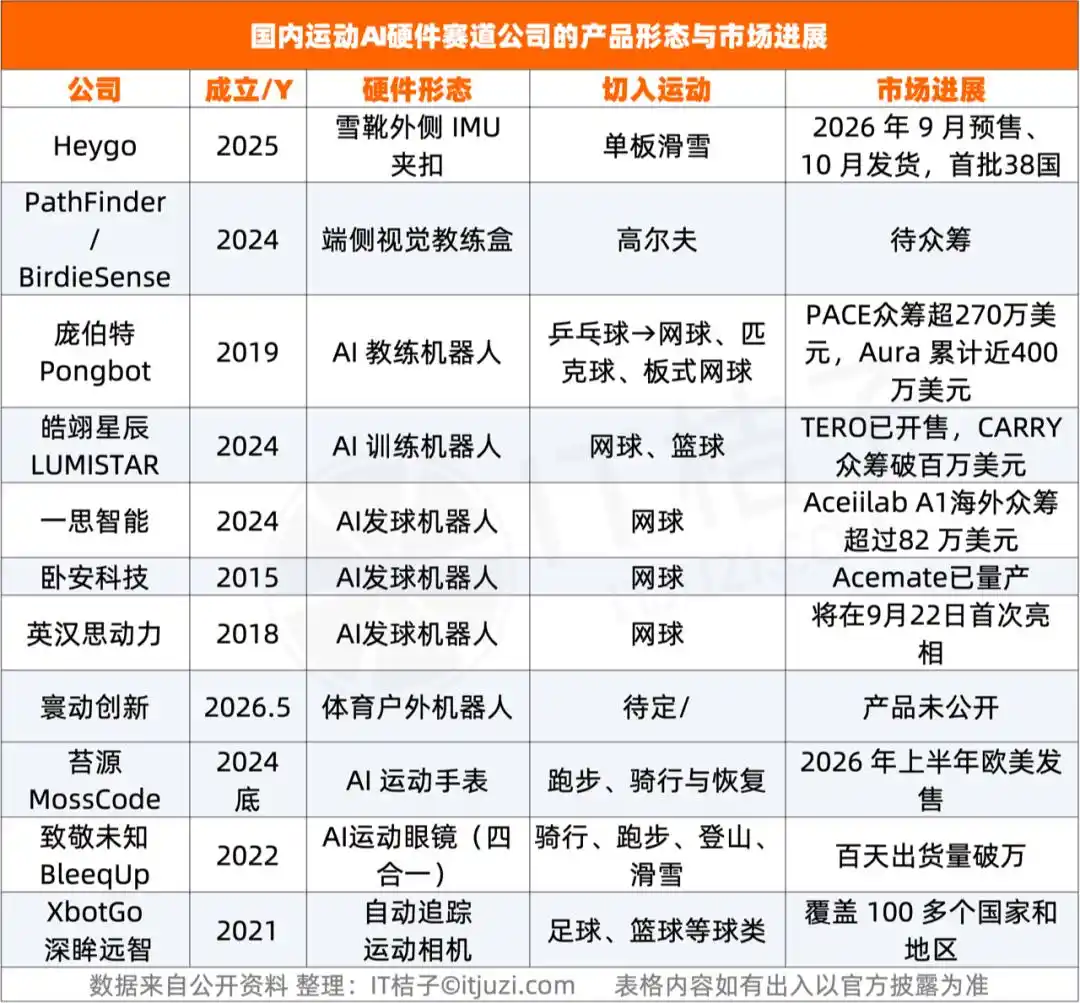
Heygo, an AI skiing hardware startup founded by former employees of ByteDance, DJI and Tencent, has drawn attention with a product that clips two sensors onto the outside of ski boots. The team says it trained its model on million-level skiing data to tackle a long-standing problem in skiing known as the gap between what the skier feels through the boot and what the ski is actually doing on snow. The company has raised an angel round worth several million U.S. dollars from Thick Snow Capital.
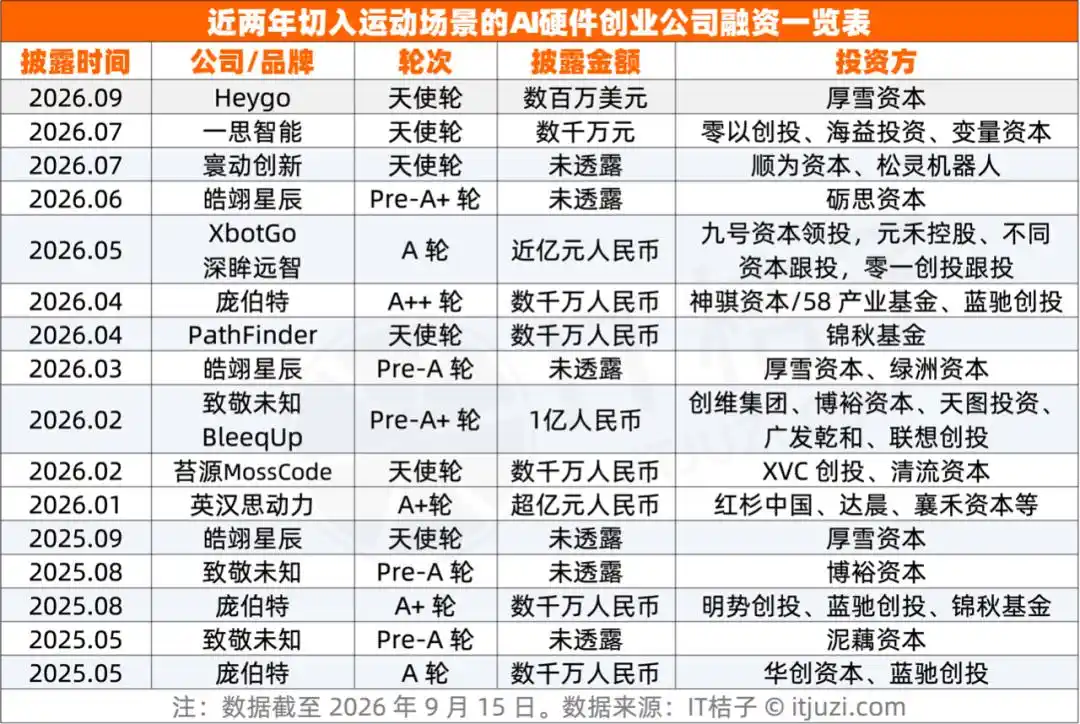
Looking across early-stage financings over the past two years, the same pattern appears repeatedly: founders with backgrounds in consumer hardware and AI robotics are moving into narrow sports scenarios. Some are established companies opening new business lines. Others are new teams spun out of DJI, ByteDance, Amazon, Smartisan and similar hardware-heavy organizations. Their products span skiing, tennis, table tennis and golf.
No single deal has yet towered over the field, but funding activity has kept building, with firms such as Sequoia China, BlueRun Ventures and Lisi Capital appearing on cap tables. The most focused group in this market is not trying to count how much exercise a user did in a day. It is trying to judge whether a specific movement was done correctly.
AI hardware built around single-sport training
Heygo and the skiing problem it is trying to solve
Skiing has a structural issue often described in the industry as the idea that the boot is not the ski. The ski’s real state on snow — edge angle, torsion and rolling rhythm — reaches the skier’s feet with delay and loss. What the skier feels is late and blurry. A coach standing on the side of the slope can see the outline of a turn, but often cannot pinpoint which turn or which instant went wrong.
Heygo’s answer is to mount two IMUs, or inertial measurement units, on the outside of the ski boots and use a model to infer the ski’s actual posture from foot-level data. The goal is to translate body sensation into a technical description that can be checked and reviewed. The mass-production version keeps only two external sensors, with measurement accuracy controlled within 3 degrees, IP68 water resistance and battery life of about one week.
The company’s other key design choice is how feedback is delivered. Traditional ski training relies on body awareness and a few comments from a coach standing nearby. Heygo instead gives voice prompts through Bluetooth earphones while the user is skiing, and it speaks only at key turns so the rhythm is not constantly interrupted. Once the user gets back on the lift, the system can review the session immediately. Tone and level of detail change with the user’s skill level. That matters because too much data at high speed can make the experience worse, not better.
The founding team combines several backgrounds. Founder Wu Zhenhua previously handled regional business and user growth for Feishu at ByteDance. Co-founders come from algorithm teams at Tencent and ByteDance, as well as hardware teams at DJI and Seeed. The mix covers content operations, algorithms and hardware.
Heygo has so far completed only its angel round, funded exclusively by Thick Snow Capital. The product uses a pricing model that combines hardware in the RMB 1,000 range with a subscription. Presales are scheduled to begin in September 2026, with shipments in October and an initial rollout covering 38 countries.
BirdieSense brings computer vision to the putting green
Golf serves a user base with stronger willingness to pay, but many players know their swing has problems without being able to identify exactly what is wrong. AI hardware is trying to close that feedback gap.
PathFinder was founded in 2024 by entrepreneurs born in the 2000s with research backgrounds in robotics at the University of Pennsylvania. Its product, BirdieSense, is a small device placed on the putting green.
BirdieSense uses a monocular camera in a pure-vision setup. It performs swing capture, 3D pose analysis and deviation comparison on-device, then outputs voice feedback directly. The full process does not rely on the cloud, and response latency is measured in milliseconds.
In April 2026, the company raised an angel round worth tens of millions of yuan from Jinqiu Fund, an early-stage investor focused on AI. Its post-money valuation was not disclosed. The product is aimed mainly at golf courses in North America.
Tennis robots become a crowded new battleground
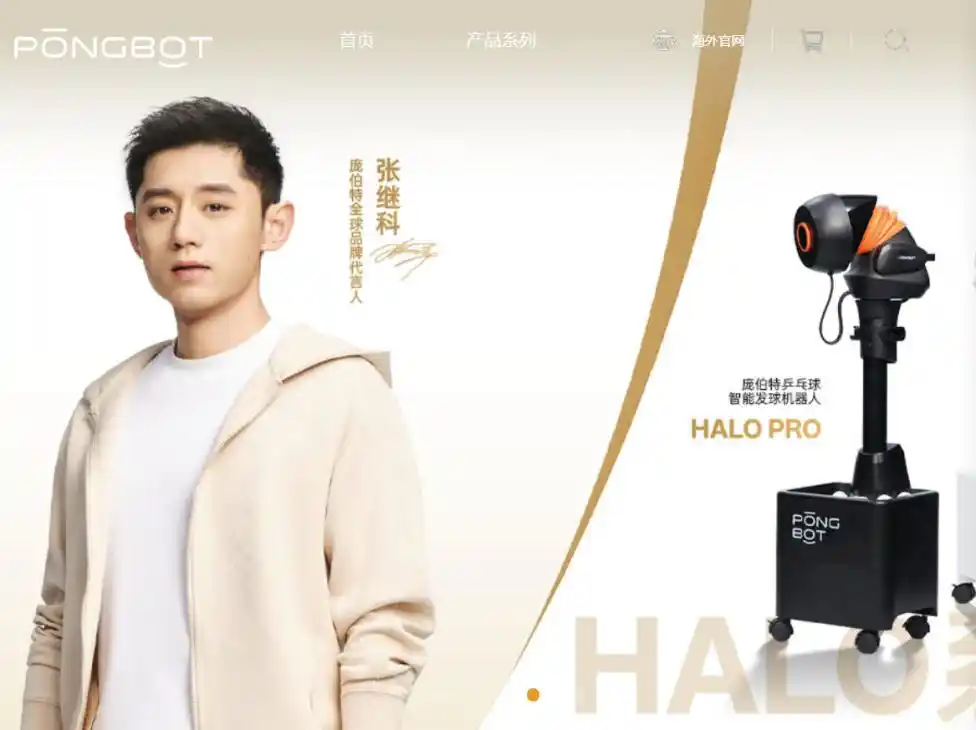
PomBot is operated by Chuangyi Technology, a Shanghai company founded in 2019 that started with table tennis serving robots. In April 2026, the company formally announced Zhang Jike as its global brand ambassador and promoted the product as Zhang’s “AI table tennis coach.”
Its product path then expanded from table tennis into other racket sports. In October 2024, the PACE tennis robot raised $2.7 million on Kickstarter. In May 2026, Aura, an all-in-one model supporting tennis, pickleball and padel, went live and passed $1 million in five hours. It eventually came close to $4 million, setting a crowdfunding record for the tennis robot category.
The company also moved quickly through three financing rounds. Its Series A in May 2025 was backed by China Growth Capital and BlueRun Ventures. The A+ round in August 2025 added Future Capital and Jinqiu Fund. The A++ round in April 2026 came from Shenqi Capital and BlueRun Ventures. Trade media put the combined total of the three rounds at close to RMB 200 million.
In table tennis and tennis, training depends heavily on repeated ball feeding. A robot replaces a clear and familiar part of the process: the sparring partner. That makes the payment logic easier to explain. Skiing and golf work differently. Those products deliver judgment after the fact, so users first need to trust the quality of that judgment.
That is one reason the field has attracted many entrants.
SwitchBot launched the AI tennis robot Acemate in May 2025. Its S10 campaign raised more than $2.4 million and was named one of Time’s Best Inventions of 2025. Trade media, however, reported a ball-collection accuracy rate of about 30%.
In January 2026, Yinghansi Power said it had completed consecutive Series A and A+ rounds worth more than RMB 100 million in total. The Shenzhen company originally focused on exoskeleton robots before shifting toward sports AI hardware.
According to the latest update in the report, an embodied tennis robot jointly developed by LimX Dynamics and Yinghansi Power will make its first appearance at the Billie Jean King Cup Finals on Sept. 22, 2026. The event is the women’s team world cup in tennis. SwitchBot Robotics had been the official partner of the 2025 finals.
Another entrant, Yisi Intelligence, was founded at the end of 2024 and is also building AI tennis robots. Founder Liu Liqian came from DJI. The company completed an angel round in July this year. Its first product, the Aceiilab A1, raised more than $820,000 in overseas crowdfunding and has entered batch delivery.
Behind the rush of new players is a demand gap that has remained open for years.
According to Huxiu, Yinghansi and PomBot together hold more than 80% of the North American market, while total monthly shipments for the category are only 1,000 to 2,000 units. The top of the market is concentrated, but the overall market is still small. What current entrants are betting on is not just a fight over existing share. They are betting that the category can evolve from a ball launcher into a true intelligent training partner.
LUMISTAR moves into basketball, with an investor as founder
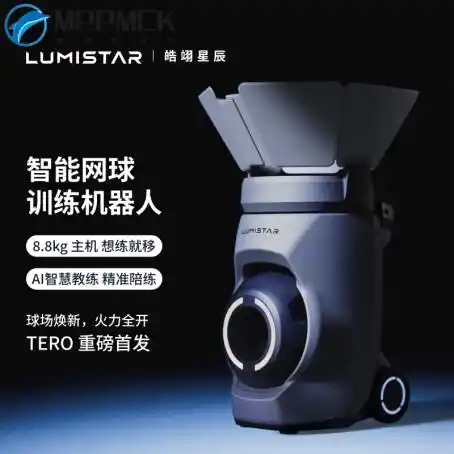
LUMISTAR is operated by Haoyi Xingchen (Shanghai) Robotics Technology, founded in January 2024. The company is headquartered in Shanghai and has R&D and operations in Shenzhen. Founder Hou Haoxiang is also the founding partner and president of Thick Snow Capital, the investor behind Heygo.
The company has two product lines. One is TERO, an AI tennis training partner that combines ball serving, sparring and data analysis, with pricing starting at $1,299. The other is CARRY, an AI basketball training partner built around four 4K cameras that provide 190-degree panoramic vision. It first locates the player, then decides the passing path, and after training it generates more than 20 data points including release angle and shot heat maps. Retail pricing is $4,999.
CARRY launched on Kickstarter in July 2026, raising $600,000 on its first day and finishing above $1 million. More than 90% of buyers came from overseas markets.
Funding has also come quickly. The company completed an angel round in September 2025 from Thick Snow Capital alone, a Pre-A round in March 2026 from Thick Snow Capital and Oasis Capital, and another investment in June 2026 from Lisi Capital. That makes three rounds in less than two years.
Tennis robots are already entering close-range competition, while basketball training remains largely open. Traditional shooting machines still work as fixed-point rebounders. Without someone feeding the ball, practice stops. Even with a feeder, no one may explain what is wrong with the motion. CARRY is aimed at that missing layer.
Direct competition with PomBot may still come later. One is extending into pickleball and padel, the other into basketball, and both have football and badminton on their roadmaps.
The report also mentions Huandong Innovation, a Shenzhen company registered in May 2026. Its direction is outdoor mobile robots for sports scenarios, following an embodied-intelligence route. Its business scope also covers wearable smart devices and smart sports consumer devices. The core team comes from DJI and Anker. It completed an angel round in July 2026 from Shunwei Capital and Songling Robot, whose main business is mobile robot chassis, giving the deal a stronger industrial angle than a purely financial one.
Viewed together, these companies do not share one technical route. They share a choice of entry point. Skiing, golf, tennis and basketball all have expensive professional instruction that is hard to access consistently, and all involve movements that can be broken into data. Running and cycling, where the entry barrier is lower, are mostly absent.
A second branch: AI for recording sports activity
The companies above focus on sparring, assisted training and movement correction. Another group is solving a different problem: recording what the user did in full. The direction is adjacent, but the endpoint is different. Main product types include sports watches, sports glasses and sports cameras.
MossCode and the AI sports watch angle
MossCode is operated by Shenzhen Wuyin Dynamics Technology, founded at the end of 2024. The team comes from EcoFlow, OPPO, Apple, Suunto and Coros. Founder Ni Ruoyang previously worked in investing at Sequoia China, another case of an investor becoming an operator.
The company’s angle is straightforward. Garmin focuses on data during exercise, while Whoop emphasizes recovery. Between the two is a gap, and serious users often end up wearing one device on each wrist. MossCode wants one watch to cover both.
In February 2026, the company raised an angel round worth tens of millions of yuan from XVC and Qingsong Fund. The report says the process from first contact to closing took only one month, and the post-money valuation reached $100 million.
BleeqUp and the sports-glasses route
BleeqUp founder Wu Dezhou was formerly a partner at Smartisan and general manager of Huawei Honor’s product line. He started the company in 2022. In 2024, he concluded that general-purpose AI glasses were within the strike zone of smartphone makers, making direct competition difficult for a startup, so he chose the outdoor sports segment instead.
Its Ranger product went on sale in September 2025. One pair of glasses combines sports goggles, a 16-megapixel action camera, open-ear headphones and real-time intercom.
The company raised a $10 million angel round in July 2023, with Alibaba among the investors. It then completed two Pre-A rounds in May and August 2025, bringing in Niou Capital and Boyu Capital. In February 2026, it raised a further RMB 100 million in a Pre-A+ round from Skyworth Group, Boyu Capital, Tiantu Capital, GF Qianhe and Lenovo Capital.
XbotGo and the auto-tracking camera on the sideline
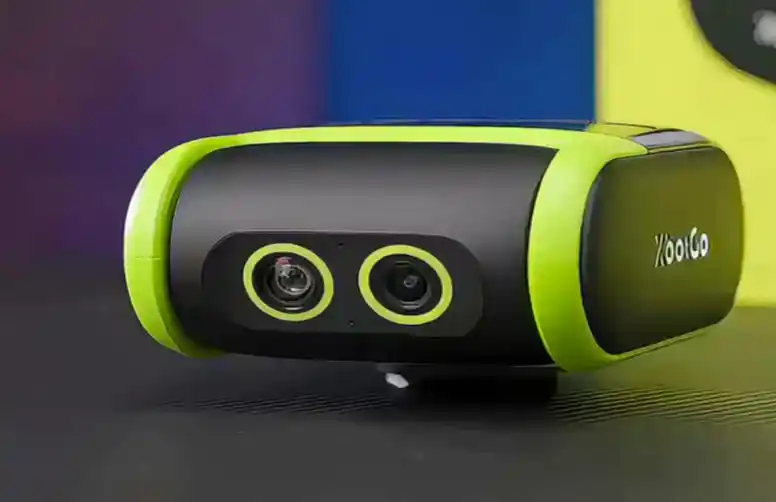
Filming a sports match once meant a camera operator running with heavy gear. Now a smart camera set up on the sideline can use AI to track players and the ball automatically, then cut highlight clips such as goals, three-pointers and penalties with one tap.
XbotGo founder Tan Kefeng holds a PhD in computer science from the University of California. Before returning to China, he was a technical lead at Amazon’s advanced hardware lab, Lab126, and won Qualcomm top technical awards multiple times. His company, Shenmou Yuanzhi, was founded in 2021 and has teams in Silicon Valley, Beijing, Shenzhen and Suzhou. Members come from Huawei, Amazon, ByteDance and DJI.
In 2026, the company launched Falcon, a standalone model with dual-lens 4K shooting and 6 TOPS of edge computing power. It can complete full-session tracking without connecting to a phone. Priced at $299, it raised nearly $2.5 million on crowdfunding platforms. The company says its products cover more than 100 countries and regions and have served more than 100,000 event shoots. Overseas, it also reached an exclusive partnership with sports event management platform TeamSnap.
In May 2026, XbotGo raised a new round worth nearly RMB 100 million, led by Ninebot Capital, with Yuanhe Holdings and Butong Capital participating. Early investor Zero2IPO Ventures oversubscribed, and Yunxiu Capital acted as long-term exclusive financial adviser.
What these three companies share is that they record the full process of exercise, including video, audio and heart-rate data. But after the recording is done, the next step is still left to the user. That is the dividing line in this market: recording is the entry point, judgment is the endpoint. The closer a company gets to judgment, the harder the technology becomes and the higher the ceiling may be.
Why this category has accelerated in the past two years
On the demand side, professional guidance in sports has long been expensive and hard to access.
Global tennis participation exceeded 106 million in 2025, up 21.6% from 2021. In the U.S. market, the ratio of active players to coaches reached 800 to 1, while professional coaches in Europe and the U.S. charge more than $100 per hour. Ski instructors are often billed by the day, and golf coaches by the hour, making long-term use difficult for ordinary enthusiasts.
Human coaches are limited by stamina, time and attention. They get tired, they miss sessions and they can make wrong judgments. Machines do not face those constraints. The gap has existed for decades. What was missing was a low-cost way to fill it.
The first supply-side condition is cheaper and more practical edge computing. BirdieSense uses the Rockchip RDK X5, which provides 10 TOPS of computing power and allows local swing capture and 3D pose analysis with millisecond-level response even without an internet connection. The report argues that the same cost-performance level was not available five years ago.
The second condition is that large models have made language-based guidance possible. Earlier hardware in this category could output many curves and metrics, but users often could not interpret them. Now models can express the result directly in natural language and adjust the explanation to the user’s level.
The third condition is distribution. The combination of overseas direct-to-consumer sites and crowdfunding platforms has lowered the threshold for early hardware startups to test demand. PomBot crossed $1 million in five hours, and XbotGo’s Falcon raised nearly $2.5 million through the same route.
What the report sees in the market now
The technical routes fall into two broad groups.
- One relies on IMUs and sensors to collect body data. Heygo and MossCode fit here.
- The other relies on pure vision to capture visible motion. XbotGo, BirdieSense, and the robots from PomBot and LUMISTAR fall into this group.
The choice depends on whether the key information sits inside the body or appears in visible movement trajectories.
Product form matters less than it may seem. Sports AI hardware is no longer limited to wearables. AI sports glasses, ski-boot clips, sideline cameras, training robots and mobile robots look very different, but most avoid the crowded watch-and-band market and instead enter through narrow scenarios that existing devices cannot measure well.
The concentration of big-tech hardware backgrounds among founders is also striking. Over the past two years, early-stage teams have come from DJI, ByteDance, Huawei, Amazon Lab126 and Smartisan. Amazon Lab126 produced XbotGo. Smartisan produced BleeqUp. DJI alumni founded Aceiilab and Huandong Innovation. ByteDance Feishu alumni founded Heygo. University of Pennsylvania robotics researchers founded PathFinder.
Some investors have also become founders. Hou Haoxiang of LUMISTAR is a founding partner of Thick Snow Capital. Ni Ruoyang of Wuyin Dynamics, the company behind MossCode, is a former Sequoia China investor. The report says this path has appeared repeatedly in consumer hardware over the past two years.
The broader pattern is clear. These startups are trying to extract data that the naked eye cannot easily see and that coaches cannot always describe precisely, then turn that data into feedback users can act on directly. In the report’s framing, that is where AI gives hardware a new layer of value.
This article is adapted from the WeChat public account ITjuzi (ID: itjuzi521), written by Wu Meimei.