
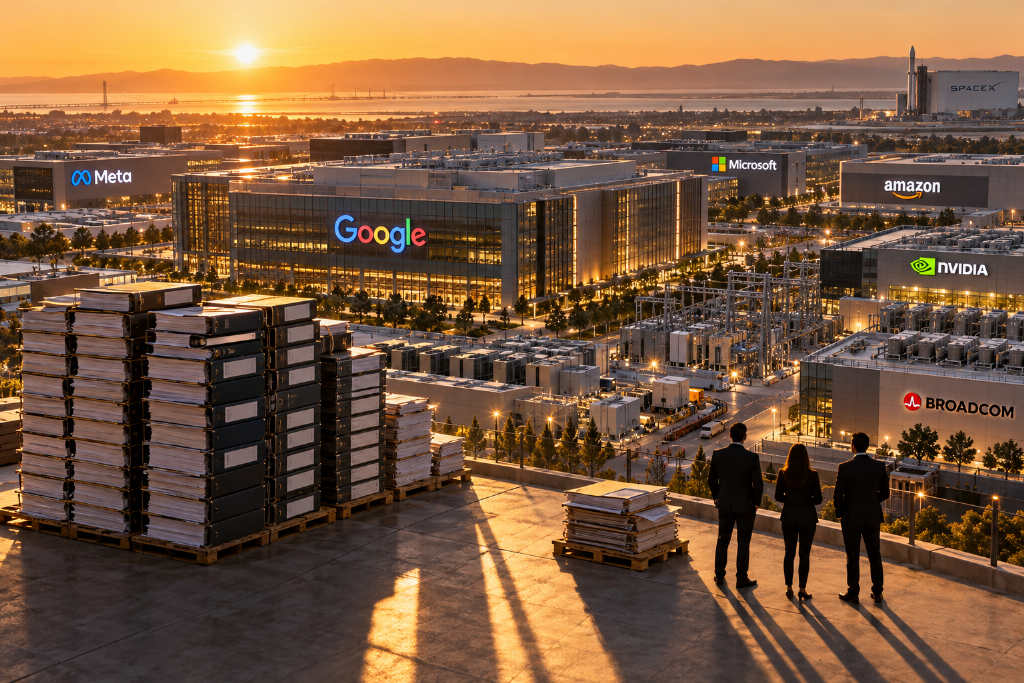
An AI infrastructure spending surge is driving a sharp increase in off-balance-sheet commitments across the largest U.S. technology groups.
Based on the latest quarterly filings, disclosed off-balance-sheet commitments at Alphabet, Meta, Microsoft, Amazon, Nvidia, Broadcom and SpaceX have reached $4.11 trillion. That is up nearly $992 billion from the $3.12 trillion Morgan Stanley counted at the end of August, meaning close to $1 trillion of new commitments were added in about 90 days. If Morgan Stanley’s earlier tally that included commitments cited in news reports rather than formal filings is added back, the total rises to $4.29 trillion.
Those companies also carry about $1 trillion of debt and lease liabilities on their balance sheets. On that basis, every $1 of on-balance-sheet liabilities is matched by more than $4 of commitments that do not appear on the balance sheet.
The current figure is not the ceiling. Nvidia is scheduled to release quarterly results in late November, while Oracle and Broadcom are due in December. None of the three has updated to the latest quarter yet, which means the current $4.1 trillion should be treated as a floor.
Goldman Sachs chief credit strategist Amanda Lynam said investor focus on these off-balance-sheet exposures is continuing to build. She also warned that rating agencies do not treat them in the same way. S&P adjusts leverage for off-balance-sheet leases, while Moody’s and Fitch do not make the same adjustment, leaving potential methodology changes as an issue to watch.
Five companies added $577 billion in a single quarter
A closer look at the five companies that have already filed third-quarter reports shows how quickly the numbers moved. Their combined off-balance-sheet commitments rose from $2.48 trillion in the second quarter to $3.05 trillion in the third, an increase of $577 billion, or 23%.
Meta
Meta added $195 billion, up 29% from the prior quarter. Its non-cancelable purchase commitments jumped from $349 billion to $455 billion, mainly tied to third-party cloud computing capacity for 2027, 2028 and later periods. The counterparties were not disclosed.
Signed leases not yet commenced increased from $279 billion to $356 billion, including $68 billion of leases signed in July. Meta also disclosed $41.5 billion of residual value guarantees tied to joint venture projects at the Hyperion data center in Louisiana and a data center project in El Paso, Texas.
The report noted that Meta, which has $97 billion in operating cash flow and credit ratings of Aa3/AA-, saw its credit default swaps hit a record high after earnings. It then announced an equity financing plan of as much as $95 billion, with $37.5 billion already completed and about $60 billion of at-the-market issuance still to come.
Amazon
Amazon added $131 billion, a 41% increase and the largest percentage gain among hyperscale cloud companies. Its unconditional purchase obligations nearly doubled from $130 billion to $254 billion, including a new $159.6 billion line item for property and equipment. Leases not yet commenced rose from $137 billion to $165 billion.
The main offset came from $21.3 billion still owed to OpenAI, which was recognized in the third quarter and moved onto the balance sheet. The report also said Amazon shares fell sharply last Friday after capital spending came in above expectations.
Alphabet
Alphabet added $164 billion, up 18%. Purchase commitments increased by $95 billion. Leases not yet commenced rose from $85 billion to $131 billion. Energy equipment guarantees doubled from $7.6 billion to $16.2 billion, with maturities extended to 2049, and the company added a new $6.6 billion TPU hardware repurchase guarantee.
Against a backdrop of $80 billion already raised in equity markets and continued negative free cash flow, Alphabet’s off-balance-sheet commitments have now crossed $1 trillion, reaching $1.059 trillion. That makes it the first single company in the group to exceed the $1 trillion mark.
Microsoft
Microsoft added $35 billion, up 6%, making it the most restrained among the group on this measure. It signed about $53 billion of new data center leases in the third quarter, of which $17 billion had already commenced and moved onto the balance sheet. Leases not yet commenced rose from $329 billion to $365 billion.
One caveat remains. Microsoft discloses purchase and construction commitments only once a year in its 10-K, so the current $229 billion figure still reflects the position at the end of June. The actual number is likely to be revised materially higher when the next annual filing arrives. Even so, the report said the “cleanest” hyperscale cloud company still needed to issue $25 billion of bonds recently.
SpaceX
SpaceX added $51 billion, up 174%, the fastest pace in the group. Its off-balance-sheet commitments rose from $29 billion at the end of the second quarter to $40 billion at the end of the third quarter. Then, in an 8-K filed on Oct. 26, the company disclosed a $40 billion Apollo GPU master finance lease agreement scheduled to begin in the first half of 2027, lifting the total to $80 billion.
Rating agencies are not using a single framework
Lynam said that if off-balance-sheet leases and purchase commitments for the five main hyperscale cloud companies are combined, the total has increased eightfold since 2023.
Yet the exposure is not treated consistently in credit ratings. S&P adjusts leverage calculations for off-balance-sheet leases, while Moody’s and Fitch do not apply the same treatment. That leaves any future change in rating methodology as a risk point the market is tracking.
The lack of transparency in accounting treatment is already feeding into market pricing. Research firm Needham said Meta’s enterprise value would rise 35% if off-balance-sheet liabilities were included. After Meta reported earnings, its CDS reached a record high and the company then announced a large equity financing plan.
Lynam also said some companies have made clear they want to lock in capital before the market becomes saturated. The report described that language as a direct footnote to Meta’s equity financing decision, and possibly not the last example.
Three main buckets make up the $4.1 trillion total
The $4.1 trillion can be broken into three broad categories.
- First, signed leases not yet commenced total $1.39 trillion, up from $1.12 trillion in August. These assets are typically data center shells financed by special purpose vehicles, or SPVs, and only move onto company balance sheets once they are energized and begin operating.
- Second, purchase commitments stand at $2.25 trillion, up from $1.73 trillion at the end of August. This category includes Meta’s large commitments for third-party cloud capacity and Amazon’s new property and equipment purchase obligations.
- Third, guarantees and backstop commitments have climbed from $158 billion to $273 billion. These include Alphabet’s energy equipment guarantees and TPU hardware repurchase guarantee, as well as Meta’s residual value guarantees tied to two data center joint ventures.
Market value has fallen as commitments keep rising
Morgan Stanley warned in August that these commitments carry “strategic value” while compute supply remains constrained. But if supply and demand normalize earlier than expected, companies may have to pay for excess capacity or try to renegotiate contract terms.
The market has already started to respond. Alphabet shares suffered a record one-day drop this month, Amazon has continued to weaken, and Nasdaq 100 constituents have lost more than $1.2 trillion in combined market value this month.
Put simply, large technology companies added about $1 trillion of off-balance-sheet obligations in one quarter, and more than $1 trillion of market value disappeared in one month. Those commitments do not vanish when share prices fall. They still have to be paid when due. The central question now is whether AI commercialization revenue can catch up before the next wave of commitments arrives, with the next 10-Q reporting season not far away.


