
The constraint on AI is bigger than power alone
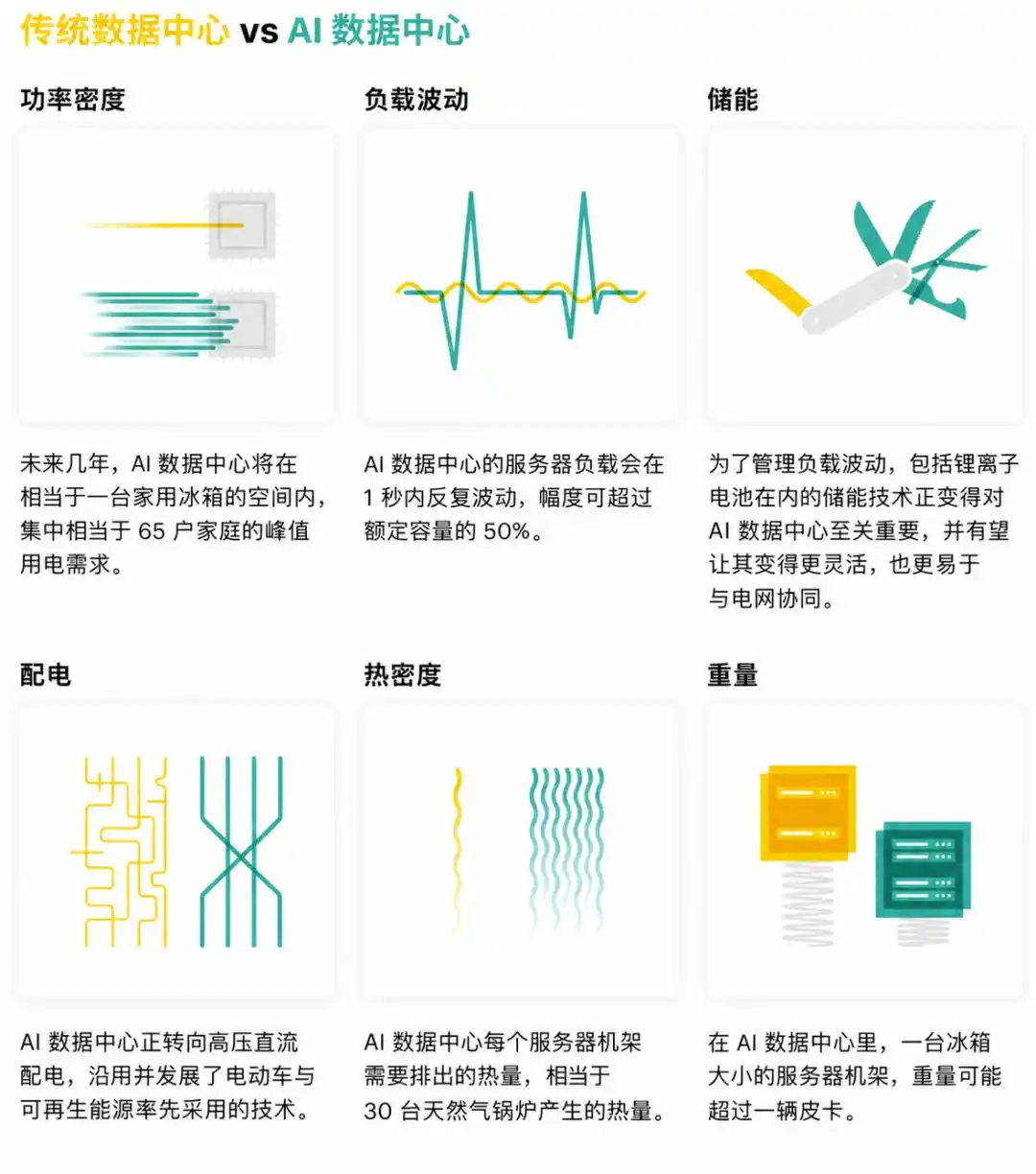
A server rack the size of a refrigerator can now weigh more than a pickup truck. According to the International Energy Agency’s April 2026 report, the next generation of AI data-center racks could reach peak power demand equal to 65 households running electricity at the same time by 2027. To keep those systems from overheating, each rack would need to shed heat comparable to 30 gas boilers.
The same report offered another benchmark. In 2025, capital spending by five tech giants topped $400 billion, and the figure is set to rise another 75% in 2026. That already exceeds annual global investment in oil and gas extraction.
The MarsBit article argues that the industry slogan “the end of compute is power” captures only part of the picture. Electricity is necessary, but the real limit on AI expansion often lies in a full chain that includes generation, grids, transformers, cooling, storage, packaging and capital, with each link moving at a very different speed.
To understand that chain, the article says, it helps to step away from stock narratives about a GPU arms race or generalized power anxiety and return to the physical basics.
From first principles, AI burns electricity into tokens
Strip away the commercial framing and AI, at the physical level, does something simple: it sends electrical energy into transistors, flips bits, performs matrix multiplication and outputs tokens.
On that basis, the article presents a rough expression for “effective intelligence” as the product of four factors:
- available power,
- hardware efficiency, or how much computation each joule can deliver,
- algorithmic efficiency, or how many useful tokens each unit of computation can produce,
- and utilization, meaning how much of the time the machines are actually working.
The formula is not meant to be exact. Its value is that each term maps to a concrete infrastructure layer. Power points to generation and transmission. Hardware efficiency points to chips, memory, packaging and interconnects. Algorithmic efficiency points to model architecture and inference software. Utilization depends on scheduling, cooling and power reliability.
If any one factor breaks down, the others cannot compensate. That is why the bottleneck keeps moving. Two years ago, the problem was getting GPUs. Then it shifted to advanced packaging and high-bandwidth memory, or HBM. Now the pressure is showing up in transformers, gas turbines and grid interconnection queues.
Two physical facts: energy becomes heat, and moving data costs more than computing it
The article starts with energy conservation. Nearly all the electricity consumed by a data center ends up as heat, aside from a tiny share that becomes optical signals or mechanical vibration. In practice, power delivery and cooling are two sides of the same problem. Every kilowatt sent into a rack has to be removed as heat. As rack density rises, traditional power distribution and air cooling are both being pushed to their limits.
The second fact is that moving data is more expensive than computing on it. A classic chip-design estimate cited in the article says that at 45nm, one 32-bit floating-point addition consumes about 0.9 picojoules, while reading the same amount of data from off-chip DRAM consumes hundreds of picojoules, a gap of two to three orders of magnitude.
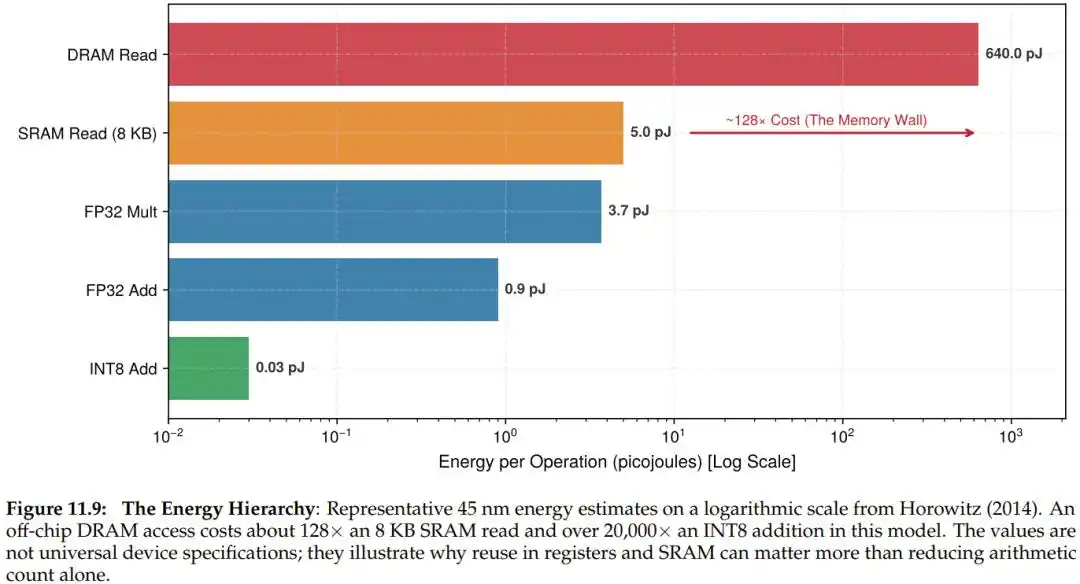
Absolute values have changed with process improvements, but the relationship has not. In modern AI chips, a large share of energy is spent not on “compute” but on “movement.” That is the common logic behind HBM, CoWoS advanced packaging, NVLink, co-packaged optics and supernodes: shorten the distance data has to travel.
As for the physical floor, the article cites Landauer’s principle, which puts the minimum energy required to erase one bit at room temperature at roughly 3×10⁻²¹ joules. Using Nvidia’s Rubin GPU as an example, it notes that a single package can deliver about 50 PFLOPS of FP4 inference performance at around 2 kilowatts. On a rough basis, that implies tens of femtojoules per FP4 operation. Even if one operation is broken into hundreds of bit operations, today’s chips still sit several orders of magnitude above the theoretical lower bound. The article explicitly labels that as a rough estimate for scale only.
Its conclusion is that AI’s energy problem is not a hard collision with physics. It is, at least for now, an engineering, supply-chain and institutional problem. The real constraints show up in factory schedules, grid plans and local council records.
Efficiency is improving fast, but electricity demand is still climbing
On the demand side, the IEA estimates that global data-center electricity use rose 17% in 2025. AI-focused data centers saw power use jump 50%, while total global electricity demand grew only 3% over the same period. In the agency’s baseline scenario, data-center electricity consumption rises from 485 TWh in 2025 to 950 TWh in 2030, or about 3% of global power use. Electricity demand from dedicated AI data centers triples over that span.
At the same time, the report says AI energy efficiency per task has improved at a pace rarely seen in energy history. Advances in hardware and software have cut the energy required for each AI task by at least an order of magnitude per year in recent years.
The article frames that combination as a classic Jevons paradox. The IEA breaks it into three forces moving together: better efficiency, surging usage and new use cases unlocked by higher capability.
Video generation, reasoning models and agentic tasks can consume hundreds or thousands of times more energy per request than simple text generation. Once AI shifts from answering a question to spending half an hour completing a task, the compute cost per interaction moves into a different range.
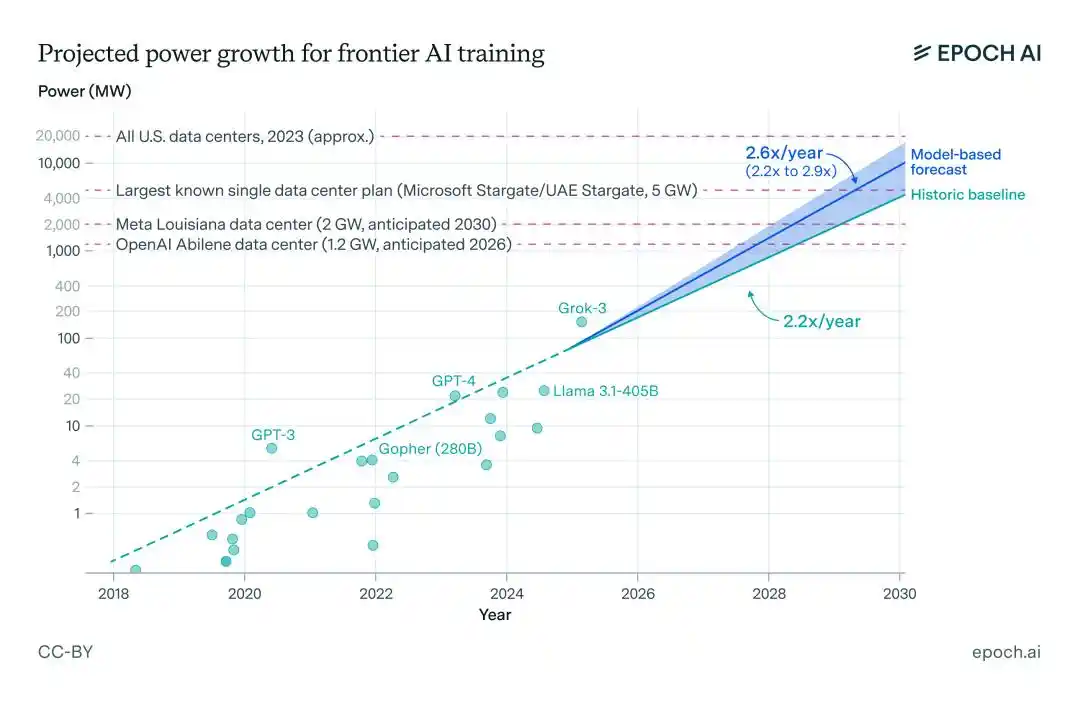
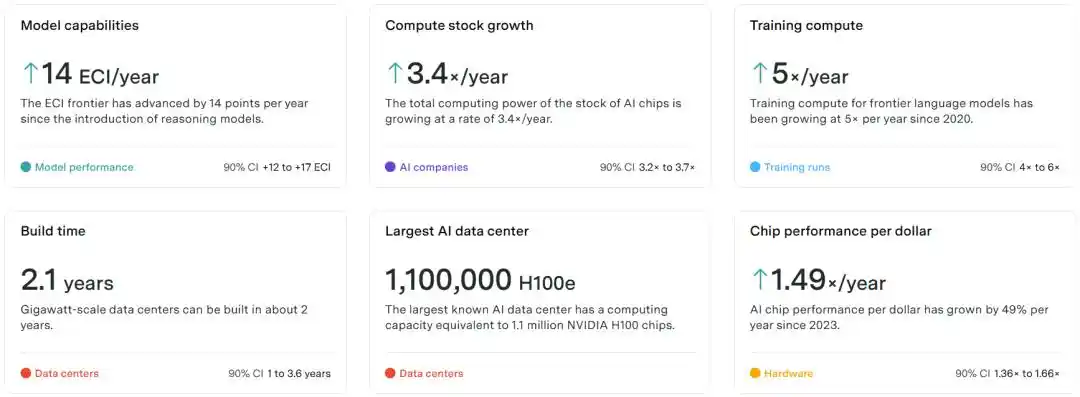
Training is expanding at the same time. Epoch AI estimates that frontier-model training compute has grown by roughly 4x to 5x per year since 2020. After accounting for hardware efficiency gains and longer training runs, the power required for a single frontier training run is still rising at about 2.2x annually. The largest runs now exceed 100 megawatts. If the trend continues, a single run could require 4 to 16 gigawatts by 2030.
Another Epoch AI tracker shows the total compute capacity embodied in the global stock of AI chips growing at about 3.4x per year.
China offers another signal on the inference side. In May 2026, Yu Ying, deputy director of the National Data Administration, said average daily token calls in China had exceeded 140 trillion by the end of March, up more than 1,000x from the end of 2024. At the start of 2024, the figure was about 100 billion. Supply has expanded in parallel. By the end of July 2026, China’s total intelligent computing capacity had reached 2.45 million PFLOPS.
The article adds that the global 3% share does not look alarming on its own. The real stress comes from concentration. In a 2025 report, the IEA estimated that by 2030, data centers would account for nearly half of U.S. electricity demand growth, and U.S. power use for data centers would exceed the combined electricity consumption of aluminum, steel, cement and chemicals.
AI demand moves by the quarter. Grids move by the decade.
If the question is whether the world has enough electricity in aggregate, the article says yes. The issue is speed.
AI data centers are being built much faster. Epoch AI says gigawatt-scale data centers can be completed in about two years. The IEA puts the range at two to three years. The power system runs on a different clock. Delivery times for large power transformers in the U.S. have stretched to as long as four years. Gas turbines take more than three years. New nuclear projects are measured in decades or, at minimum, around ten years.
The article describes this as a mismatch between three clocks: chips iterate yearly, data centers are built in roughly two years, and grids are planned over ten-year horizons. The IEA says the speed of the AI revolution is diverging more sharply from the speed of the physical, social and economic systems that support it.
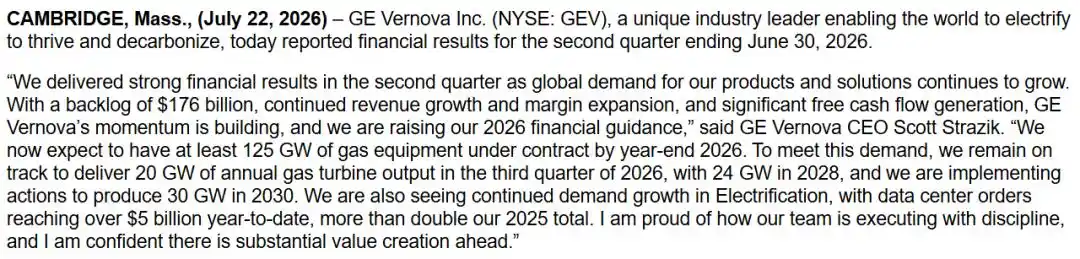
Gas turbines are a clear example. Global gas-turbine orders surged 70% in 2025. In its second-quarter 2026 earnings report, GE Vernova said its gas-equipment backlog plus reserved capacity had reached 116 GW and was expected to hit at least 125 GW by year-end. Its annual production capacity, however, is only expected to rise to 20 GW in the third quarter of 2026, 24 GW in 2028 and 30 GW by 2030.
By simple division, the article says, the current backlog amounts to nearly six years of output. With large units booked out beyond 2028, some developers have turned to reciprocating internal-combustion engines as a second-best option.
Transformers tell a subtler story. They account for a small share of total data-center cost, yet they can determine whether a project is energized on time. PwC analysts estimate delivery times for large U.S. power transformers at up to four years. Upstream, grain-oriented electrical steel for transformer cores has only one domestic producer in the U.S., Cleveland-Cliffs. A supply chain built for two decades of mostly flat load growth is suddenly being asked to serve a customer that revises expectations upward every quarter. Bloomberg reported that of roughly 12 GW of U.S. data-center capacity scheduled to come online in 2026, only about one-third was actually under construction.
Faced with interconnection delays, many U.S. developers are opting to bring their own power. IEA satellite tracking shows that about one-fifth of a group of on-site gas-generation projects at U.S. data centers had already begun site clearing or construction. By 2030, on-site gas could supply 15 GW to 27 GW of power to data centers.
That route is expensive. Because AI loads fluctuate sharply, on-site gas systems need to be oversized by 30% to 70% relative to actual demand to provide stable power.
Nuclear is a longer-dated bet. Microsoft signed a 20-year power purchase agreement with Constellation to restart Three Mile Island Unit 1, now renamed the Crane Clean Energy Center, with generation expected to resume as early as 2027. Meta signed with Constellation to buy 1.1 GW from the Clinton nuclear plant starting in mid-2027. Amazon expanded its agreement with Talen to secure up to 1.9 GW of nuclear power. Third-party tracking cited in the article says major cloud providers have signed about 9.8 GW of nuclear-related agreements.
The IEA also warns that the first small modular reactors, or SMRs, are unlikely to enter service until around 2030. In other words, nuclear addresses the 2030s, not the immediate shortage.
Power scarcity eventually shows up in prices. PJM, the largest U.S. electricity market, covers 13 states and Washington, D.C. Its capacity-market clearing price jumped from $28.92 per megawatt-day for the 2024/25 delivery year to $329.17 for 2026/27. PJM’s independent market monitor estimated that about 40% of the $16.4 billion cost in the December 2025 auction was driven by data-center load. By the July 2026 auction for the 2028/29 delivery year, prices had hit the cap for a third straight time. The article says electricity is turning from an engineering issue into a household and political issue.
Rack density is rising so fast that power delivery and cooling are both being redesigned
If the grid is the external constraint, the inside of the rack is undergoing its own quiet upheaval.
The logic is straightforward. To reduce data movement, GPUs need to sit as close together as possible in larger high-speed interconnect domains. The larger the domain, the more chips are packed into a rack, and the higher the power density. The article presents that as a physical logic with little room for retreat.
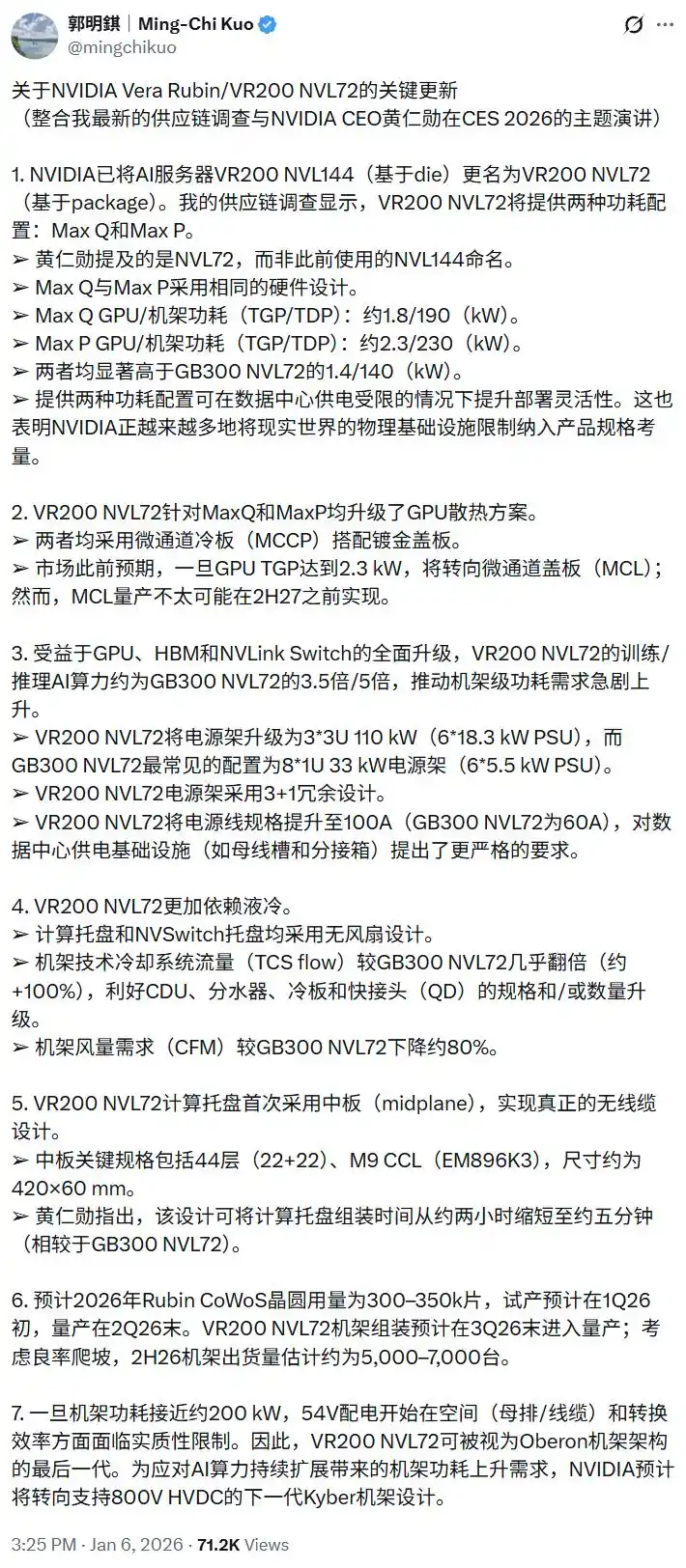
It cites industry estimates showing rack power at about 40 kilowatts in the Hopper era and 120 to 140 kilowatts in the Blackwell era. Supply-chain checks by TF International Securities analyst Ming-Chi Kuo indicate that Nvidia’s Vera Rubin NVL72 rack will come in two power configurations, around 190 kilowatts and 230 kilowatts, both well above the roughly 140 kilowatts of the GB300 NVL72. The 2027 Rubin Ultra “Kyber” rack is widely expected to reach about 600 kilowatts. The IEA says AI server power density increased 11-fold from 2020 to 2025 and will quadruple again by 2027.
Nvidia’s own blog describes the Vera Rubin NVL72 more like industrial equipment than a computer: about 1.3 million components, nearly 1,300 chips and a weight of roughly 4,000 pounds, or about the same as a pickup truck.
That density is breaking both the power-delivery system and the cooling system at the same time.
On the power side, Kuo says that once rack power approaches 200 kilowatts, traditional 54-volt distribution runs into hard limits in busbars, cable space and conversion efficiency. That is why Vera Rubin NVL72 may be the last generation of the Oberon rack architecture. The physics is simple: transmitted power equals voltage times current, and line losses scale with the square of current. Raise the voltage and more power can move through less copper. That is the reason the industry is shifting toward 800-volt high-voltage DC distribution. The IEA notes that AI data centers are borrowing from electric vehicles and renewable-energy systems as they move in that direction.
On the cooling side, heat loads in the hundreds of kilowatts are beyond the practical limit of air cooling. Full liquid cooling is moving from optional to standard.
The article also points to a newer issue that gets less attention: load volatility. The IEA found that server loads in AI data centers can swing by more than 50% of rated capacity within a second. Thousands of GPUs switch in sync between compute phases and communication phases during training, making the facility look like a giant electrical switch to the grid. That is one reason battery storage is becoming standard equipment. By 2030, global data centers could contain 20 GW to 25 GW of battery storage. With the right incentives, those batteries could become grid-balancing assets rather than just backup systems.
One symbolic detail stands out. Kuo says Vera Rubin will offer “Max Q” and “Max P” power configurations to fit different data-center power conditions. In the article’s reading, chip specifications are starting to bend to the electrical realities of the machine room. Data centers are becoming power-electronics systems, not just buildings full of servers, and chip companies are being pushed toward power engineering as well.
Why the bottleneck moved from GPUs to memory and packaging
Inside the rack, one of the least intuitive developments of the past two years is that the scarcest part of an AI chip stack is often not the compute core.
The reason again comes back to data movement. In large-model inference, especially during token-by-token decoding, the bottleneck is often how quickly model weights and context caches can be pulled from memory. That is the memory wall.
The solution is to stack DRAM vertically into HBM and use advanced packaging such as CoWoS to place memory and GPU on the same interposer, shrinking the data path from centimeters to millimeters.
The cost of that approach is that it drags the broader memory industry into shortage. The IEA said in its April 2026 report that HBM shortages had formed rapidly over the prior six months and were expected to last at least through the end of 2027. SK Hynix said as early as October 2025 that all of its 2026 capacity had already been sold out. Market researcher TrendForce estimated in early 2026 that average DRAM prices in the first quarter would rise 50% to 55% quarter over quarter.
Because the same wafer capacity yields far fewer bits when used for HBM than for conventional memory, AI demand for HBM is squeezing supply for phones and PCs. IDC says memory accounts for about 15% to 20% of the bill of materials in a mid-range smartphone. The article describes this as a strategic reallocation of wafer capacity that is reversing a long-running trend of trickle-down specifications in consumer electronics.
Advanced packaging is another choke point. The article estimates that TSMC’s monthly CoWoS capacity will reach about 130,000 wafers by the end of 2026 and could double to about 260,000 by 2028, up from roughly 35,000 at the end of 2024.
Even with nearly a fourfold expansion in two years, capacity remains sold out. Morgan Stanley estimates Nvidia controls about 60% of CoWoS capacity. Kuo estimates that the Rubin platform alone will require 300,000 to 350,000 CoWoS wafers in 2026.
From a first-principles perspective, the article says, this shift is unavoidable. As Moore’s Law slows, gains in transistor density on a single die become harder to achieve. Performance growth increasingly comes from putting more silicon and more memory into one package, then linking more packages into a larger interconnect domain. The manufacturing bottleneck has therefore moved from front-end lithography to memory stacking and advanced packaging, processes that used to be treated as back-end steps. TSMC is now pushing larger-area panel-level packaging under CoPoS, while optical interconnect is moving from between racks toward the edge of the package itself. Each step is still about reducing distance.
Capital is now part of the infrastructure bottleneck
Power, heat and chips are tied together by capital.
The article says several institutions use slightly different accounting methods, but the direction is the same: Amazon, Alphabet, Microsoft and Meta are on track for combined capital expenditure close to $700 billion in 2026. The IEA argues that data-center investment has become too large to be supported by corporate balance sheets alone and will require heavy reliance on capital-market financing. That makes the pace of AI power growth highly sensitive to market sentiment, return expectations and broader financing conditions.
Cash-flow pressure is already visible. CNBC reported that Alphabet’s capital expenditure in the first half of 2026 rose 111% year over year to $98 billion, pushing free cash flow negative for the first time in the second quarter. Analysts expect Microsoft’s free cash flow to turn negative in the fourth quarter as well.
The article then asks a more practical question: how much of the “gigawatts” announced on paper are actually energized? It uses OpenAI’s Stargate project as an example. The project has been described as a $500 billion, 10 GW buildout, with its flagship site in Abilene, Texas. Based on satellite imagery, Epoch AI estimated that as of March 2026, the Abilene site had about 0.3 GW of operating capacity against a planned full-load capacity of 1.2 GW. Another report, citing OpenAI’s chief financial officer, said the company’s total effective compute capacity across all sites and partners was about 1.9 GW by the end of 2025.
“Contracted,” “under construction” and “energized” are three very different states, the article says, and many of the industry’s biggest numbers refer only to the first. Confusing them can create both false boom narratives and false collapse narratives.
Another detail shows how power is changing the cost stack. According to reports cited in the article, Crusoe’s chief executive said its Abilene data center, including the associated gas plant, costs about $19.2 billion per gigawatt, roughly double the $9 billion to $11 billion per gigawatt for a traditional grid-connected “powered shell.” If that figure is accurate, then in a self-generation model, power is no longer a supporting cost. It sits alongside chips as a primary cost item.
Local opposition may be the slowest constraint of all
Beyond power, heat, chips and money, the article identifies another limit that engineering cannot solve directly: whether local communities are willing to host these projects.
Data Center Watch estimates that in the first quarter of 2026, at least 75 U.S. data-center projects were blocked or delayed by local opposition, representing about $130 billion in value, roughly equal to the scale seen in all of 2025. The number of active opposition groups doubled from 396 at the end of 2025 to 833, spanning 49 states. In the second quarter, at least 45 more projects worth about $68 billion were affected, bringing the first-half total close to $200 billion. In the first six weeks of 2026 alone, state legislatures introduced more than 300 data-center-related bills, and 14 states saw proposals for statewide construction pauses.
Residents are objecting for many reasons: higher power bills, water use, noise, land consumption and emissions from the growing number of bring-your-own-power projects that rely on gas generation.
The IEA offers a more balanced view. In systems with excess power supply, stable new load can spread fixed grid costs and lower electricity prices. In tighter regions, though, fast data-center construction, uncertain load profiles and inflated interconnection requests can push prices higher.
This is the slowest constraint because it cannot be accelerated with purchase orders or financing. Transformers can be produced faster. Gas turbines can be manufactured on overtime. Trust has to be rebuilt one community at a time. In that sense, whether data centers can shift from being seen as a burden on the grid to a resource for the grid — by adding storage, participating in demand response or paying for grid upgrades — may determine the ceiling for the next expansion cycle.

Could orbital data centers bypass the ground bottleneck?
If first principles are pushed to the limit, the article says, a natural question follows: if the constraints are power, cooling and land, why not move compute to a place with near-constant sunlight and no neighbors to complain?
That is the logic behind orbital data centers. Google unveiled its “Suncatcher” plan in November 2025, proposing satellites equipped with TPUs in sun-synchronous dawn-dusk orbit. Google said solar panels in the right orbit could generate up to eight times as much power as on the ground, and reports said it had discussed launch cooperation with SpaceX.
The article says Google has already run inference on an in-orbit TPU and produced “a haiku about being in space.” SpaceX went further, filing with the U.S. Federal Communications Commission in January 2026 to deploy as many as 1 million data-center satellites. Startup Starcloud had already put an H100 into orbit in 2025. In China, the “Three-Body Computing Constellation” has launched its first 12 computing satellites and deployed multiple AI models in orbit. Alibaba’s Qwen3 has also been deployed to a space computing center through Guoxing Aerospace’s “Star Computing Plan” and completed end-to-end inference in orbit.
Physics still imposes limits. In a vacuum there is no convection, so heat can only be removed through radiation, which requires very large radiator panels. Frontier-model training needs thousands of chips to synchronize gradients at every step, demanding bandwidth far beyond current inter-satellite links. Launch cost remains decisive. Google’s own paper assumes launch prices may not fall below $200 per kilogram until the mid-2030s.
The better interpretation, the article says, is that space data centers are not an answer to “not enough energy.” They are an answer to “grid connection is too slow” and “social permission is too hard” on Earth. The real scarce resource in AI infrastructure is energy that can be connected to computation quickly, legally and reliably.
The slowest link sets the pace
The article closes by revisiting the phrase “the end of compute is power” and offering a fuller version: as long as token demand grows faster than gains in unit efficiency, the electricity line item in AI will keep rising. What determines how fast a country or company can move is the speed of the slowest link in the chain.
Over the past three years, the migration of bottlenecks has been clear: first GPUs, then HBM and CoWoS, and now transformers, gas turbines and interconnection queues. The next bottleneck could be money if capital markets lose patience before infrastructure catches up. It could be permitting if local opposition keeps spreading. If annual chip generations continue to outpace the three-year build cycle of machine rooms, the risk could even become stranded assets — facilities that cannot accommodate the next generation of hardware by the time they are finished.
No single technology solves the problem in one move. The article’s broader point is that AI competition is no longer just a race in models and chips. It has become a systems race spanning energy, manufacturing, finance and governance. The most overestimated factor is often the headline breakthrough. The most underestimated are the quiet links in the chain: a transformer, a sheet of grain-oriented electrical steel, a planning permit.
The original article was credited to the WeChat public account “机器之心” (ID: almosthuman2014), with the author line shown as “关注AI Infra的”.


