
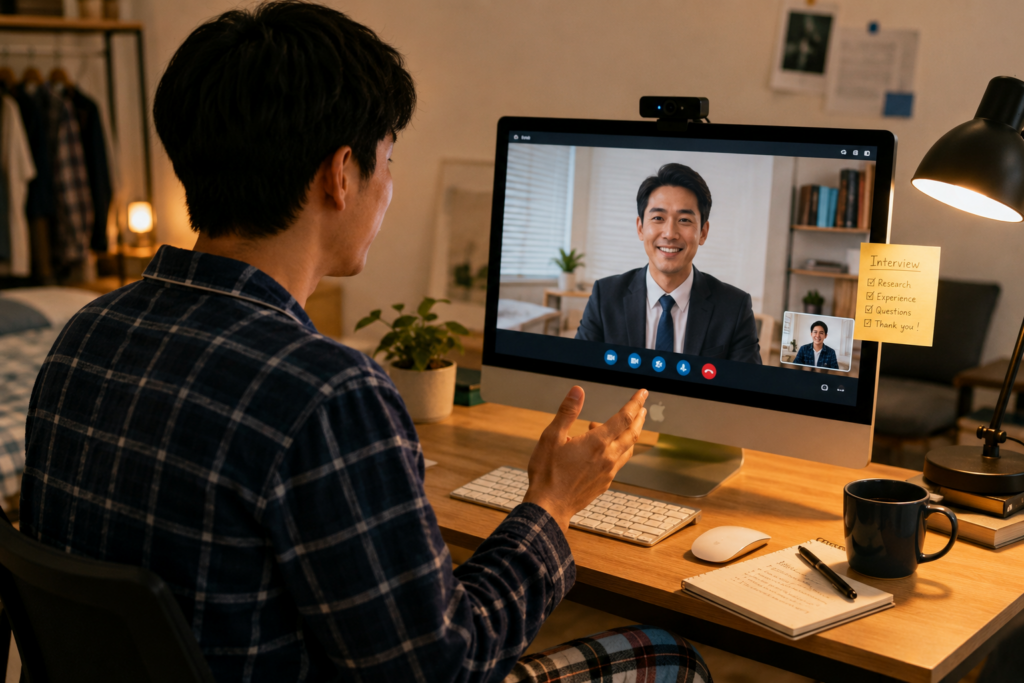
Job interviews at 1 a.m., sometimes done in pajamas, are no longer an odd edge case. WIRED reported that as AI interviews become a first-round screening tool for more employers, candidates are starting to book interviews whenever they want, including in the middle of the night, because there is no human interviewer whose workday needs to be respected.
Always-on interview systems are changing candidate behavior
Traditional interviews usually have to fit the schedules of recruiters and hiring managers. For people who already have jobs, that can mean taking leave or making excuses just to attend an interview.
AI interview platforms now market themselves as available 24 hours a day. Candidates can open an interview after work, after putting children to bed, or during a sleepless late-night stretch. For international applicants moving across time zones, or workers trying to switch jobs while staying employed, that flexibility addresses a long-standing scheduling problem.
Survey data cited in the report shows that if an AI interview can deliver a result within 48 hours, nearly half of job seekers, 47.9%, would rather choose that route than wait two or three weeks for a human interview process to move forward.
Recruiting firms are putting AI deeper into the screening stack
The shift is tied to rapid growth in AI recruiting tools. By 2026, 96% of U.S. recruiting professionals were using AI in their work, and about 21% to 23% of companies were letting AI handle the first round of interviews.
HireVue processed about 20 million assessments in the first quarter of 2024 alone. Apriora, a startup behind an AI interviewer named Alex, says the system can ask follow-up questions in real time and conduct as many as 1,000 interviews a day. The company has also raised $17 million in Series A funding. Another startup, Ribbon, focuses on voice and video AI interviews that run continuously around the clock.
Priya Rathod, an editor at job market intelligence platform Indeed, said AI interviews are already common in customer service, retail and entry-level tech roles.
Efficiency is drawing employers in, but many candidates dislike the experience
Convenience has not removed the sense of distance. Wafa Shafiq, a job seeker in Canada, found out only after receiving a confirmation email that the interviewer for a marketing role would be Apriora’s Alex. She described the experience as “cold but efficient” and said it felt “a little dystopian.”
Kendall McGill, a job seeker in Baltimore, hung up after realizing the voice on the other end of the phone was AI. “I’d rather talk to a person,” McGill said. Debra Borchardt, a 64-year-old veteran editor, quit an AI interview in less than 10 minutes and called it “an extra insult to job seekers.”
The resistance is now showing up in survey results. A May 2026 survey found that 38% of U.S. job seekers had dropped out of a hiring process because it included an AI interview. Only 12% said they would simply go along with it if required. TikTok is also filled with videos from candidates describing negative experiences, with “talking to a robot about life plans” becoming a common target of frustration.
Transparency and bias concerns are moving to the center of the debate
Matthew Bidwell, a management professor at the Wharton School of the University of Pennsylvania, warned that large language models contain racial and gender bias, and said using them to screen and assess candidates is “concerning.”
Career expert Keith Spencer said AI interviews “should not be a surprise.” Employers, he argued, should at least tell candidates in advance and provide guidance on how to prepare, because the first step of the process shapes how applicants view a company’s culture.
AI is now active on both sides of the hiring market
The change is not limited to employers. Survey data shows that 74% of U.S. job seekers are also using AI during their search. In response, 79% of recruiters said AI-generated content should be regulated.
The result is a direct pull between human expectations and operational speed. Employers want faster screening. Candidates want more freedom over timing. But once the interviewer is a machine rather than a person, questions about acceptance, transparency and fairness become part of the hiring process itself.