
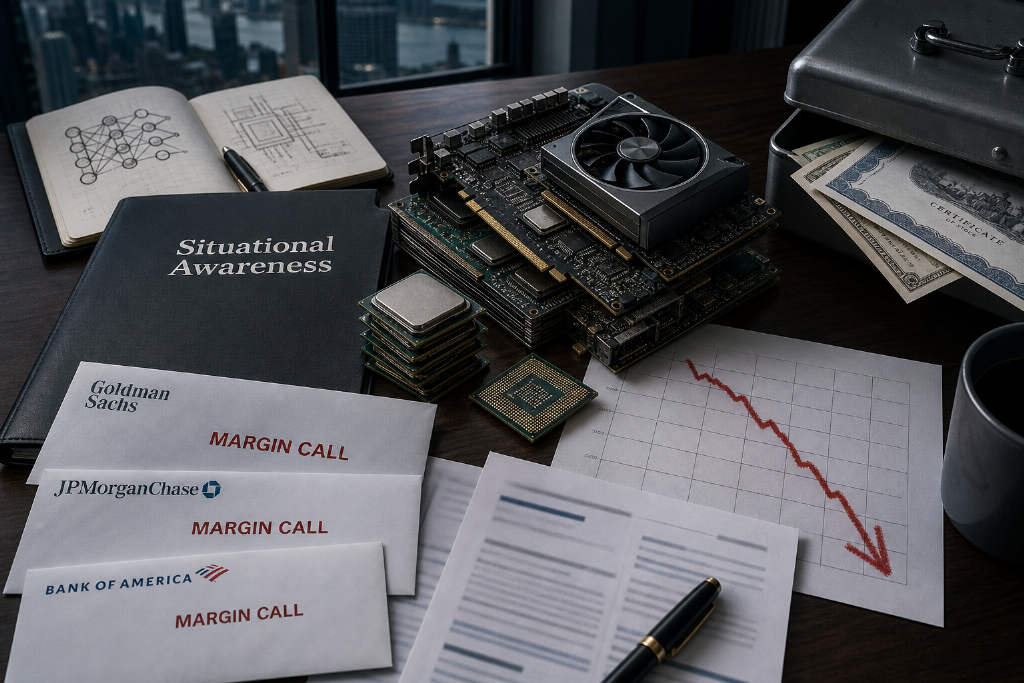
Situational Awareness, the hedge fund founded by former OpenAI researcher Leopold Aschenbrenner, came close to collapse in late July after a sharp reversal in semiconductor stocks hit its leveraged AI trade.
The fund told investors in an email that 「we are one step away from permanent capital loss.」 SA had grown from $1.5 billion to $45 billion in assets within a year and, six months earlier, was still being treated as one of Wall Street’s standout AI investing success stories. But after the semiconductor downturn in July, the fund lost 67% of its investment gains in a week and was forced to sell public-market holdings to relieve margin pressure and avoid being liquidated by its banks.
From OpenAI researcher to AI fund founder
Public reports cited in the article said Aschenbrenner graduated from Columbia University at 19, ranking first in a double major in economics and mathematical statistics, before joining OpenAI’s Superalignment team. That group was co-led by former OpenAI chief scientist Ilya Sutskever and Jan Leike and focused on the safety problem of aligning superintelligent AI with human values.
OpenAI dismissed him in April 2024 for what it described as improper disclosure of internal information. Two months later, he published the 165-page report Situational Awareness: The Decade Ahead, which drew broad attention in Silicon Valley and later helped him raise capital.
The article said Aschenbrenner often spoke at dinner gatherings in San Francisco about his dream of buying a galaxy. He believed AI was advancing so fast that humanity would not be far from colonizing other planets, and that he needed to start accumulating money now. SA became the vehicle for that ambition.
Investors lined up behind him. The Collison brothers, co-founders of Stripe, former GitHub CEO Nat Friedman, and quantitative trading giant Jane Street all backed the fund.
Assets surged to about $45 billion in less than two years
Position-tracking data cited in the piece showed SA started in June 2024 with $383 million in seed capital. By the first quarter of 2026, assets under management had climbed to about $45 billion. Fewer than 20 people built a fund that, in under two years, matched the scale of many firms that had spent decades getting there.
SA’s strategy was simple on the surface. It went long hardware and compute names expected to benefit from AI infrastructure spending, including SK Hynix, CoreWeave and Micron. It shorted software companies seen as vulnerable to AI substitution, including Adobe and AppLovin.
The article argued that this structure looked hedged but in reality acted more like an amplifier of a one-way bet. The long and short books were both driven by the same factor: market confidence in AI.
When the market was rising, the trade produced extraordinary returns. The fund’s gain for the year at one point reached 439%. According to an exclusive Wall Street Journal report cited in the story, SA used leverage aggressively and at times could borrow about $3 against every $1 of its own capital. Goldman Sachs, JPMorgan Chase, Bank of America and Citigroup all provided financing. Goldman even presented SA as a model case to clients at its emerging managers conference in March 2025.
The piece also said Jefferies and Barclays turned down the business. One prime brokerage executive, after meeting Aschenbrenner, reportedly said his unshakable confidence was itself a danger sign.
The “best buying opportunity” turned into an exit window
By mid-July, Wall Street had started to reassess the logic behind AI infrastructure capital expenditures. On July 24, the semiconductor sector entered a clear correction.
According to the Financial Times, Aschenbrenner sent investors a reassuring note that day, calling the drop 「the best buying opportunity in the past year」 and inviting them to add money starting Aug. 1.
That call quickly unraveled. Within days, the Philadelphia Semiconductor Index had fallen 28.6% from its late-June high. SA’s major holdings, including SK Hynix, Sandisk, Bloom Energy and Nebius, were each down more than 30% for the month. Losses mounted across the portfolio, and leverage magnified the damage.
On the morning of July 30, Goldman Sachs, JPMorgan Chase and Bank of America simultaneously issued margin calls to SA. The Wall Street Journal reported that the previous day the fund had urgently approached Anthropic shareholders including Sequoia and Greenoaks to discuss a discounted sale of private equity stakes. At the same time, it was negotiating a separate transaction with Citadel, whose founder and CEO Ken Griffin joined the call from London.
A deal completed 20 minutes before the market opened
The two sides finalized the transaction in the early hours of July 30. Citadel bought all of SA’s public-market positions at about a 10% discount. The agreement was signed at 9:10 a.m., leaving just 20 minutes before the U.S. stock market opened.
That timing mattered. Once the market opened, banks no longer had to unwind SA’s positions in the ordinary course by selling them out into the public market. The transaction helped avert a broader chain reaction that could have dragged other funds into forced selling.
After the sale, SA’s asset base fell from its $45 billion peak to about $10 billion. Public reporting cited in the article said SA’s private Anthropic stake was not included in that liquidation, and outside observers saw it as the fund’s remaining core asset.
Why the hedge failed
One of the first questions after SA’s losses became public was why its hedging framework did not slow the drawdown.
A normal hedge requires two positions to react in opposite directions to the same shock. SA instead was long AI beneficiaries and short AI casualties. The problem, as the article framed it, was that both sides responded in the same direction to swings in confidence around the AI theme.
That meant the short book did not offset risk in the way investors might expect. It increased it.
John Pfeffer, founder of family office Pfeffer Capital and one of SA’s investors, publicly defended the approach by saying it was never designed for conservative pension money and that everyone involved understood it would be volatile.
Still, the scale of the move appears to have been underestimated. When semiconductor shares fell in July, SA’s long positions were losing money, while software stocks categorized as AI losers moved up, causing losses on the short side as well. The result was a collapse in returns from a 439% peak to 80%.
The article described this kind of “false hedge” with a term used on Wall Street: “Texas hedge,” a sarcastic label for a structure that resembles a poker bet more than a true hedge.
It added that Wall Street has seen versions of this before, from the bursting of the internet bubble around the turn of the millennium to the collective breakdown of quantitative funds in 2008.
Concentration, leverage and liquidity collided at once
Based on SA’s disclosed holdings in the first quarter of this year, more than 60% of the fund’s risk exposure was concentrated in a small number of AI-related stocks, combined with roughly 3x leverage. The fund’s private Anthropic stake could not be monetized quickly and could not be used to satisfy intraday margin demands, which made liquidity a central weakness at the worst possible moment.
High concentration, high leverage and medium-liquidity assets are each standard risk factors in fund management. On their own, they can sometimes be absorbed. Piled on top of one another, they leave little room for error.
The article’s conclusion was blunt: even a short adverse move can create a squeeze in which losses accumulate fast, assets cannot be sold in time and margin cannot be posted quickly enough. That is how SA went from the start of the decline to a forced fire sale in less than two weeks.
According to the Wall Street Journal, Jane Street, one of SA’s investors, took about $6.5 billion to $7 billion in mark-to-market losses in July because of the fund’s drawdown.
AI investing now faces a risk review
Bank of America CEO Brian Moynihan told CNBC this month that the episode was a warning sign and that mainstream brokers needed to review their exposure to AI-themed funds.
There were also more constructive takes. The Financial Times said that even after the size of the correction, SA’s central call on rising demand for memory chips, data centers and computing power had not been disproven.
But the article ended on a different point. A trade can be right in the long run and still fail under leverage if the investor cannot survive the path in between.
SA was still up about 80% for the year at the end of July. Yet that number only mattered because the fund remained alive. Without Citadel’s intervention, the article said, SA would most likely have been forced out by its banks.
The crisis leaves a broader question behind. It is no longer only about whether Aschenbrenner was right on AI. It is about whether capital markets will keep overlooking this kind of systemic risk while chasing the next “certain” AI narrative.