


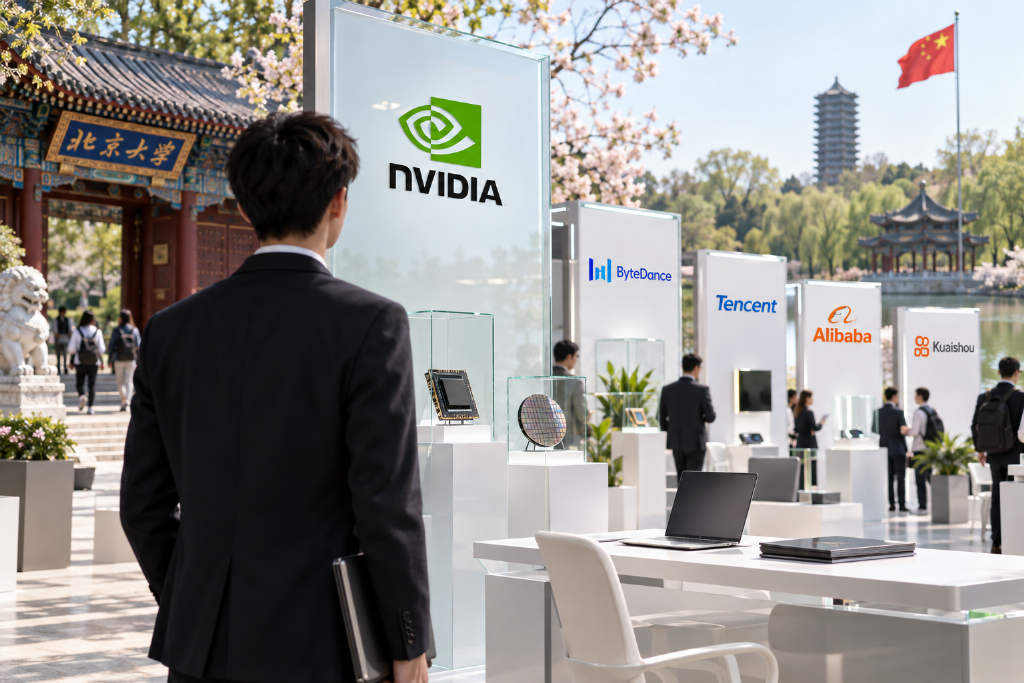
China’s hunt for elite AI talent is driving graduate pay sharply higher, with recruiters cited by MarsBit saying the best new hires from top universities can command annual packages of 8 million to 9 million yuan.
One recent example came from a social media submission that circulated widely online. It said Nvidia had offered a 2026 PhD graduate from Peking University about 2.9 million yuan in first-year pre-tax compensation for an AI computing chip R&D role.
Nvidia offer fuels discussion over AI graduate pay
According to the report, the leaked offer was for a PhD in integrated circuits at Peking University graduating in 2026. The package was said to include a signing bonus and a performance bonus, and the candidate could be assigned to Nvidia’s Silicon Valley headquarters after two years on the job.
The authenticity of the offer became a topic of debate online. MarsBit said that five years ago, total campus-hire packages for PhDs at Nvidia China were usually around 450,000 yuan to 600,000 yuan. At that time, a Tsinghua University computer science PhD who joined a core technical role at Nvidia China reportedly received a 550,000 yuan annual package, excluding stock, which was considered on the higher side of a normal range.
The comparison shows how much compensation has moved during the AI boom.
Recruiters say top candidates now reach 8 million to 9 million yuan
The report quoted several headhunters as saying Chinese internet companies are showing even stronger demand for fresh PhDs from prestigious schools. One recruiter said a newly graduating PhD interning in ByteDance’s Seed program could receive a package of about 2 million yuan. Several recruiters said annual compensation in the millions of yuan is no longer unusual for new PhDs from Peking University and Tsinghua University.
One example involved a graduating PhD focused on large models at Tsinghua University’s Institute for Interdisciplinary Information Sciences, where starting pay could reach 4 million to 5 million yuan. The report noted that the institute is led by Turing Award winner Andrew Yao and focuses on computer science, AI and quantum information. It also runs the Tsinghua Computer Science Experimental Class, widely known as the Yao Class. The article named Wu Jiajun, Tencent chief AI scientist Yao Shunyu, Pony.ai co-founder Lou Tiancheng, StepFun chairman Yin Qi and Meshy AI founder Hu Yuanming as alumni.
A recruiter identified as Amy gave MarsBit a rough market pay ladder for new PhDs from top schools. In her account, more ordinary candidates are now above 2 million to 3 million yuan a year, preferred candidates are above 5 million to 6 million yuan, and the very best are above 8 million to 9 million yuan.
The report also said a fresh graduate in large models from a Project 985 university received a 6 million yuan offer from Xiaohongshu despite holding a master’s degree, not a PhD. It added that JD.com had even produced an 8 million yuan annual offer for a new graduate. Amy said that reaching this pay level requires more than a prestigious academic background. Top conference and journal papers, competition results and hard-core research directions also matter.
Embodied AI roles are expensive as well
High pay is not limited to large language model work. John, a recruiter in the embodied intelligence sector, said compensation varies by specialization. He said some embodied algorithm “cerebellum” roles come in around 1 million yuan a year, while positions focused on world models are generally above 1.5 million yuan.
Earlier this year, Xinghaitu partner and CFO Luo Tianqi said during a media group interview that the company had offered total packages as high as 5 million yuan to several newly graduating PhDs, putting it in direct competition with leading AI giants for top research talent.
Why companies are willing to pay so much
The report pointed to the economics of model development. Building an AI model can cost hundreds of millions of dollars, and training a next-generation model such as GPT-5 could exceed $500 million. Against that backdrop, a top researcher who improves a training strategy may save tens of millions or even hundreds of millions in computing costs.
MarsBit also cited DeepSeek technical reports as examples. It said the DeepSeek-V3 report attributed training efficiency to coordinated optimization across algorithms, frameworks and hardware, while the V4 report disclosed engineering acceleration results relative to a baseline. In the report’s framing, those cases show how technical and engineering choices can materially affect the efficiency of compute spending.
That is why companies are not simply paying for labor. They are paying for scarce technical judgment and for a better chance of keeping pace in the next phase of AI competition.
ByteDance, Tencent, Alibaba and Kuaishou are all stepping up hiring plans
The article said major Chinese internet companies have made their AI talent programs more visible this year.
- ByteDance has launched its 2026 “Top Seed” campus hiring program for top large-model talent, recruiting about 30 outstanding PhD students in areas such as large language models, machine learning algorithms and systems. The company said it wants to find the top 5% of people in the large-model field to do what the other 95% cannot.
- Tencent has introduced the “Qingyun Plan” for top technical students worldwide. The program offers tailored training paths for graduates, access to work on core businesses and what the company describes as highly competitive pay tied to forward-looking technical topics.
- Alibaba and Kuaishou are also advancing their own elite talent tracks, named the Alibaba Star top talent plan and the Kuai Star top technical talent plan.
The report added that some of these programs include students who are still in their third year and have not yet graduated, with some reportedly receiving compensation in the millions of yuan. In Tencent’s Qingyun Plan, it said, PhDs working on post-training have an average annual salary of 3 million yuan.
Heavy corporate spending meets a changing supply pipeline
The salary battle is backed by aggressive AI investment. According to figures circulating in the market and cited by the report, ByteDance’s 2026 AI investment budget is close to 160 billion yuan. Alibaba has announced 380 billion yuan in spending on AI and cloud computing over three years, together with additional capital expenditure.
Tencent’s quarterly spending on AI infrastructure has also exceeded 100 billion yuan, according to the report. On Oct. 8, there was also a report that Tencent Holdings was considering an offshore bond sale of as much as $5 billion, possibly launching as early as that month, though the final use of proceeds had not been determined. The MarsBit article said the market widely speculated the money would go toward stronger AI investment.
Still, the article raised a question over how long this level of compensation can last. It pointed to the supply side as well. A prior central policy document required 80% of newly added doctoral programs to be concentrated in shortage fields such as science, engineering, medicine and agriculture, with artificial intelligence listed among the core directions. In 2026, universities including Tsinghua University, Chongqing University, Southeast University and Shandong University are all increasing doctoral places in AI-related interdisciplinary programs.
That means the AI labor market may not follow a smooth supply-demand curve over the next few years. The report drew a parallel with the internet era, when the rise of the mobile internet economy, rapid business expansion and heavier homogenized competition led to a wave of excessive hiring.
An industry boom, and a personal choice
The article argued that when people ask whether a sector’s high pay can last, they are also questioning whether the industry’s expansion can remain as intense as it is today. The last two years of enthusiasm around large models have also been the period of the steepest pay growth for AI talent. Historically, the piece said, industry booms often begin with broad optimism and end in divergence, not only among companies but also among the people who once helped build the sector.
For top new PhDs now entering the market, the report’s closing view was straightforward: if the direction of the tide is clear, joining a major platform may be the most practical decision.
The original article was published by the WeChat public account Touzijie (ID: pedaily2012) and written by Feng Yuchen. MarsBit republished the piece.