
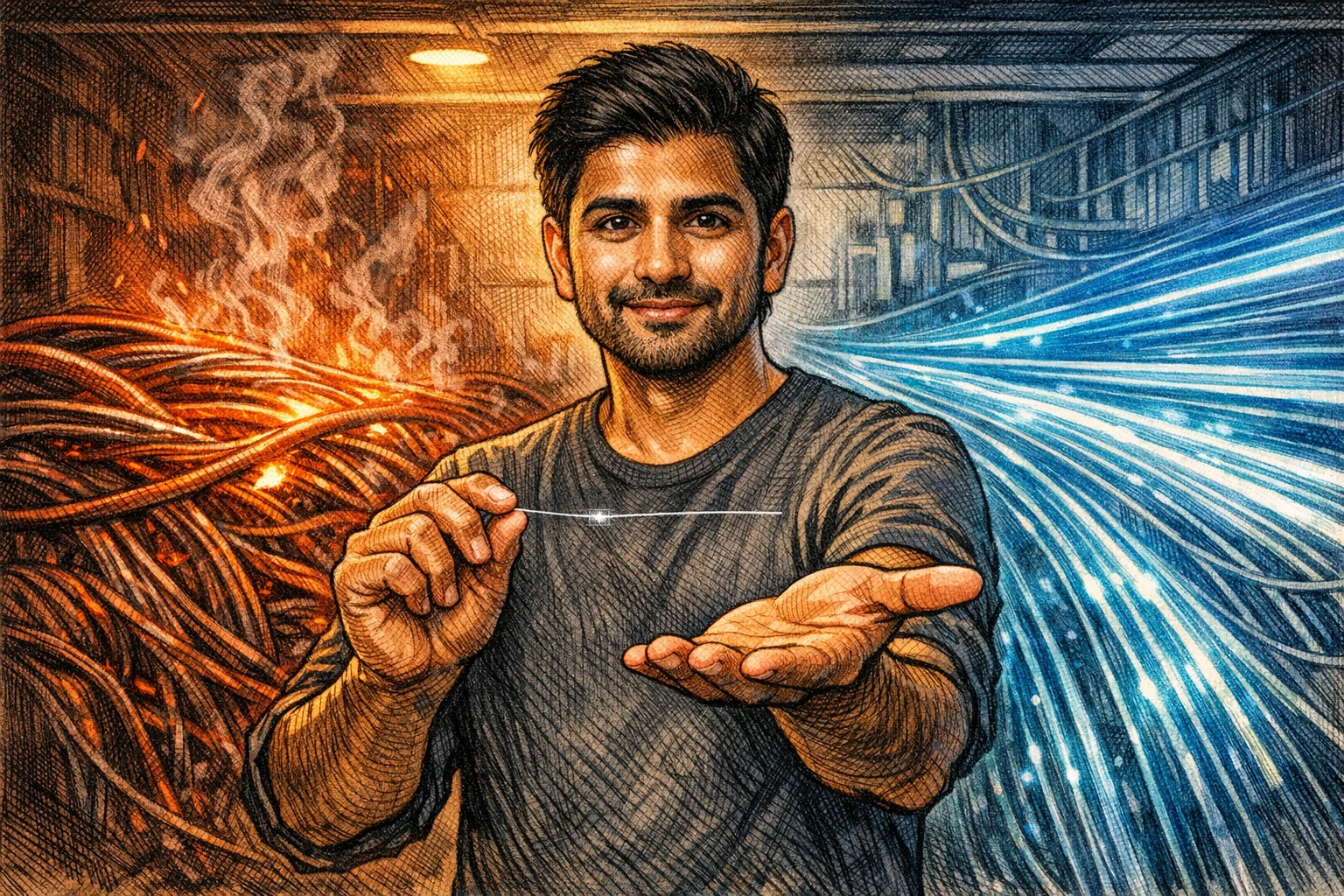
The AI computing boom is pushing the U.S. power grid to its breaking point. A startup called Arcturus claims it can slash transmission losses by half using laser-injected carbon nanomaterials into copper and aluminum wires. The company has completed an $8 million seed round, but the samples are only a few centimeters long — still in proof-of-concept.
Each AI query can consume up to 1,000 times more electricity than a traditional web search. Multiply that by billions of daily AI calls, plus GPU clusters running 24/7, and it's clear why securing stable power for data centers has become the hottest infrastructure bottleneck. Market estimates project global data center electricity demand will reach 132 GW by 2026, growing 27% annually, with total consumption exceeding 1,000 TWh — more than Japan's entire yearly usage. The aging U.S. grid is being stress-tested by this new demand.
Most solutions focus on building more power plants or expanding transmission lines. But one founder, experimenting in a Malibu garage, took a different angle: the problem isn't just insufficient supply — the transmission side is quietly burning massive amounts of electricity every day.
Copper's Physical Weakness: More Heat, More Loss
Copper forms the backbone of the modern world — from power grids and electric motors to data center power distribution. But it has a fundamental physical limit: conductivity drops as temperature rises. Hotter wires mean greater losses, creating a heat-amplifying loop. Arcturus CEO Amir Mashal says, "I kept peeling back layers of the onion and found the same bottleneck everywhere. The modern world really runs on metal." His opportunity lies in optimizing the material itself.
Arcturus uses a laser to inject carbon nanomaterials into copper and aluminum wires — adding nanoscale carbon structures inside traditional metal conductors allows the same-size wire to carry more power with less heat at the same temperature. Mashal emphasizes it's a plug-and-play replacement: "Same form factor, no system redesign needed, and workers don't need extra training to handle or crimp this material."
The stealth-mode startup recently went public and announced the $8 million seed round, led by Initialized Capital with participation from Toyota Ventures, Breakthrough Energy Discovery, 1517, and Wireframe Ventures.
What Halving Loss Means: 3% vs. a Year of Growth
If Arcturus' material actually replaces conventional grid wires, Mashal estimates it could halve transmission losses, freeing up an average of 3% additional power — and up to 10% during peak congestion. To put that in perspective, 3% roughly equals the entire U.S. annual growth in electricity demand. No new power plants, no grid expansion — just letting existing wires waste less heat could deliver a full year's worth of power growth.
For data centers, the benefits are twofold. Less wire heat means busbars inside server racks can carry more power, while cooling systems face less load — cooling itself is a major data center power consumer. Mashal says, "Whether your drone needs double flight time or your graphics card keeps overheating, the bottleneck is the same." Arcturus targets data centers, drones, and robotics as early markets, with the grid as the ultimate goal.
From Centimeters to Meters: A Long Gap Ahead
One detail warrants caution. Mashal's current production site is a Malibu garage, and the samples are only a few centimeters long — just proof-of-concept. The new $8 million funding is planned to scale production to "dozens of meters" for testing in electric motor coils and power busbars.
Going from centimeters to meters, then to mass production capable of serving real grids, is the chasm every materials startup must cross. Carbon nanomaterials' superior performance is nothing new in academia — the hard part is manufacturing enough at acceptable cost and yield. Grid conductors also require electrical certification and inclusion in utility procurement lists, often taking years. However, targeting data centers first is a pragmatic choice: their procurement cycles are shorter, tolerance for new materials is higher, and the pain point of cooling and power waste is clear. Arcturus can accumulate data in controlled environments before attempting large-scale grid tests.