

A recent artificial-intelligence selloff has brought losses in several major U.S. technology stocks close to their declines during the dot-com bust. Investors are still asking whether AI has been in a bubble—and, if so, whether it has already burst.
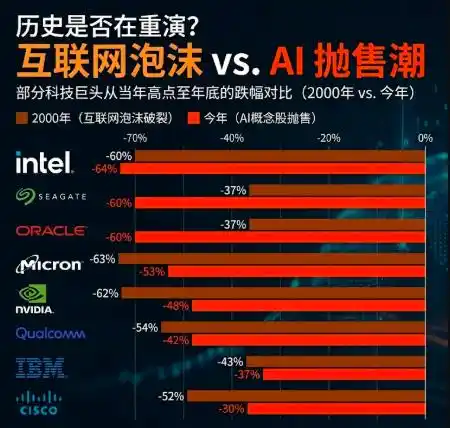
A comparison of seven companies that survived the internet bubble and remain active today shows how closely some of the declines line up. The figures compare each stock’s fall from its annual high to year-end in 2000 with its decline from its 2026 high to date. Some have fallen more this year, while others have held up better. On the numbers alone, it is difficult to say which episode qualifies as a genuine bubble collapse.
| Company | 2000: peak to year-end | 2026: peak to date |
|---|---|---|
| Intel | Down 60% | Down 64% |
| Oracle | Down 37% | Down 60% |
| Cisco | Down 52% | Down 30% |
| Micron | Down 63% | Down 53% |
| Qualcomm | Down 54% | Down 42% |
| Seagate Technology | Down 37% | Down 60% (adjusted for its spinoff) |
| Nvidia | Down 62% | Down 48% |
The dot-com bubble peaked on March 10, 2000, when the Nasdaq closed at 5,048.62 after touching 5,132.52 intraday, both records at the time. The bubble then began to deflate. Federal Reserve rate increases and the federal government’s antitrust case against Microsoft helped trigger a market reversal. Share prices fell sharply, and many companies went bankrupt.
One major difference is that the dot-com bust helped bring on a recession. Weakness spread to sectors that had not initially been affected and was followed by another deep selloff in 2001. It remains unclear whether the AI downturn will last in the same way.
In 2000, investors rotated out of technology stocks and into lower-valuation and defensive shares. Utilities and consumer staples each rose more than 40%. Yet the selling was broad enough to leave the S&P 500 nearly 15% below its high for the year by year-end. This year, the selloff has been concentrated in AI-related stocks, with another large rotation underway. Health care has gained 24% since late April, while the S&P 500 has entered correction territory.
Anthropic’s closely watched IPO last Thursday failed to spark a market rebound. For now, at least, the real economy continues to show considerable resilience.
A localized bubble—or a broader downturn?
The more optimistic reading is that the current slide represents a small bubble, or a series of bubbles around data centers and the chips they use. Memory-chip stocks have shown behavior commonly associated with extreme bubbles this year, particularly in South Korea, where large numbers of leveraged retail investors entered as share prices reached their peaks.
The sector’s surge and reversal resembled the final phase of many bubbles, but played out over just a few months: from lows after the United States and Israel launched attacks on Iran in March to a peak in June. The article suggests that much of this “mini-bubble” may already have burst.
Micron’s stock nearly quadrupled in three months before losing more than half its value. Broader semiconductor stocks first doubled, then fell 43%. Suppliers providing power and equipment to AI data centers showed a similar pattern. Bloom Energy was one example, with equally extreme share-price swings.
Newer cloud data-center operators have also struggled. The article likens them to “subprime borrowers” in this cycle and points to Nvidia-backed CoreWeave as a prominent case. After its IPO last year, CoreWeave’s share price surged to more than four times its starting level, then fell back to where it began.
A further decline to the start-of-year level would be painful, but could still fall short of the panic of the dot-com collapse. Although the bubble peaked in 2000, some companies suffered their worst damage in 2001. Cisco, already down by half, lost another half in the first three months of 2001. It did not recover its March 2000 high until last December.
Uncertainty over wider AI-sector risks
More pessimistic investors worry that the current downturn may be more than a small bubble. The broader AI sector could enter a damaging feedback loop: falling share prices may push companies to scale back ambitious investment plans, hurting highly valued suppliers and their lenders and further weakening demand.
If that happens, expectations for exceptional growth in data-center spending could be revised down. The impact would reach beyond the economy to companies investors had expected to benefit from that spending.
Falling share prices could also spill into other industries. Retail investors have recently been enthusiastic buyers of equities, particularly AI-themed stocks. Economists generally believe the paper gains households receive from a rising stock market have provided a significant boost to consumer spending. If that wealth effect reverses, weaker consumption could weigh on the wider economy, including traditional sectors with no direct connection to AI.
Vincent Mortier, chief investment officer at asset manager Amundi, said: “Usually, you only truly realize you are in a bubble when it bursts.”
For now, the article says, localized mini-bubbles around data centers and their suppliers have burst, and a considerable amount of speculative excess across the AI sector has been squeezed out. Whether a larger AI bubble is also deflating remains uncertain.
This article was published by the WeChat account Cailian Press and written by Xiaoxiang.



