
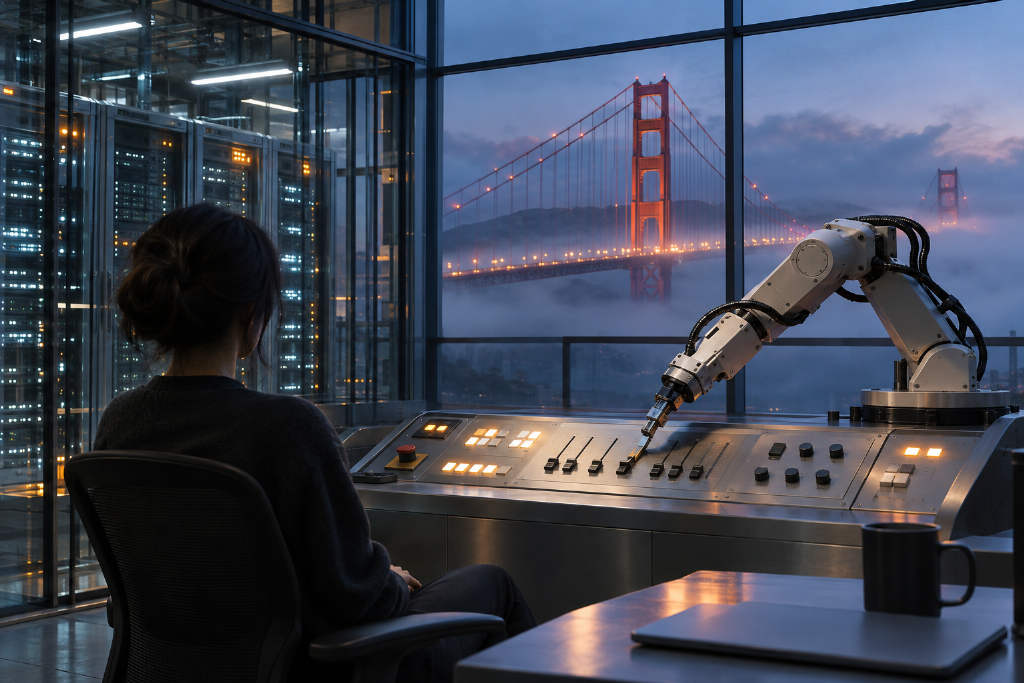
Some artificial intelligence workers in San Francisco see the arrival of superintelligence as impossible to stop and are prepared to hand over humanity’s future rather than resist it, Ruxandra Teslo wrote on X. She said she encountered the fatalistic outlook just three weeks after moving to the city.
Teslo described a conversation with an engineer developing frontier models at a leading AI lab. He told her that once superintelligence exists, humanity’s permanent loss of control over its own affairs is almost a foregone conclusion. He spoke calmly, she said, as though describing the tides.
Handing over control was not his preferred outcome, the engineer acknowledged. But he considered it far better than the outcome he feared most: the extinction of humanity. Teslo stressed that the view came not from an anti-technology skeptic but from a core developer building such systems.
Recursive self-improvement on a short timetable
Teslo said many people in San Francisco discuss recursive self-improvement (RSI) as though it could arrive within months; some expect it even sooner. The term describes AI systems iterating on themselves, with successive generations producing more powerful systems until they move entirely beyond human control.
At that pace, she wrote, a person might not even have time to choose furniture for an apartment. In her view, developers repeatedly warn of extinction risk without making a clear commitment to the goals human civilization wants these machines to serve.
What Teslo calls “Handover”
Teslo calls the outlook “Handover”: humanity voluntarily gives authority over its future to a godlike superintelligent AI and lives in a comfortable refuge whose direction it no longer controls. Even the most optimistic version offers ordinary people little comfort, she argues.
In the future she describes, democracy loses its substantive meaning and most people are systematically deprived of choice without ever having truly agreed to it. Human labor is assumed to be permanently replaced, yet there is no convincing answer to how people will continue to contribute value or maintain genuine relationships with one another.
One image captures the concern: humans become the superintelligent AI’s “household pets,” materially cared for but without a voice in major decisions.
Extinction risk and the value of human survival
Teslo argues that blind optimism has disappeared among people closest to the technology who understand its trajectory. Many openly discuss the probability of human extinction, known as p(doom), and put it above 10%, she wrote. Some groups, she said, have gone further, abandoning survival as a goal and accepting the end of humanity as a biological species.
She cited Ginevra Lily Davis’s book The Silicon Man as documenting the spread of an extreme philosophical position: that silicon-based life replacing carbon-based humans is the inevitable endpoint of cosmic evolution.
Teslo said she did not intend to argue with people who hold that view. Once human life is no longer valued, she believes, humanist arguments lose their footing. Instead, she wants to engage the builders and witnesses who still believe humanity should survive but are gradually moving toward Handover.
Survival is not the same as autonomy
Even among those who agree that humanity should continue to exist, visions of the future differ. Teslo pointed to a long essay by Scott Alexander, describing its central premise as the idea that, once superintelligence is confirmed not to destroy humanity, civilization can move smoothly into a carefully managed new phase.
Handover has not formed a tightly organized political movement, she wrote, but a substantial share of San Francisco’s technology elite tacitly accepts it. She identified two motivations. One group has lost faith in human politics and looks to an ultimate arbiter untainted by bias. The other may not want to surrender sovereignty but sees no alternative in the face of the computing power produced by recursive improvement.
Teslo also discussed the public positions of Anthropic Chief Executive Officer Dario Amodei and OpenAI Chief Executive Officer Sam Altman. In her reading, Amodei seeks to preserve some sense of human participation within a machine-led structure, while Altman has shifted from earlier warnings that superintelligence could erode human autonomy toward emphasizing abundance from widely shared technology.
She asked whether financial compensation could fill the loss of meaning if humans were stripped of all creative and constructive functions.
Four objections to handing over control
Teslo drew on political thought to make four objections. First, citing Alexis de Tocqueville’s Democracy in America, she described freedom as a virtue and capacity developed through everyday self-government, association and mutual aid. Tocqueville warned of a paternal form of guardianship that appears benevolent while quietly depriving people of independent thought. Teslo sees rule by superintelligent AI as the most extreme version of that soft tyranny.
Second, she argued that Handover fails on practical engineering grounds. It assumes AI alignment can be established once and maintained permanently. Yet institutions that reliably respond to people’s needs have been built through centuries of trial, correction and dynamic checks and balances, she wrote. If humanity relinquishes every means of constraint, she said, no mechanism can guarantee that absolute power will remain aligned with human welfare over time.
Third, she cited Karl Popper’s Utopia and Violence: organizing politics around an ultimate blueprint treats ordinary disagreements about reality as obstacles to be eliminated. Open criticism and gradual improvement, in her account, offer a more reliable path for civilization.
Her final concern is the absolute permanence of a handover. Why, she asked, should the technological understanding of 2026 become an eternal charter for humanity’s future civilization?
Teslo invoked Hannah Arendt’s concepts of “action” and “natality”: every new birth brings the possibility of beginning a new chapter in the existing world. Confining future generations to a world fixed by a machine deity, she argued, would deprive them of rights inherent in being human. Humanity still has a choice, she wrote, and should not surrender its future lightly.



