
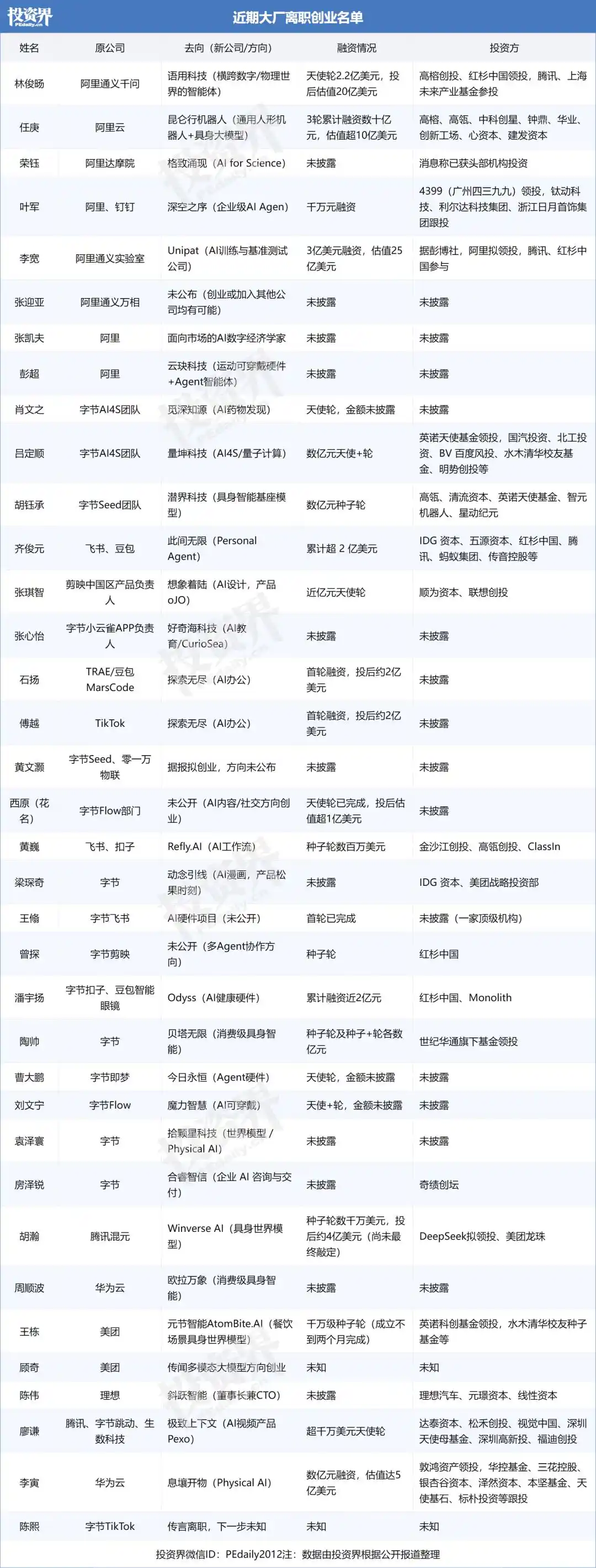
Investors are circulating what the article calls a "departure list" from China’s biggest tech companies. Behind that list is a visible startup wave: researchers, technical leads, and executives who worked on large models, AI agents, and AI-for-science projects are leaving major employers to build companies of their own.
One detail stands out throughout the piece. In a number of cases, financing was arranged before the founders formally left their jobs, with top-tier funds moving early to secure a place in the cap table.
Several names are driving the discussion
The article first points to Lin Junyang, the former technical lead of Alibaba’s Tongyi Qianwen and, according to the report, the youngest P10 in Alibaba’s history. Two months ago, in an early-morning post, Lin announced that he had founded Yuyong Technology in Shanghai. The company raised $220 million in an angel round at a $2 billion post-money valuation, despite having no product, no revenue, and only three months of business registration history.
The report says earlier signals had already appeared in corporate registration records. Tencent had completed an equity investment one month before the public announcement. Going back to May, Sequoia China and Gaorong Ventures were already in talks with him. The article also cites a detail circulating in the industry: 28 days passed between first contact and the signing of a TS, or term sheet.
The second name is Hu Han, formerly a distinguished scientist at Tencent Hunyuan. Hu left Tencent in July. He holds a PhD from Tsinghua University and is one of the authors of the Swin Transformer paper, which won the Marr Prize at ICCV 2021. During his time at Tencent, he led work on Hunyuan’s vision-language model and embodied foundation model, and also built the Hunyuan speech team.
After leaving, Hu founded Winverse AI. The company remains relatively quiet publicly, but Bloomberg reported that DeepSeek had agreed to lead its seed round. The deal was described as worth tens of millions of dollars, with a post-money valuation of about $400 million. Meituan Longzhu also made an investment commitment, though the transaction had not been finalized.
The third example is Li Kuan. The article says that in August last year, he was still an intern in Alibaba Tongyi Lab’s DeepResearch project group and one of the project leads behind the open-source agent WebSailor. By December last year, his startup UniPat had surfaced as an AI training and benchmarking company. His co-founders include Yin Huifeng, another WebSailor project lead.
According to venture capital chatter cited in the piece, UniPat was incubated by Sequoia. Although the company has not yet completed equity changes at the corporate registration level, it has already gone through multiple financing rounds. Earlier reports said Alibaba would lead a $300 million round in UniPat, with Tencent and Sequoia China also participating, at a $2.5 billion valuation.
From scientists and technical leads to interns, from companies with no product to teams still in stealth mode, the pattern is the same. Capital is arriving earlier and earlier. The article’s conclusion is that venture firms in the AI era are showing an unusually strong urge to secure positions by backing people before they even leave their desks.
The list keeps getting longer
The report says several more names entered the public record in October alone.
- Rong Yu, head of the AI for Science direction at Alibaba DAMO Academy, confirmed his departure on Oct. 15 and founded Gezhi Yongxian, which has already received backing from top institutions. He had also spent years at Tencent AI Lab.
- Ye Jun, former Alibaba vice president and president of DingTalk, left Alibaba in 2025 after 19 years with the company. Once his non-compete period ended, he founded Deep Space Sequence, targeting enterprise AI agents. In mid-October, he disclosed that the company had been operating for about three months and had already raised financing in the tens of millions of yuan.
- Huang Wenhao, head of model evaluation at ByteDance Seed and co-founder of 01.AI, confirmed his departure on Oct. 20. The article says the Peking University computer science PhD had led the team that pushed Yi-34B to the top of the global open-source model rankings, and that entrepreneurship is likely his next step.
The piece also notes departure rumors involving Chen Xi from ByteDance’s TikTok e-commerce business and Zhou Chang, one of the core AI R&D leads at ByteDance Seed.
By the article’s rough count, no fewer than 100 people have left major tech companies over the past two years to strike out on their own. It adds that this year, the movement has become almost monthly. The list was compiled from public information and only includes people who left large companies to become founders, not those who joined other firms after resigning.
ByteDance alumni stand out
Among all the groups mentioned, ByteDance alumni are especially prominent. The article describes the company as something like a training ground for the current large-model startup wave. By outside estimates cited in the report, at least 30 mid- to senior-level ByteDance employees have chosen to launch startups in the large-model boom alone, and many of them had already secured first-round financing before formally resigning.
One example is Qi Junyuan, former vice president of product at Feishu and head of Doubao’s PC business at ByteDance. His startup Today AI has raised a cumulative $200 million, with participation from IDG Capital, Tencent, 5Y Capital, Ant Group, Sequoia China, Transsion, Tongge Venture Capital, and Shanghai Jiao Tong University Hanyuan Asset.
The article also mentions founders from the AI4S team, including Xiao Wenzhi, who launched Mishen Zhiyuan, and Lü Dingshun, who founded Liangkun Technology.
Looking further back, the report says earlier departures have already produced visible companies. Wang Changhu, founder of Aishi Technology, previously led vision work at ByteDance AI Lab. He left in April 2023 and built PixVerse, an AI video generation product focused on overseas markets. This year, according to the article, Aishi Technology’s cumulative Series C financing reached RMB 2.98 billion.
Another case is Chen Mian. The article says he left Jianying in 2023 and founded Yanyu Technology. The company’s ARR has exceeded $300 million, its B+ round was close to $300 million, and its post-money valuation topped $2 billion. The report adds that news has already circulated about a possible Hong Kong IPO process.
Capital is backing people as much as projects
The article frames the expanding departure list as a map of AI talent migration.
It draws a parallel with the U.S. market, where OpenAI alumni have already produced multiple unicorns. Former chief scientist Ilya Sutskever founded Safe Superintelligence, which has raised a cumulative $6 billion, with market talk of a new round at a $32 billion valuation. Former chief technology officer Mira Murati founded Thinking Machines Lab, which completed a $2 billion financing at a $12 billion valuation. Anthropic is also cited as a company built by former OpenAI executives.
The report then turns to Google. In August this year, Jeff Dean, who had spent 27 years at Google, left with several longtime collaborators to found Discovery Loop, a research company focused on letting AI generate research hypotheses and run thousands of experiments in parallel. By September, the company, still without a product, was reportedly seeking financing at a valuation of about $50 billion.
In the article’s telling, the same migration is now underway both inside and outside China. More than a decade ago, during the internet boom, talent flowed from startups into large tech platforms. Now the direction has reversed. Talent is spilling out of the giants, and investors are following that movement with their money. In every industrial shift, the report argues, cognition, capability, and team quality remain the scarcest assets.
Resumes can set a price, but products still decide the outcome
The article also points to another side of the AI talent race: some new graduates are receiving annual compensation packages worth several million yuan from major AI companies. When the timing is right, they may also choose to start companies of their own. In that sense, the market’s intense demand for top technical talent is creating what the article calls a new class of high-net-worth individuals.
Still, the piece does not treat elite résumés as a guarantee of success. It says the halo of a founder’s past can help set a valuation, but it does not ensure delivery. In the end, valuations still have to come back to products, revenue, and execution.
After leaving Alibaba, Ye Jun once joked in an interview that "executives who start businesses often fail." The article presents that line not as a prediction, but as a sober view of the limits that even experienced operators face.
Its final point is simple: startup success remains a low-probability outcome. Even so, many people in this cycle still feel it would be a waste not to try. Talent is the most expensive asset, the departure list will keep growing, and the next name may already be in a meeting room discussing a term sheet.
This article was originally published by the WeChat public account Touzijie (ID: pedaily2012) and written by Yang Jiyun.



