
AI is redrawing job boundaries rather than erasing one profession
For the past two years, discussion of AI and employment has been dominated by two opposing claims. One predicts that AI will eliminate product managers and junior programmers. The other says that anyone who masters large-language-model tools can multiply individual productivity by 100 times.
Two reports released on Nov. 10, 2026, present a less binary picture. Lenny Rachitsky, the author of Lenny’s Newsletter, published the fifth report in his technology labor-market series, State of the tech job market: late 2026. On the same day, OpenAI and freelance marketplace Upwork released the research article Work at the Frontier: AI’s effect on freelance work and its full companion report, The Rebundling of Freelance Work in the AI Age. The first set of data covers full-time technology roles; the second examines freelance work.
Taken together, the findings do not show AI eliminating an entire job title or producing a broad-based software hiring boom. Instead, traditional job boundaries are being broken apart. Single-skill positions are being combined into broader assignments, while much of the new demand is appearing around chips, data centers, hardware and physical delivery. Hiring is also becoming more concentrated in the San Francisco Bay Area.
PM postings hit a four-year high, but starts do not follow
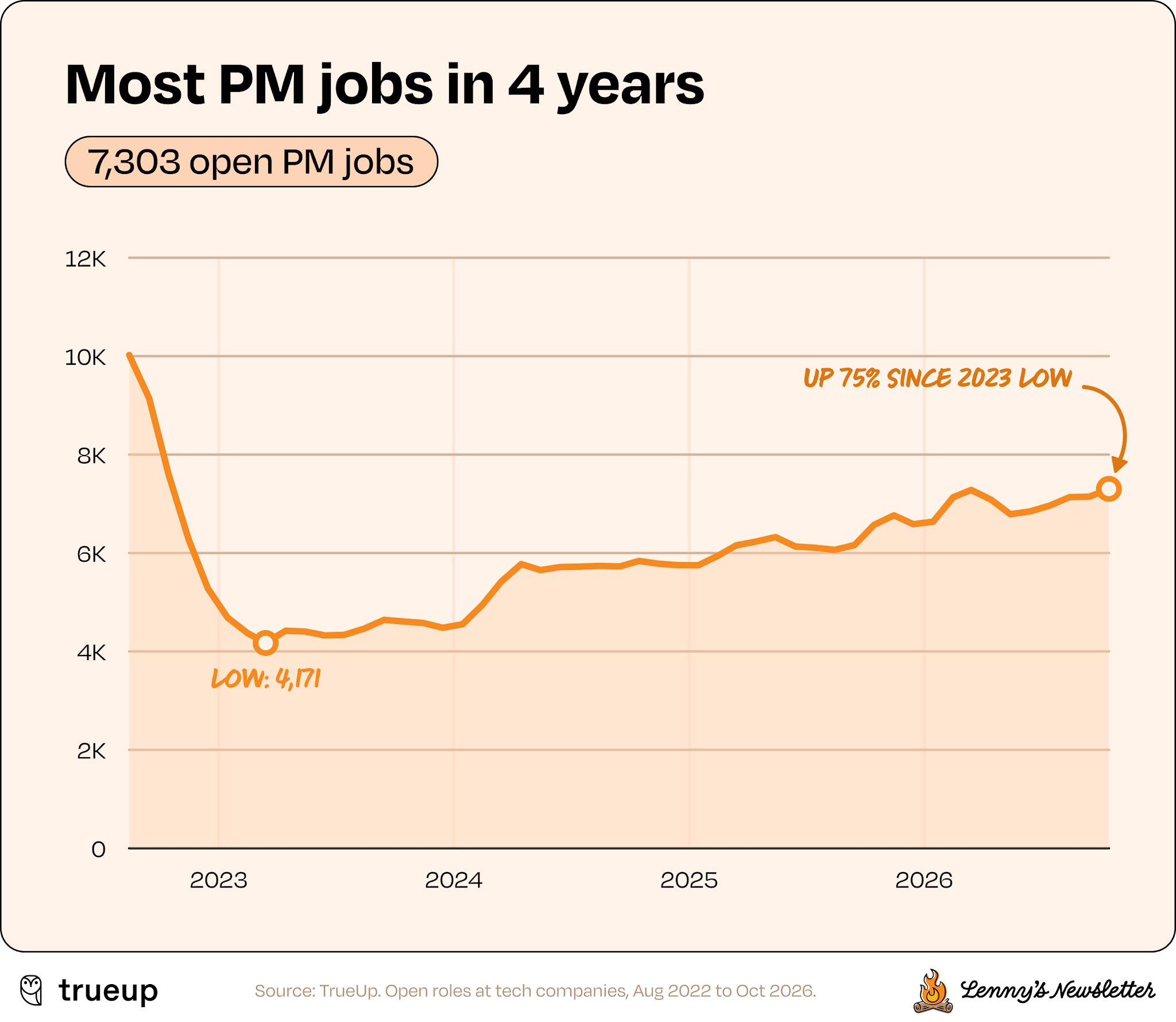
Product management is the clearest example of the gap between job advertising and actual hiring. Data from TrueUp, which tracks open roles at more than 9,000 technology companies worldwide, showed 7,303 open PM positions globally by October 2026. That was a four-year high and 75% above the low recorded in March 2023.
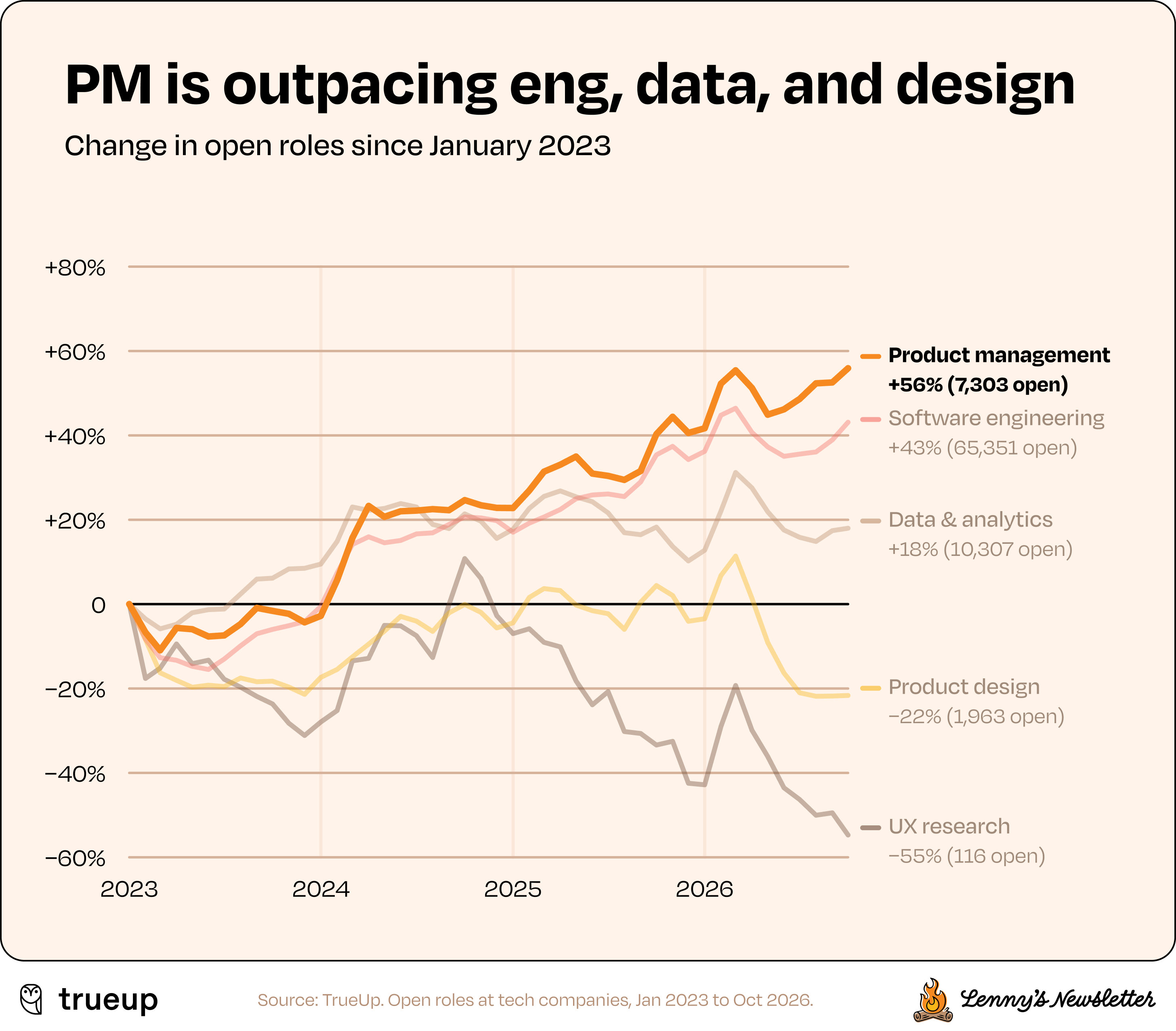
Since January 2023, PM postings had risen 56%, ahead of engineering at 43% and data and analytics at 18%. Product design postings fell 22%, while user-experience research postings fell 55%.
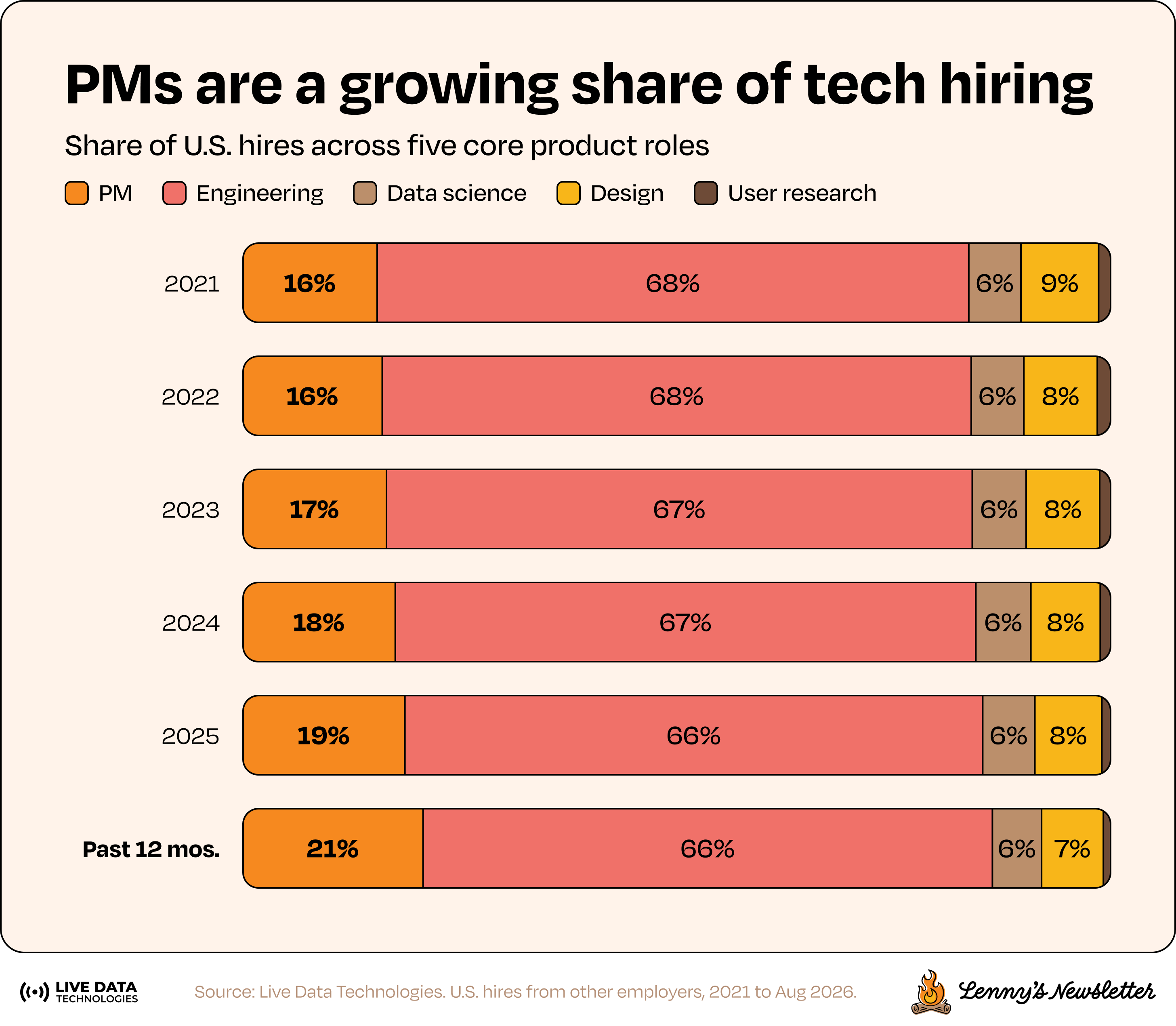
Those figures alone could suggest that companies are aggressively competing for product managers. Lenny’s report also used data from Live Data Technologies, which tracks career moves among 124 million professionals. Its hiring statistics cover the United States only. On an actual-start basis, PM hiring was flat or lower. Still, PMs were the most resilient of the five core functions: their share of actual hiring rose from 16% in 2021 to 21% currently, making PM the only core role to increase its share.
A separate report published by independent product analyst Aakash Gupta on Oct. 22, 2026, showed the same divergence. Between February and June 2026, external PM starts in the United States were 18% below the comparable period in 2023 and 45% below 2022. During the same period, PM postings on TrueUp jumped 77%.
In 2025, companies replaced only 0.92 PMs hired externally for every PM who left, down from 1.16 in 2022. Overall, U.S. PM hiring was 52% of its 2022 level. Outside the United States, the decline was steeper at 23% year over year, with India and Europe each down about 25%. U.S. median PM compensation, however, rose from $220,000 to $250,000, an increase of 14%.
“Job postings measure the advertisements companies put out. Hires measure the people who actually start working. Only one of those numbers represents the real market,” Gupta wrote.
The author of the Falkster blog manually audited 200 PM postings in April 2026 and found that 196 of them could have been written in 2022. Falkster’s count put AI PM roles at 46% of open PM positions, but only about seven of every 100 actual PM starts. Gupta’s report showed AI PM starts increasing from 789 to 1,988, or roughly 2.5 times higher, but they still represented only 6.8 of every 100 PM hires.
The number of AI-related keywords in job advertisements is expanding, as are the requirements. The analysis described in the source suggests that companies may be reluctant to add headcount quickly. Instead, they may leave demanding positions open while searching for a small number of people who understand both business and AI. The apparent PM victory is relative resilience inside a shrinking market, not broad expansion.
Engineering stalls as design and research fall further
Software engineering performed considerably worse than product management. TrueUp data showed engineering-posting growth slowing from 29% in 2024 and 15% in 2025 to just 2.5% over the past year. By October 2026, global engineering postings stood at 65,351, below the level recorded in March.
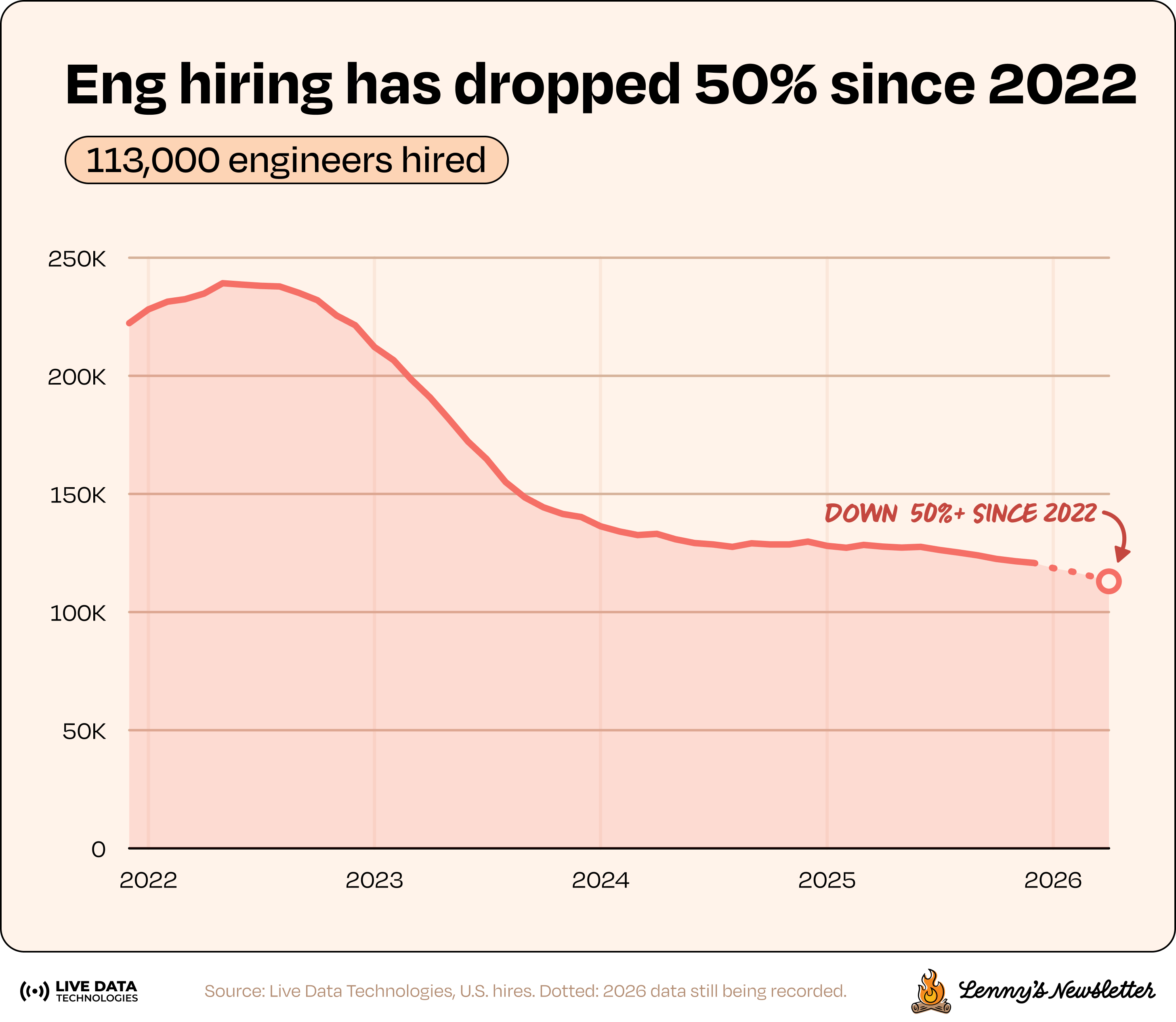
U.S. companies hired about 113,000 software engineers between May 2025 and April 2026, less than half the 239,000 hires recorded at the 2022 peak. Since January 2024, the engineering market has produced a clear gap: openings rose 44%, while actual starts fell 17%.
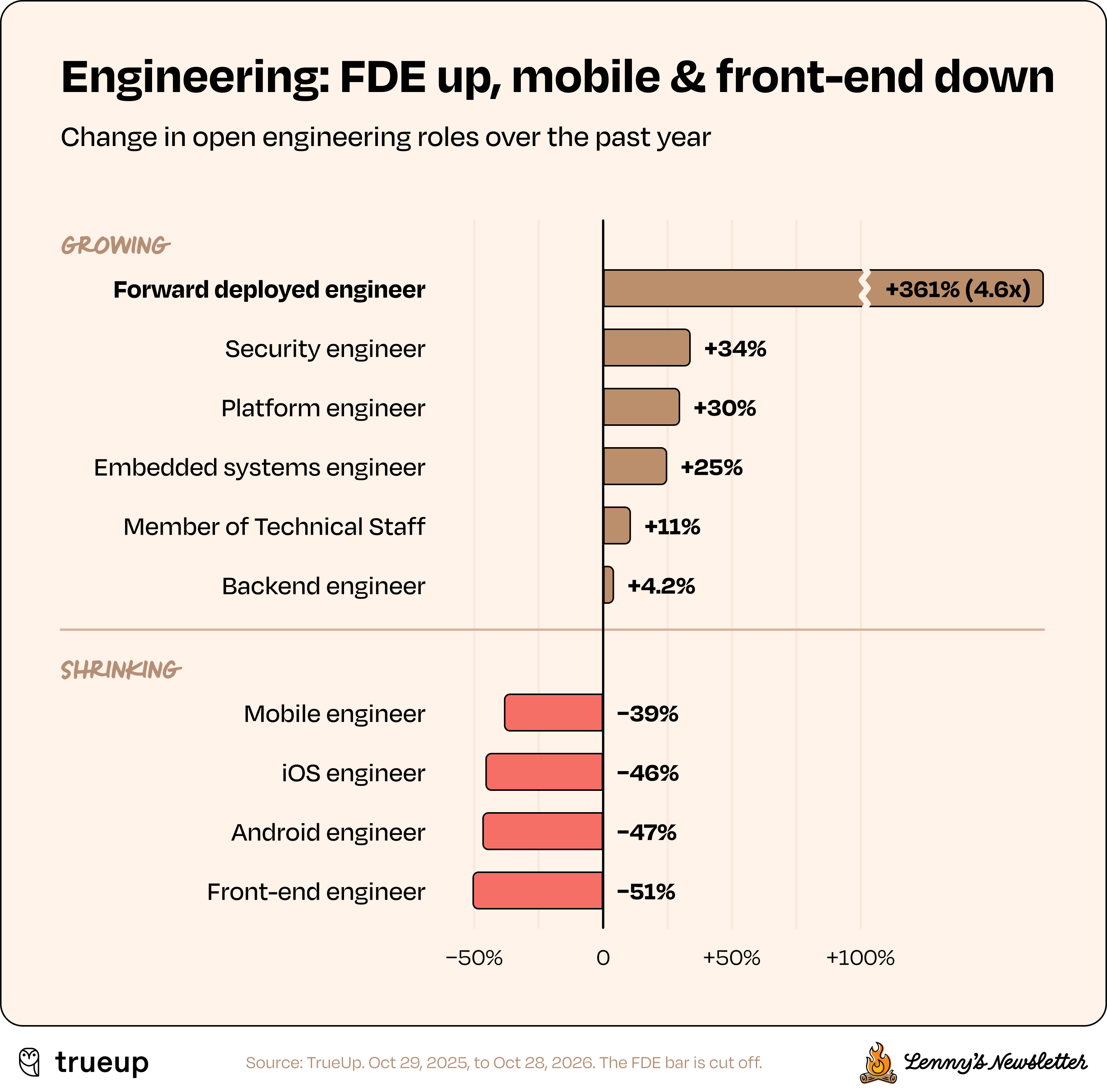
The effect of AI tools is also visible within engineering. The report said demand for front-end engineers and mobile developers had “nearly halved” over the past year. Rachitsky described the shift as a collapse of specialized, siloed engineering disciplines. Smaller teams using AI coding tools are taking on broader end-to-end responsibilities.
At the same time, newer engineering roles close to customers are growing rapidly. Forward-deployed engineers, or FDEs, help customers deploy and operate products directly and combine engineering with delivery work. Global FDE postings rose 4.6 times in one year to roughly 1,500. Rachitsky cautioned that the increase may reflect both stronger demand and the renaming of roles such as sales engineers.
Product design and user research were the weakest areas among the five core product functions. Global product-design postings fell 28% year over year to about 1,900, the lowest point in the series. U.S. companies hired about 12,600 product designers during the past 12 months, less than half the 27,600 hired in 2022.
The ratio of PM postings to design postings deteriorated from 1.9 to 1 in early 2023 to 3.8 to 1 now. User research was pushed closer to the margins. The United States hired only about 1,800 UX researchers over the past year, down 66% from 5,300 in 2022. Globally, just 108 UXR roles remained open.
Hiring requirements reflect the same merger of responsibilities. In a frequency count of skills, “LLM” overtook every traditional skill in PM descriptions. “Claude” ranked third, while Cursor, OpenAI and MCP entered the top eight. “Evals,” referring to model evaluations, entered the top 10. In engineering descriptions, LLM mentions surpassed Java. In design postings, Claude moved above CSS to rank second in spring 2026.
Tao Zhang, co-founder and chief product officer of Manus, said AI is now good at completing tasks, so companies no longer need engineers who are “only good at executing tasks.”
Freelance work is being repackaged
The OpenAI-Upwork study offers a more granular view of the same shift. The 24-page report compared the distribution of work-related conversations on ChatGPT with changes in freelance orders on Upwork. Its central question was whether AI was taking freelancers’ work or changing how they win and deliver projects.
The researchers said the results “do not point to a simple substitution story.” Among 63 work categories that could be matched, 43 were common on ChatGPT while losing share on Upwork. The other 20 moved in the opposite direction.
Standardized writing and basic support work appeared more frequently on ChatGPT and accounted for smaller shares of Upwork jobs. Content writing represented 14.5% of work-related ChatGPT use but only 1.3% of Upwork jobs. Its share of Upwork postings fell about 31% from the first half of 2025 to the first half of 2026. Customer and technical support made up 6.5% of ChatGPT work-related use and 1.2% of Upwork jobs.
Work involving complex visual judgment, interactive delivery and multimodal integration remained more dependent on human freelancers. Video and animation represented 10.0% of Upwork jobs versus 1.0% of ChatGPT work-related use. Graphic, editorial and presentation design accounted for 10.5% of Upwork jobs versus 2.3% on ChatGPT. Mobile development represented 7.8% of Upwork jobs, compared with only 0.2% of ChatGPT work-related use.
The report’s central concept is “rebundling.” The diversity of common tasks in AI-related freelance orders rose from the equivalent of 14.6 tasks in early 2023 to 21.2 by the end of 2025, a 45% increase. An individual AI-related order contained 3.3 tasks on average, compared with 3.2 for non-AI orders. But the share of orders combining tasks that had rarely appeared together reached 8.4% for AI jobs, more than three times the 2.4% rate for non-AI jobs.
The study gave one example: a single brief may now ask a freelancer to generate an AI video, edit the video and create motion graphics before delivering a finished production. Previously, those assignments might have gone to three separate people.
The change also appeared in contract economics. After controlling for work subcategory and posting month, fixed-price budgets for AI-related freelance jobs were 52.4% higher, compared with about 70% before adjustment. Hired hourly contracts involved 40.6% more work during the first 90 days. Adjusted posted hourly rates, however, were only 1.5% higher.
The data does not show AI lifting freelancers’ hourly prices by much. It is more consistent with clients combining work from several functions into larger projects.
An earlier OpenAI study released on Sept. 16, 2026, pointed in the same direction. It analyzed more than 1.5 million work-related ChatGPT messages from April through July. Among about 6,200 tracked employees, the share using AI for cross-occupation tasks rose from 13.1% to 25.9% in three months. People who had tried cross-occupation work repeated the behavior the following month at a rate of 23.6%, compared with 8.4% among those without that experience.
Media reports on Upwork’s second-quarter earnings, released Aug. 10, 2026, said active clients fell 4% year over year to 763,000. Gross services volume, or GSV, declined 4% to $966.4 million, while GSV per active client rose 5% to a record $5,230. AI-related GSV grew more than 22%, and AI strategy and consulting grew more than 50%.
The OpenAI-Upwork research is descriptive analysis from parties with a stake in the market. Its time windows do not fully match, and it does not track a causal migration between platforms. The available figures show fewer clients, but potentially larger and more complex AI projects among those who remain.
Growth is shifting outside software and toward the Bay Area
The flat technology labor market does not mean that companies have stopped hiring. Lenny’s report put total global technology openings above 281,000, up 17% year over year and 73% above the March 2023 low. The three traditional software core areas—PM, software engineering and product design—accounted for only a modest 2% combined increase.
Most of the additional roles were in chips, data centers and physical delivery. Hardware-engineering postings doubled over the past year. Business operations added about 4,200 openings, and supply-chain roles rose 63%. The fastest-growing technology jobs were mostly physical positions, including data-center technicians, installation engineers and field-service engineers.
Rachitsky said the AI boom was creating jobs primarily to build and operate chips, data centers and hardware infrastructure, rather than to write software.
Remote options also continued to recede. Only 14% of technology postings now offer remote work, a record low compared with 21% at the end of 2022. The remote share fell from 25% to 14% in engineering, from 34% to 19% in design, and remained near a low 21% for PM roles.
Hiring became more concentrated in the San Francisco Bay Area. Bay Area postings rose 43% year over year and represented 15% of all openings. In core product development, one in every four open PM and design roles was in the Bay Area, as was one in every five engineering roles.
There is not yet enough actual-start data to determine whether software engineers will see a new recovery. Technology-recruiter postings rose nearly 300% from their mid-2023 level, reaching a record. That could indicate companies are building a pipeline for the next engineering hiring cycle. It could also reflect more outsourcing of recruiting and greater reliance on headhunters.
The market is changing through task combinations
The available figures do not support a single “machines replacing people” explanation. The clearest pressure is on jobs defined by narrow specialization and one execution skill, such as engineers focused only on front-end pages or basic mobile code, execution roles limited to standardized research and image slicing, and freelance writers paid by the individual article.
At the same time, higher fixed budgets, rising median PM compensation and dense, office-based collaboration in the Bay Area are appearing around two kinds of work. One involves people who can recombine tasks across functions, understand the limits of model evaluation and deliver complex outcomes directly to customers. The other involves people building the physical foundation of AI, including computing capacity, hardware and data centers.



