
Two warning lights flashed in AI infrastructure last week. Same time. CoreWeave got hit in both its stock and its bonds, which pushed up its financing costs. Meta, meanwhile, kept spending huge sums on AI while free cash flow stayed negative, putting return-on-investment worries right back on the table.
And this is bigger than just those two names. It gets to the same basic question: if AI buildouts rely more and more on outside money, how much longer can this arms race keep going?
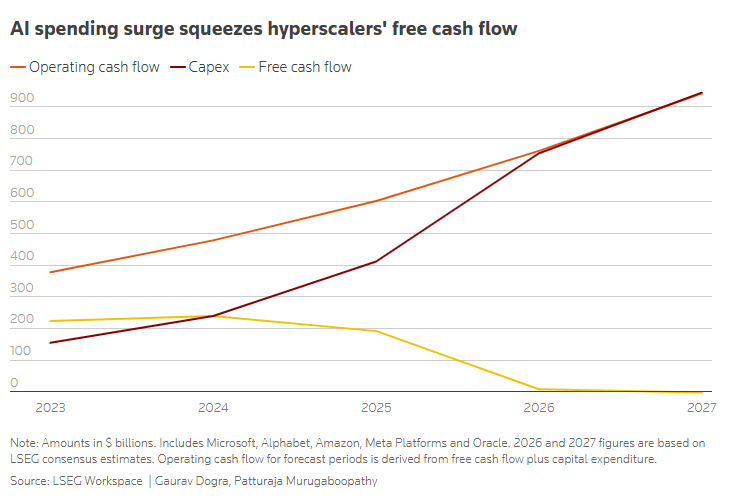
The cloud giants are stuck in a textbook prisoner’s dilemma. Each one understands what collective overinvestment can do. But none wants to be the first to tap the brakes. Reuters, citing analysis of LSEG consensus forecast data, said Microsoft, Alphabet, Amazon, Meta and Oracle are expected to have total capital expenditures above free cash flow by 2027. For each extra $1 of operating cash flow, the group is projected to add about $1.57 of capex. That gap keeps getting wider. And it is pushing companies once famous for asset-light economics toward a model far more dependent on capital markets.
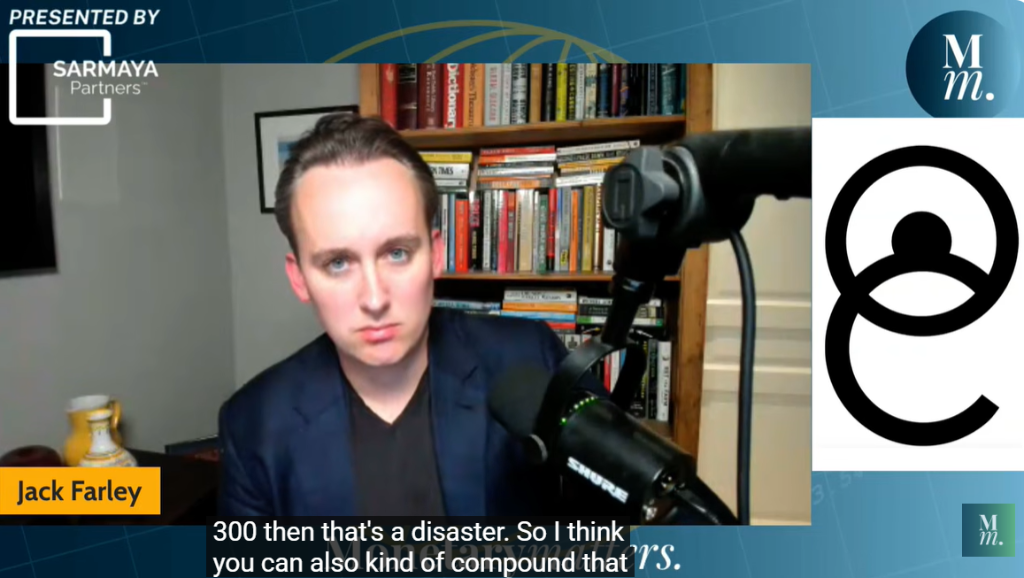
Investor Citrini, speaking on the Monetary Matters podcast, put the core risk plainly: "In the first three years of the AI trade, sentiment-driven selloffs still had a floor, because most of the spending came from hyperscalers’ operating cash flow. But now, more and more infrastructure is being financed on some pretty staggering expectations." He said that in the first three years of the AI trade, sentiment-driven selloffs still had a floor because most spending came from hyperscalers’ operating cash flow. Now, more and more infrastructure is being financed on very aggressive expectations.
Once funding moves away from internally generated cash and toward equity issuance and debt, market sentiment starts shaping real investment directly. If sentiment breaks lower, incremental capital can vanish. This is not just a company spending its own money anymore. The market is helping decide how much gets built. That is the reflexivity risk. Confidence supports financing, financing supports investment, and when confidence fades, tighter funding feeds back into lower investment and weaker growth expectations.
AI is changing big tech. Sure. But it is also changing how these companies actually work as businesses. The logic behind the AI infrastructure race may be shifting from investment drives growth to confidence determines investment.
No one wants to stop first
Cornell Capital Group, in its report AI Prisoner’s Dilemma, spelled out the structure pretty clearly. If one company spends hard on AI while rivals do not, it can grab market leadership. If it holds back while rivals spend, it risks getting left behind. In that setup, aggressive investment becomes the rational move for every player no matter what competitors do.
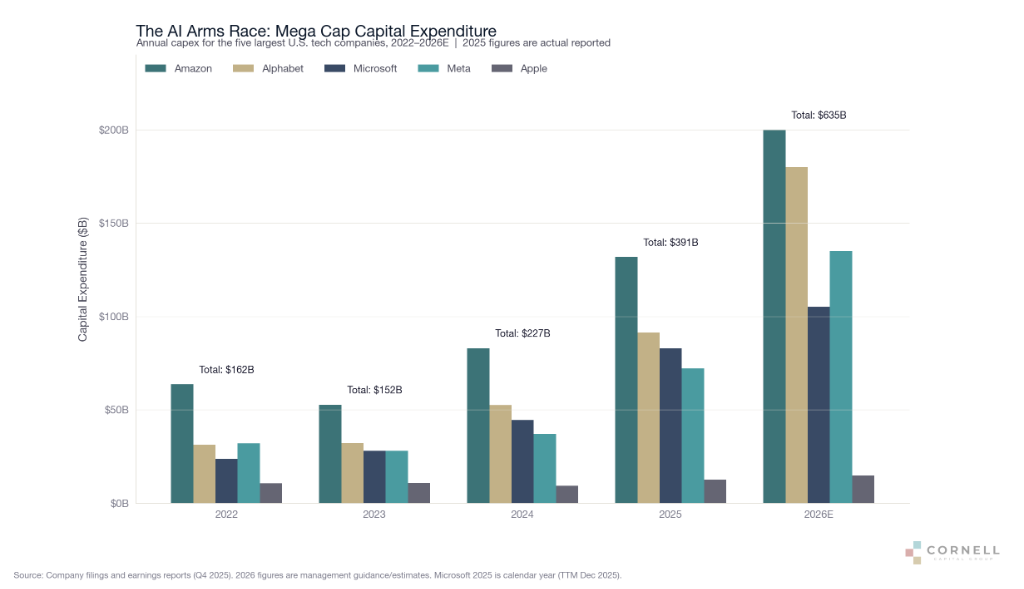
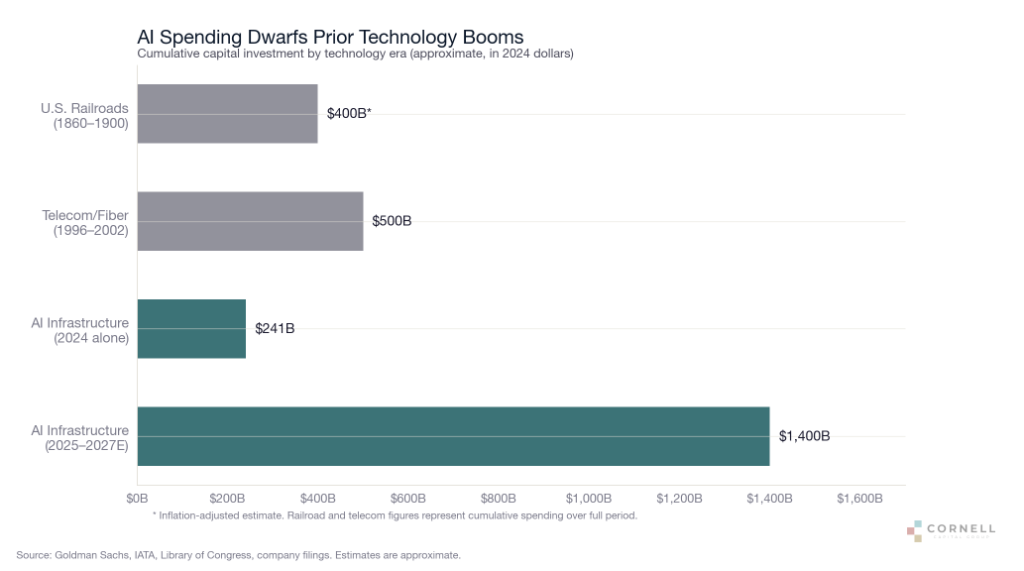
The figures show just how extreme that logic has become. In 2024, Amazon, Alphabet, Microsoft, Meta and Apple spent about $227 billion in combined capex. In 2025, that number jumped to $391 billion. Management guidance for 2026 suggests the total could exceed $635 billion. Goldman Sachs estimates cumulative capex by hyperscalers will hit $1.15 trillion to $1.4 trillion from 2025 through 2027, more than double the $477 billion recorded from 2022 through 2024.
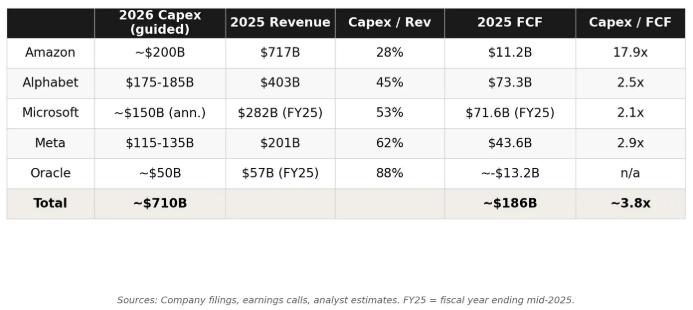
Company guidance for 2026 is even hotter. Amazon is targeting $200 billion in spending. Alphabet has guided to $175 billion to $185 billion, and CEO Sundar Pichai said "That number may still not be enough." Meta has guided as high as $135 billion.
Analyst Amin Mrini, in a report titled The $700 Billion Prisoner’s Dilemma, said the five companies’ combined 2026 capex commitments come to about 3.8 times their combined free cash flow. His take was blunt: the most cash-generative companies in history are moving onto a path where they spend nearly $4 for every $1 of free cash flow, with record debt issuance filling the gap.
The structural reason is simple enough. This infrastructure is hard to compress. Data centers, power agreements and specialized chips all come with procurement and build cycles measured in years. By the time demand is fully visible in revenue, the response window is already shut. Mrini wrote that this lag turns expectations into obligations.
History offers uncomfortable parallels
Cornell Capital’s report points to three historical episodes as reference points for the current AI buildout.
First: the 19th century U.S. railroad boom. Railroad stocks and bonds reached $10.6 billion, roughly $400 billion in today’s dollars, well above the $1.2 billion size of U.S. government debt at the time. Railroads really did transform the country. But after the Panic of 1873, during the Long Depression, 90% of railroad companies failed, and during the Panic of 1893, one-quarter of railroad mileage entered receivership. Manufacturers, farmers and merchants came out ahead. Railroad shareholders, for the most part, did not.
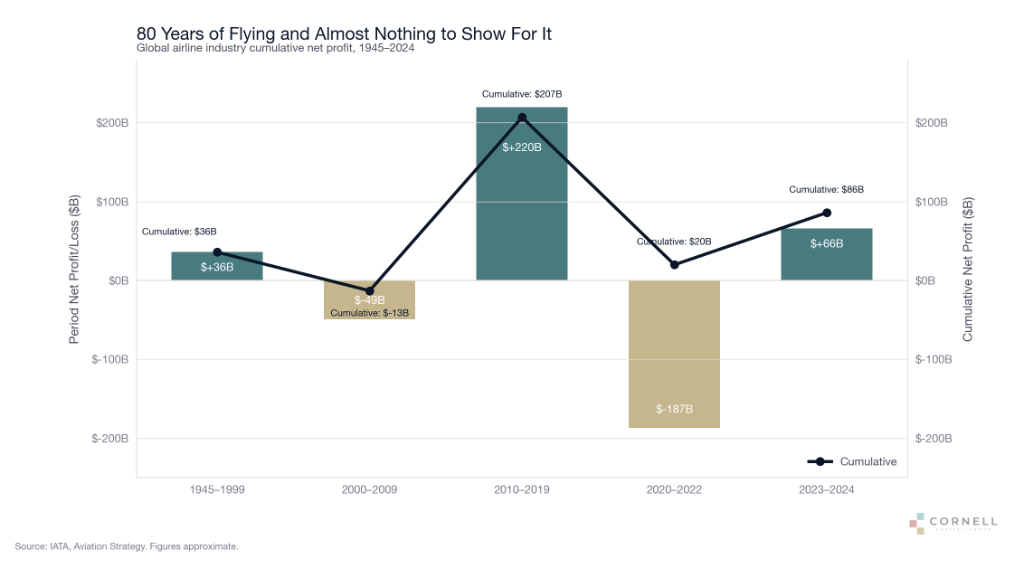
Second: commercial aviation. Over the past 80 years, the global airline industry produced about $86 billion in cumulative net profit. The three years of the Covid pandemic alone wiped out nearly $190 billion. Warren Buffett once put the structural problem this way: "If a far-sighted capitalist had been present at Kitty Hawk back then, his best move would have been to shoot Orville Wright down. It would have saved later investors endless trouble." Buffett himself sold out of stakes in four U.S. airlines in 2020 at a loss of about $5 billion.
Third: the late-1990s telecom bubble, which the report treats as the closest direct comparison. More than $500 billion poured into fiber-optic cable and wireless networks, much of it financed with debt. By 2002, more than 23 major telecom companies had filed for bankruptcy, about $2 trillion in market value had been erased, and less than 5% of installed fiber had been lit. But the cheap bandwidth left behind by failed investors later helped make Netflix, YouTube and the wider cloud computing industry possible.
Cornell Capital’s conclusion is harsh and direct: the paradox of transformative technology is that the more companies spend and the harder they compete, the faster the technology gets commoditized. Great for consumers. Bad for investor margins.
The cash flow squeeze is already visible
Reuters’ analysis of LSEG data gives that argument a financial-statement backdrop.
Oracle is the clearest example of pressure right now. Its capex as a share of operating cash flow rose from 47% in fiscal 2022 to 174% in fiscal 2026, through May of this year. Capex hit $55.7 billion while operating cash flow was only $32 billion, pushing free cash flow negative. Oracle shares are down 36% this year, and the company plans to raise $45 billion to $50 billion through debt and equity financing for cloud infrastructure expansion.
Microsoft posted $35.8 billion in operating cash flow in its latest quarter, while capex including finance leases reached $37.5 billion. Amazon’s operating cash flow over the past 12 months rose 30% year over year to $148.5 billion, but free cash flow fell to $1.2 billion.
Shay Boloor, chief market strategist at Futurum Equities, said investors are underestimating how deeply AI is changing the business model of large technology companies. Historically, these firms were seen as asset-light platforms because revenue growth could run far ahead of capital needs. AI is pushing them toward a hybrid model, one where the economics of software, advertising and cloud rely more and more on heavy physical infrastructure spending.
Mrini’s math is tougher. If current capex guidance continues through 2027 and a 15% pre-tax return on investment is used as the benchmark, AI compute revenue would need to reach about $2.9 trillion by 2030 to cover the cost of deployed capital. That is more than three times the current size of the entire cloud market. Starting from a base of about $211 billion, that implies roughly 68% annual growth for five straight years, which he said has no precedent in infrastructure markets.
Reflexivity changes the nature of the risk
Citrini’s framework for the shift in AI financing is one of the clearest ways to read the current trade.
He splits it into two phases. In phase one, hyperscalers funded spending with their own operating cash flow. That meant semiconductor names and other beneficiaries had a fundamental floor as long as those companies kept investing. As he put it, whether the market was worried about tariffs, the yen carry trade, or whatever investors were focused on in September 2023, fundamentals were still improving.
Phase two is different. Citrini said: "Now, nearly every incremental dollar of spending in AI is coming from equity financing—whether venture capital or the public markets—and from debt financing. That means AI can become more useful, usage can keep expanding, but you may still be paying too much for the compute supplying it; or sentiment can produce a much bigger shock, because unlike before, there is no fundamental floor. If market sentiment turns, that incremental capital dries up, because this is no longer just a company spending money. The market is deciding it."
The main point is this: once the funding source changes, sentiment stops being an outside variable and becomes an inside one that can directly change investment size. Citrini calls that reflexivity. Confidence supports financing, financing supports investment, investment supports revenue expectations, and those expectations loop back into confidence. If any link weakens, the positive loop can run in reverse.
He also laid out a possible trigger. The turn in the cycle, he said, may come with a sigh rather than a bang. Not a default. Not some dramatic collapse. It could be a cut in combined lab ARR forecasts from $400 billion to $360 billion, and because that growth is already fully priced, the incremental downgrade could spread outward and pull the whole system lower.
Why Jevons Paradox may not save AI infrastructure
One of the main bullish assumptions behind AI infrastructure spending is Jevons Paradox: lower compute costs should unleash enough demand to absorb new capacity. Mrini accepted that logic in part, but said it has limits in AI. Enterprise integration is slow. Regulatory constraints are real. Efficiency gains are showing up mostly at the model layer, and the demand response may go to application developers and model providers rather than the infrastructure layer that sells compute.
His formulation is simple: Jevons Paradox can hold for AI as a technology while failing for AI infrastructure as a business model.
Citrini cited economic index data published by Anthropic showing that a 10% decline in task cost led to only about a 3% increase in usage. He added that when models are less useful, token demand may actually be higher because users keep revising prompts. In his words, that is not Jevons Paradox at all.
He also said AI revenue is currently growing at about 25% to 30% a year, while capex is growing closer to 60% to 70%. The gap between the two keeps widening with each guidance cycle.
Asked what would make him bullish on semiconductors again, Citrini gave a very clear condition: paid usage would need to keep rising, the second derivative would need to reaccelerate, and financing would need to be backed by customer cash flow. That, he said, requires real adoption gains, especially for frontier models.
The market is starting to separate winners from suppliers
High AI capex does not get the same market reaction anymore. Depends on the company.
Mrini said Meta has won market approval because its AI spending is already showing up in better ad targeting and improved ad measurement, helping revenue growth and margins. In that case, compute is built into a business with pricing power, and efficiency gains can directly reduce service costs.
Google and Microsoft are at a different stage. Their spending is obvious, but the application-layer payoff has not fully arrived in the income statement yet. Both are weaving AI into search, office software, Android, enterprise collaboration and agent tools, and both are fighting for control over agent workflow orchestration. In the short run, though, the market still sees the data center bill first.
Amazon and Oracle look more like infrastructure providers. Amazon has Alexa+ and its in-house Trainium chips, but much of its spending still points to AWS compute sold by the hour. Oracle is even more reliant on cloud infrastructure, and the financing pressure there is easier to see.
The dividing line is pretty clear. Can AI spending be turned into product revenue with pricing power? Or does it mostly support the sale of standardized compute resources?
That may define the next phase of the AI trade. Capex alone is no longer enough to count as a positive signal. The market wants a cleaner line from spending to revenue, margins and cash flow.
Reuters quoted Freddy Lavric, senior trader at Winthrop Capital Management, saying that over the next two to three years, companies will need to prove AI is generating incremental revenue, expanding margins and improving cash flow. If those financial benefits fail to show up, the market will start asking whether this investment cycle has gone too far.
The real test is whether capital lasts long enough
None of this means AI-driven technological progress has vanished, or that demand has dried up. Hyperscalers are still expanding infrastructure because they believe AI will be central to long-term competitiveness.
The problem is that if every participant believes it cannot afford to sit out, they may collectively create excess supply. And if every participant leans harder on financing, market sentiment can shift from observer to determinant of investment size.
The prisoner’s dilemma explains why spending keeps rising: no one wants to fall behind. Reflexivity explains why the market has become more fragile: when internal cash flow no longer covers incremental investment, stock prices, bonds, financing appetite and capex start influencing one another. In optimistic periods, that mechanism amplifies expansion. But if revenue realization lags expectations, it can amplify contraction too.
Whether AI infrastructure turns into a high-return asset or an expensive commoditization treadmill may come down to one simple, nasty question: can demand growth outrun falling compute prices, and can that be proved before the equipment being funded today has finished depreciating?



