
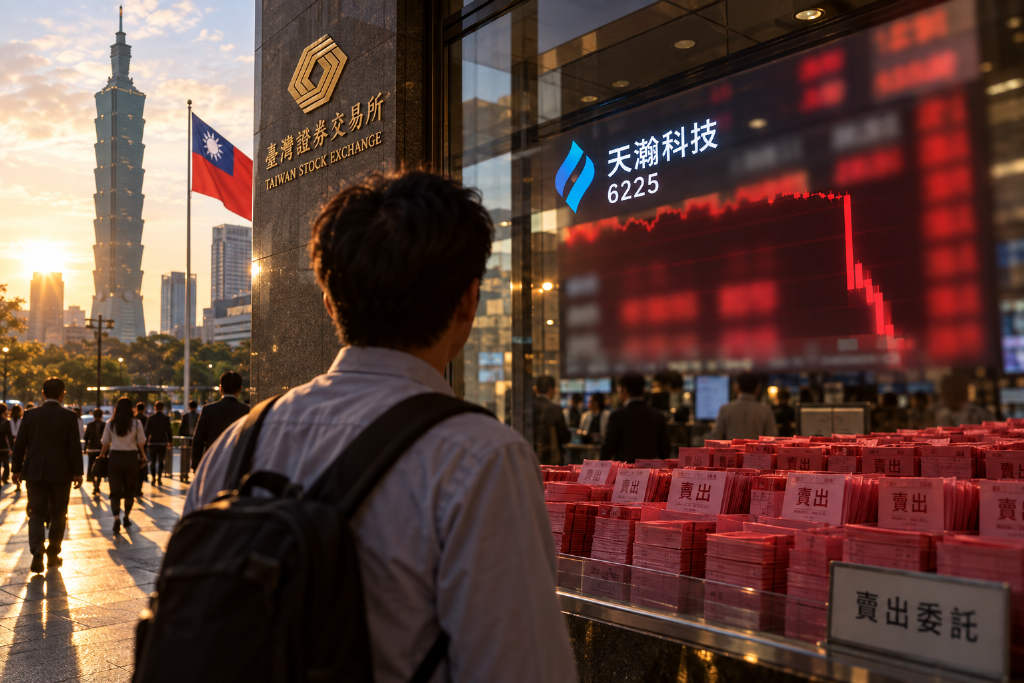
Aiplex Technology (6225) saw its newly issued shares from a cash capital increase begin trading on Tuesday, but the market did not get the expected post-allotment rally. The stock opened sharply lower and immediately hit limit-down, while more than 1,000 lots lined up to sell at the down-limit price of NT$51.3. Volume shrank sharply, leaving successful subscribers facing a liquidity squeeze and little room to exit.
More than 510,000 subscriptions chased the deal
Aiplex issued 32.2 million shares in the capital increase, with the underwriting price set at NT$17.65 per share. During the public subscription period, the stock at one point climbed above NT$80 in the secondary market. That implied a potential paper gain of more than NT$60,000 for one lot, drawing more than 510,000 subscription applications and leaving the winning rate at only about 0.53%.
Once the new shares were credited and listed, that arbitrage thesis quickly broke down. Investors who had been targeting the spread turned into sellers at the open, and the stock was pinned at limit-down almost immediately.
Full-cash settlement structure amplified the selling pressure
The report describes Aiplex as a full-cash settlement stock that has already been placed under altered trading rules because of its low net asset value per share. Under the current system, buyers of full-cash settlement stocks must prepay in full, which usually means weaker liquidity than in ordinary stocks.
On the first trading day for the new shares, 2,737 lots from the public allotment entered the market together with a large amount of other capital-increase shares. Retail investors seeking what they viewed as short-term, low-risk arbitrage crowded into the sell side at the same time. The result was a stock locked at limit-down from the open, with more than 1,000 lots queued to sell and only limited buying support.
Ancheng Investment’s full waiver had already signaled trouble
The article says the opening collapse was foreshadowed by the earlier moves of a major shareholder. Before the capital increase, Ancheng Investment was Aiplex’s largest institutional shareholder, holding more than 46% of the company. During the key payment period, it disclosed that it would give up its entire allotment of 6,021,203 shares and authorize the chairman to place all of them with specific investors.
That amounted to more than 6,000 lots, according to the report. After the capital increase, Ancheng Investment’s ownership stake was diluted to about 15%.
The report cites market chip analysts as saying that a major shareholder stepping away from the subscription can amount to transferring a large block of the capital increase to outside designated investors, possibly as part of an ownership restructuring or shell-related arrangement. For retail participants in the secondary market, the decision by the major shareholder to forgo every share was presented as a strong sign that support at higher prices was no longer there and that shareholding structure was being reshuffled.
Paper spreads can disappear when liquidity dries up
The article quotes a market analyst as saying, 「This is a typical case of liquidity risk swallowing paper profits.」 The analyst said many investors focused only on the large discount between the NT$17.65 underwriting price and the market price, while overlooking the fact that a full-cash settlement stock may not have enough normal market depth to absorb profit-taking once a large batch of newly issued shares comes to market.
If the stock remains locked at limit-down and fails to reopen effectively, the paper gains expected by winning subscribers could shrink quickly under the market’s daily 10% downside limit. The report frames the episode as a capital increase restructuring story shaped by a major shareholder’s waiver, a rush of retail subscriptions, and a first trading day that began at limit-down. Its closing point is straightforward: in this type of arbitrage trade, exit liquidity matters more than the visible spread.