

Akash is moving toward a full migration from Cosmos to Solana after Proposal 346 won 98.42% support as of Oct. 27, with turnout above 50% and comfortably past quorum. Voting remains open until Nov. 2, but Akash founder Greg Osuri has already confirmed that the migration will go ahead.
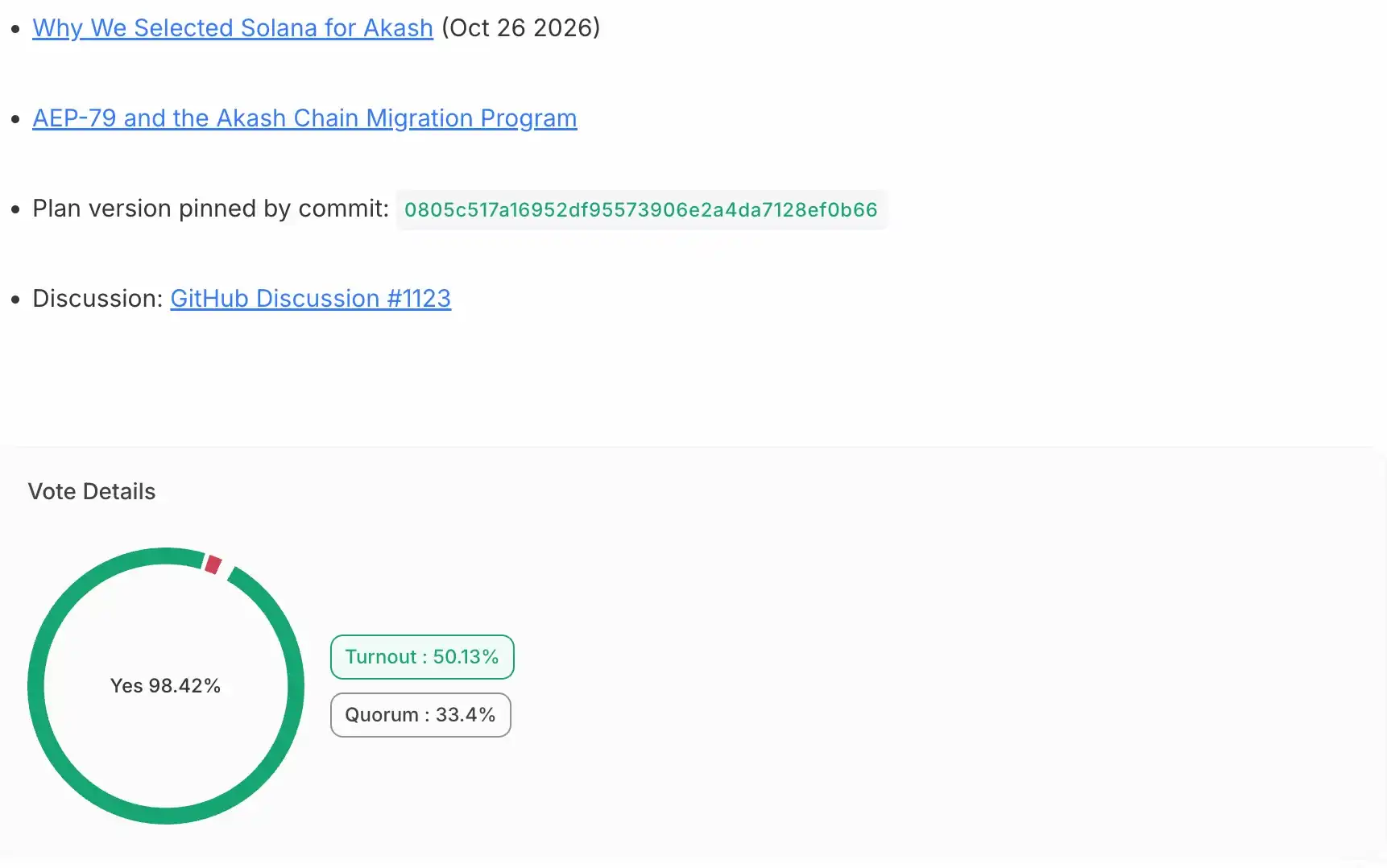
The shift would end Akash’s use of its sovereign chain, akashnet-2, and move both the token and protocol to Solana. For a project that spent years inside the Cosmos stack, the decision amounts to a reset of its infrastructure model. The team’s argument is straightforward: the cost of running an independent chain has become a drag on the growth of its decentralized compute marketplace.
Akash says the sovereign-chain model no longer fits its compute business
In its official blog, the Akash team laid out the economics behind the move. Under the current Cosmos-based setup, Akash operates its own sovereign chain with about 100 validators staking large amounts of AKT to secure consensus. That capital secures the network, but the team said it does not directly add value for buyers and sellers using the compute marketplace.
There is also an engineering burden. Core developers have had to maintain forked versions of cosmos-sdk and CometBFT over the long term, while coordinating upgrades across the validator set. For a marketplace focused on renting compute, Akash said its order flow and settlement logic do not require deep customization at the base-layer level.
Through AEP-79 in 2025, the team evaluated several paths, including keeping the sovereign chain, moving to an Ethereum L2, and rebuilding on Solana mainnet. According to the comparison cited in the report, if Akash restructures the business as a native Solana program, the entire compute marketplace would incur only 0.075 SOL per day in network fees, or roughly a little over a dozen dollars.
By giving up direct control over consensus, Akash said it can remove millions of dollars in capital lockup and cut development and operating costs, freeing resources for customer acquisition in the AI compute market.
A one-way migration path with a two-year window
Proposal 346 sets out a migration structure with deliberate friction. Within two to three weeks after approval, and after security audits are completed, AKT would be issued on Solana as a native SPL token. A one-way migration portal would then open for two years.
The conversion is set at 1:1. The ticker stays the same, and the token will keep six decimal places. Once holders move AKT from Cosmos to Solana, the corresponding tokens on Cosmos will leave circulation. There is no route back. The proposal treats the process as irreversible.

That design has drawn objections from some participants on the old chain. Validator node cosmosrescue, which holds 0.63% of the voting power, voted against the proposal and argued that the sequencing is misaligned. In its view, Proposal 346 asks token holders to decide on migration as soon as the one-way portal opens, while the formal cutover of the compute marketplace code would still depend on another vote months later. During that interim period, key rules remain unsettled, including how unmigrated tokens would be handled after the old chain stops and what the emission curve on the new chain would look like.
The proposal also starts the clock for the validator set. For the roughly 100 validators that keep the current chain running, the end state is explicit: 90 days after the final market cutover, the old chain would halt, and validator roles and staking income would end with it.
Akash ruled out staying inside Cosmos
The report frames Akash’s move as part of a broader restructuring among older Web3 infrastructure projects. In its 2026 review, the Akash team explicitly ruled out staying within the Cosmos system. The reasons given were liquidity and the clustering effect of comparable projects.
According to the article, Cosmos has been losing both capital and projects. Noble, a native stablecoin issuance chain, left in March this year. DATA Network and other projects also moved to Sui because the cost of maintaining an independent chain was too high.
Solana, by contrast, has become a destination for major DePIN networks. Helium shut down its own chain and completed its migration in 2023. Render and io.net, among other projects with a combined valuation above $3.5 billion, later launched on Solana as well. For a compute project like Akash that depends on high-frequency billing, the article says Solana offers $15 billion in stablecoin supply and more than 2.2 million daily active paying users, making it a settlement rail for institutional capital and enterprise expansion, including channels tied to products such as BlackRock’s BUIDL.
What AKT holders need to watch
The migration would change how nearly 300 million AKT move through the market and how staking works. The proposal lays out several operating rules and constraints:
- 1:1 one-way conversion: The official cross-chain portal is scheduled to go live two to three weeks after approval and remain open for two years. AKT will be issued on Solana as an SPL token with the same ticker and six decimals. Once migrated, the tokens cannot be moved back to Cosmos.
- Unstaking takes 21 days: Stakers must first unbond, which carries a 21-day lockup. The official portal will support a single transaction that triggers unbonding and queues the cross-chain move. Before the formal cutover of the compute marketplace, staked assets that remain on the old chain will continue to earn rewards.
- Different handling for self-custody and exchanges: Self-custody wallet users will need to connect addresses on both sides through the official portal. Akash said it will provide a fee-sponsored relayer, so users will not need to buy SOL in advance. Centralized exchanges are expected to handle the process in the background, with no manual action required from users.
- Phishing is the top security risk: The team said phishing sites tied to cross-chain approvals are the main threat, and users should wait for the official channels to publish the one and only portal domain.
Akash’s departure from Cosmos with nearly 300 million tokens marks a major shift for a long-running project. The article’s conclusion is that once a protocol is pushed to pursue real business growth, a shared public chain with lower marginal costs and deeper stablecoin liquidity can become more practical than maintaining an expensive standalone chain.



