
Alea Research says MetaDAO’s main constraint is no longer whether buyers will show up. The harder problem is whether the platform can keep finding enough companies that are actually worth funding.
The report says MetaDAO has run 23 public sales since its first offering in April 2025. Those sales drew $624.7 million in subscriptions, while the platform accepted $45.4 million and returned the rest. Twenty-two of the 23 sales still reached their fundraising targets. Alea argues that buyers keep coming back because what happens after the sale looks different from most launch platforms.
On MetaDAO, the money does not simply move to founders and disappear from investor control. Treasury funds stay under buyer governance, along with a company’s intellectual property and the right to issue more tokens. Without market approval, none of that moves.
Restart plan and the September push
Alea says MetaDAO announced a restart on Sept. 1, with a plan to rebuild venture capital for the internet and add institutional allocation through For Funds seats.
The report highlights several operating rules. META holders control the treasury, intellectual property, and issuance rights. Any new token issuance requires a public proposal, a stake of 200,000 META, and a three-day market process in which traders price the proposal. Revenue arrives later, because fees only start to accrue once the tokens created through fundraising begin trading.
That lag shows up in the numbers. Alea lists fee revenue at $1.8 million in the fourth quarter of 2025, $556,000 in the first quarter of 2026, and $376,500 in the second quarter. Third-quarter figures are tracked through Sept. 30.
Companies are listing later, and more value stays private
The report starts with a broader market shift. The median age of U.S. companies going public was 5 years in 1999 and 2000. After 2001, that figure rose to 11 years. By 2024, it had reached 14 years.
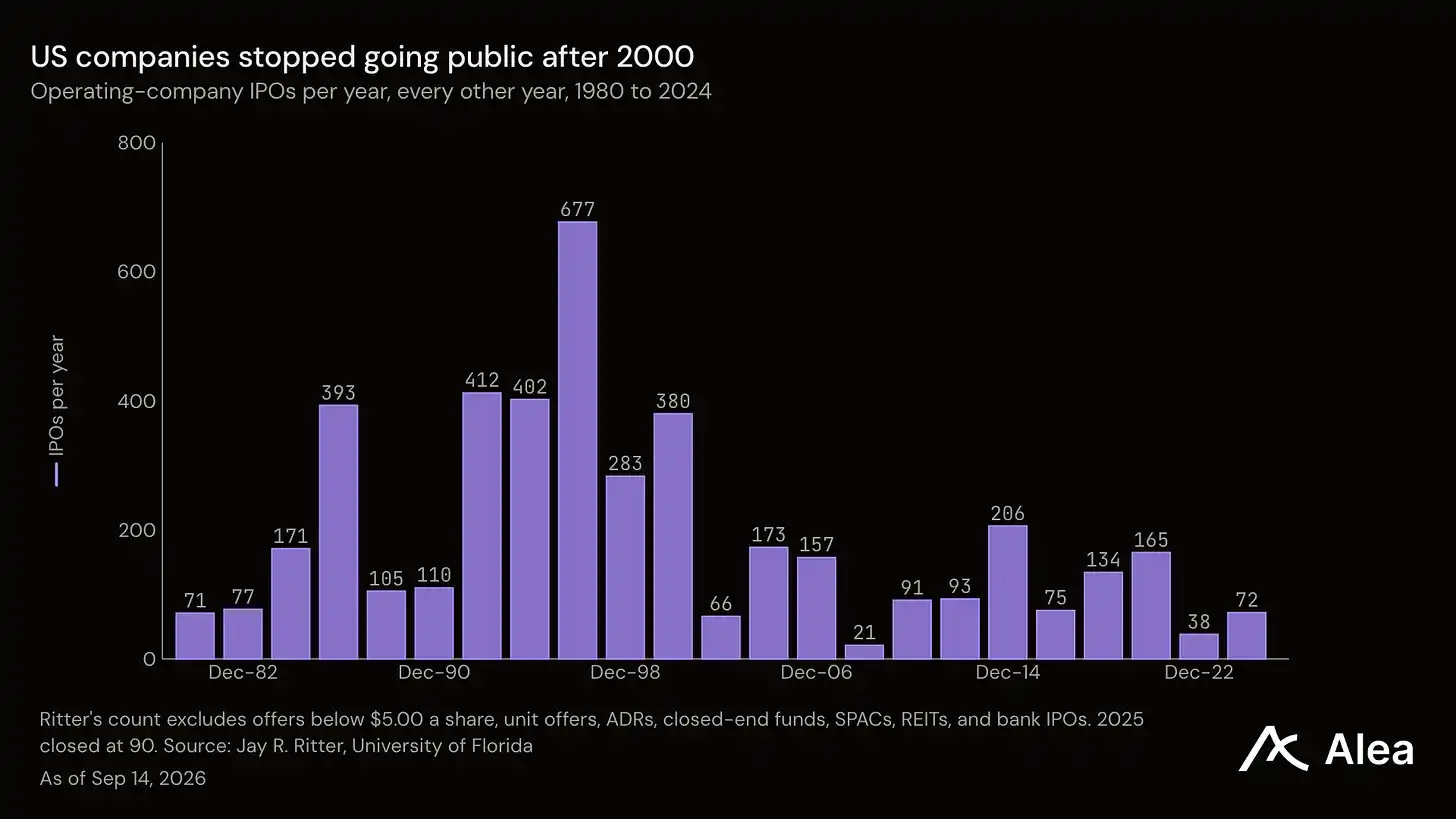
At the same time, the number of domestic operating companies listed on U.S. exchanges fell from 7,451 in 1997 to 3,657 by the end of 2025. Even when companies do go public, the median share of equity sold has dropped from 33.3% in 1993 to 14.5% now.
Alea uses SpaceX as an example. The company stayed private for 24 years and went public in June 2026 at $135 per share, closing its first day at $161. That roughly 19% first-day gain transferred about $14.4 billion to institutions that received allocations. Retail investors got what was left, with reports saying that was in the low-20% range of the offering.
The report also points to access rules in private markets. It says 24.3 million U.S. households, or 18.5% of the total, qualify to buy into those later-stage private rounds. The threshold is $200,000 in annual income or $1 million in net worth excluding a primary residence. Congress set those numbers in 1982 and never raised them. SEC records show the share of qualifying households rose from 1.8% in 1983 to 18.5% today, driven almost entirely by inflation.
Crypto, in Alea’s view, offers a better capital formation mechanism. Private company shares are entries on legal paperwork and require a buyer, board approval, and a transfer agent to move. Tokens are bearer assets on a public ledger. They can be priced continuously, settled in seconds, and governed by code every holder can read. Alea says crypto has been able to do this since 2017. What it kept getting wrong was everything that came after the money changed hands.
Most fixes stopped at the sale itself
Alea runs through a long list of earlier attempts. Regulation Crowdfunding has recorded $1.5 billion since 2016, with an average raise of $359,000. Investors cannot mark those positions to market, and records show 47% of issuers stopped filing annual reports. Regulation A+ saw $31.7 billion sought and $10.5 billion actually raised.
SPACs briefly gave retail investors a way in before mergers closed. In 2020 and 2021, 861 SPACs raised $219.9 billion. Deals completed in 2021 posted returns of -64.2% after one year and -73.0% after three years.
Crypto ran the same pattern faster. ICOs absorbed about $20 billion in 2017 and 2018, and Alea says the estimated failure rate for the 2017 cohort was between 46% and 59%.
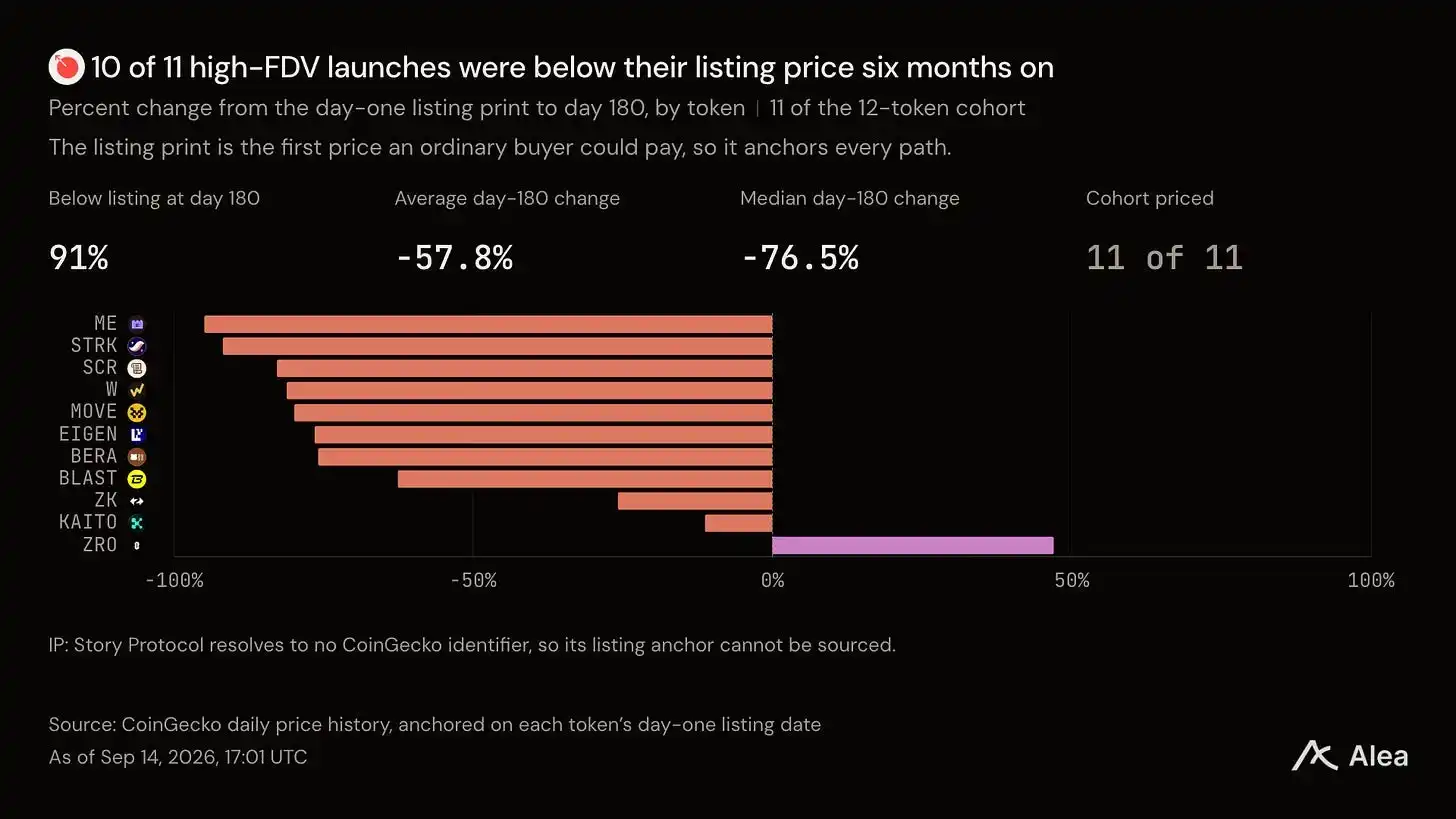
By 2024, the market answer had become low float. Only 6% to 20% of supply traded at listing, while prices implied a fully diluted valuation. Alea estimates those launches needed about $80 billion in fresh buying just to hold prices up against future unlocks.
Then 2025 rebuilt the gatekeeping that crypto had claimed it would remove. Plasma filled a $500 million cap in about five minutes. Falcon Finance targeted $4 million and took in $112.8 million. Of the 118 offerings recorded in 2025, 84.7% fell below issue price, with a median decline of -71.1%.
The report also points to Echo. Alea says Echo pushed harder than anyone else to reopen public sales, then sold to Coinbase for $375 million, even though the projects on its platform had raised only a little more than $200 million in total. In Alea’s telling, the platform itself ended up worth more than everything it had funded combined.
All of these systems, the report says, sold the same thing: a place in line. Reg CF sold shares with no readable price and no exit. ICOs and 2025 token sales sold tokens, but issuers still decided on their own how to use the proceeds. Buyer influence ended at the wire transfer. MetaDAO changes the part that comes after.
Curated sales and open access produce very different outcomes
MetaDAO runs two kinds of sales on the same contracts and the same fee schedule, according to Alea. One set is selected and promoted by the platform. The other can be launched by anyone. The results are far apart.
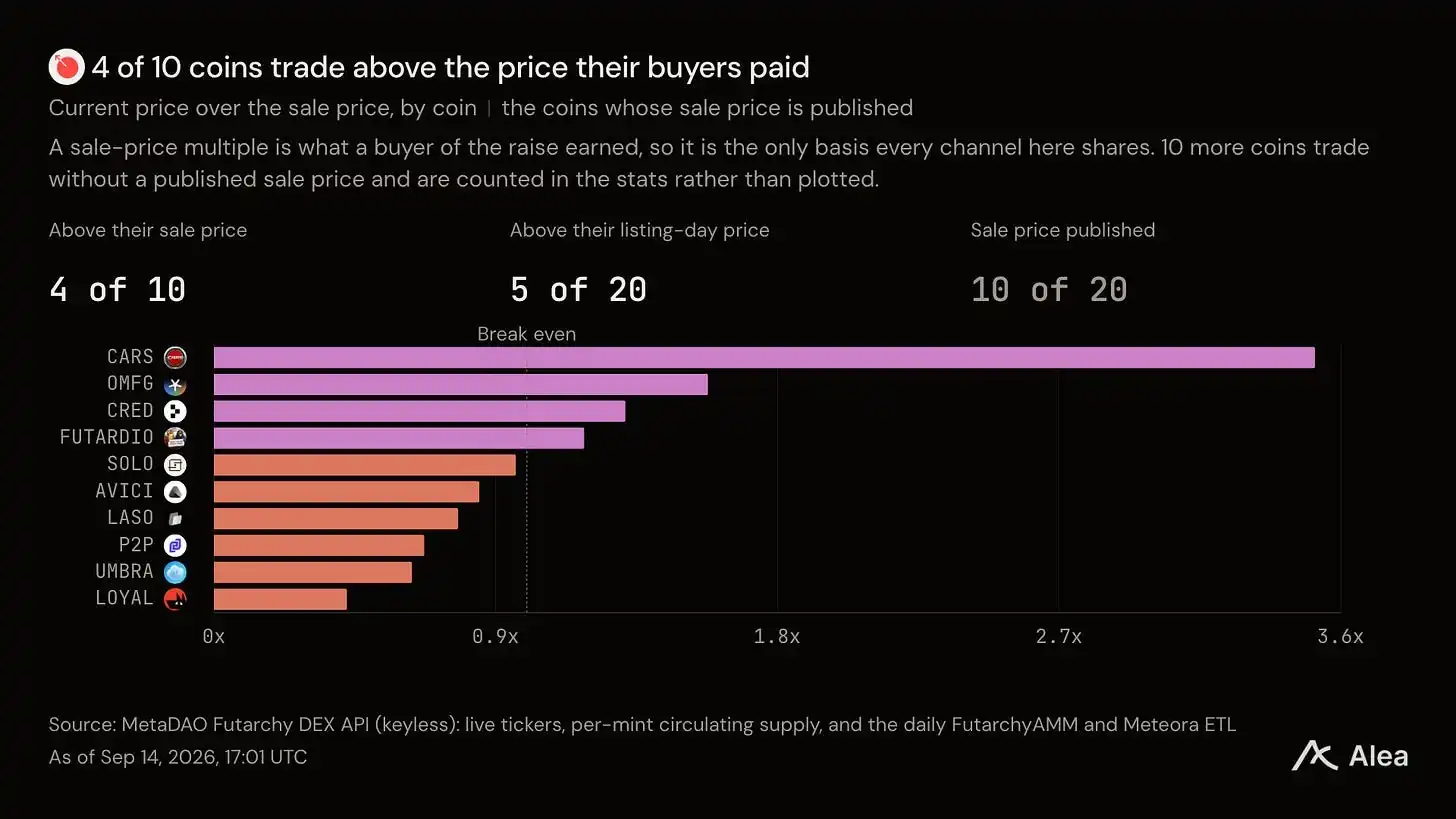
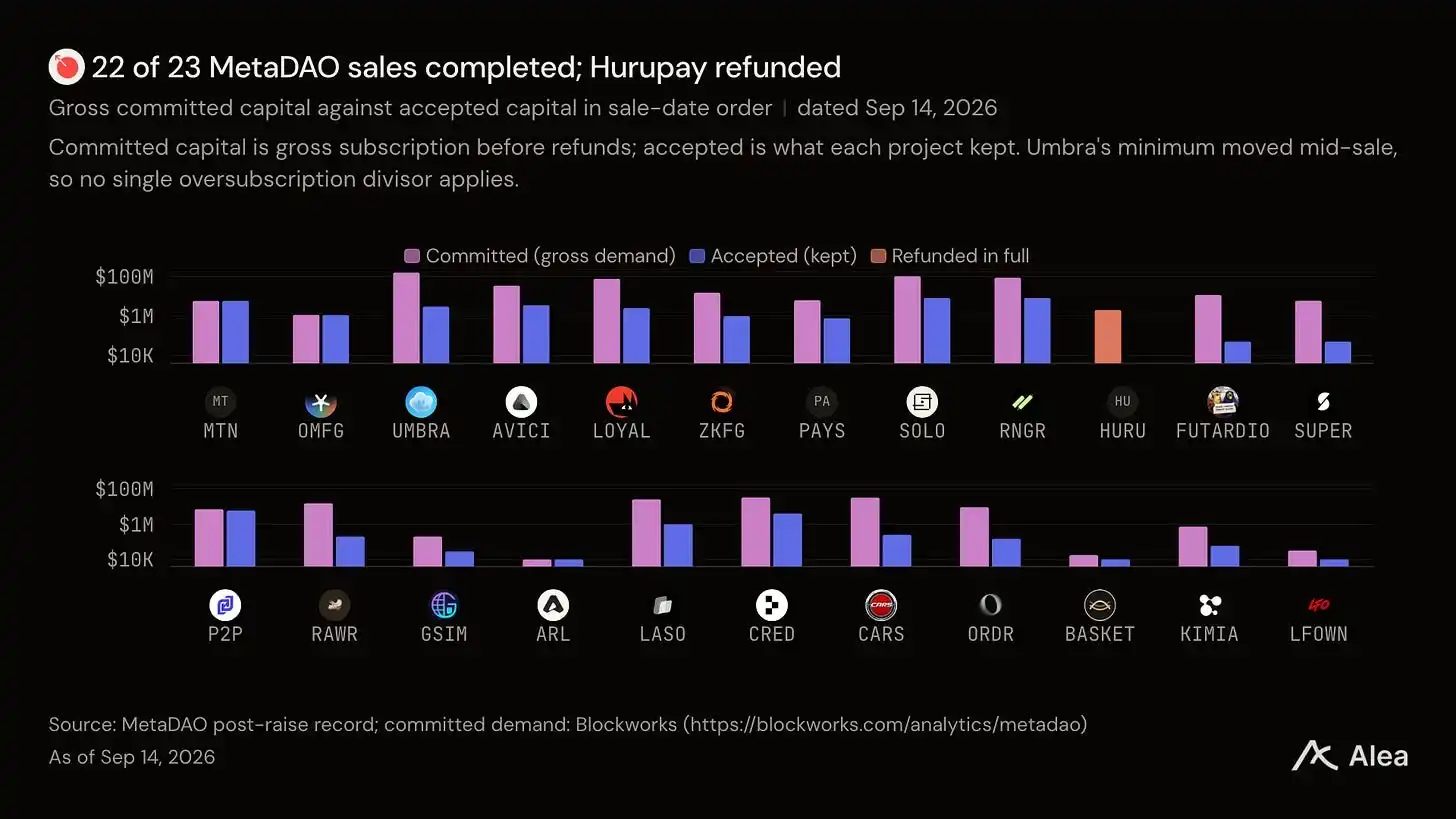
The rules include discretionary caps, meant to let committed buyers subscribe without allowing projects to raise too much. Rip Cars wanted to raise $250,000 in July. It drew $32 million. MetaDAO kept the $250,000 target and refunded the rest, allowing the company to start at a valuation Alea says still leaves room for the product to grow into it.
Across all 23 sales, subscriptions totaled $624.7 million and accepted capital came to $45.4 million, with 22 sales completing.
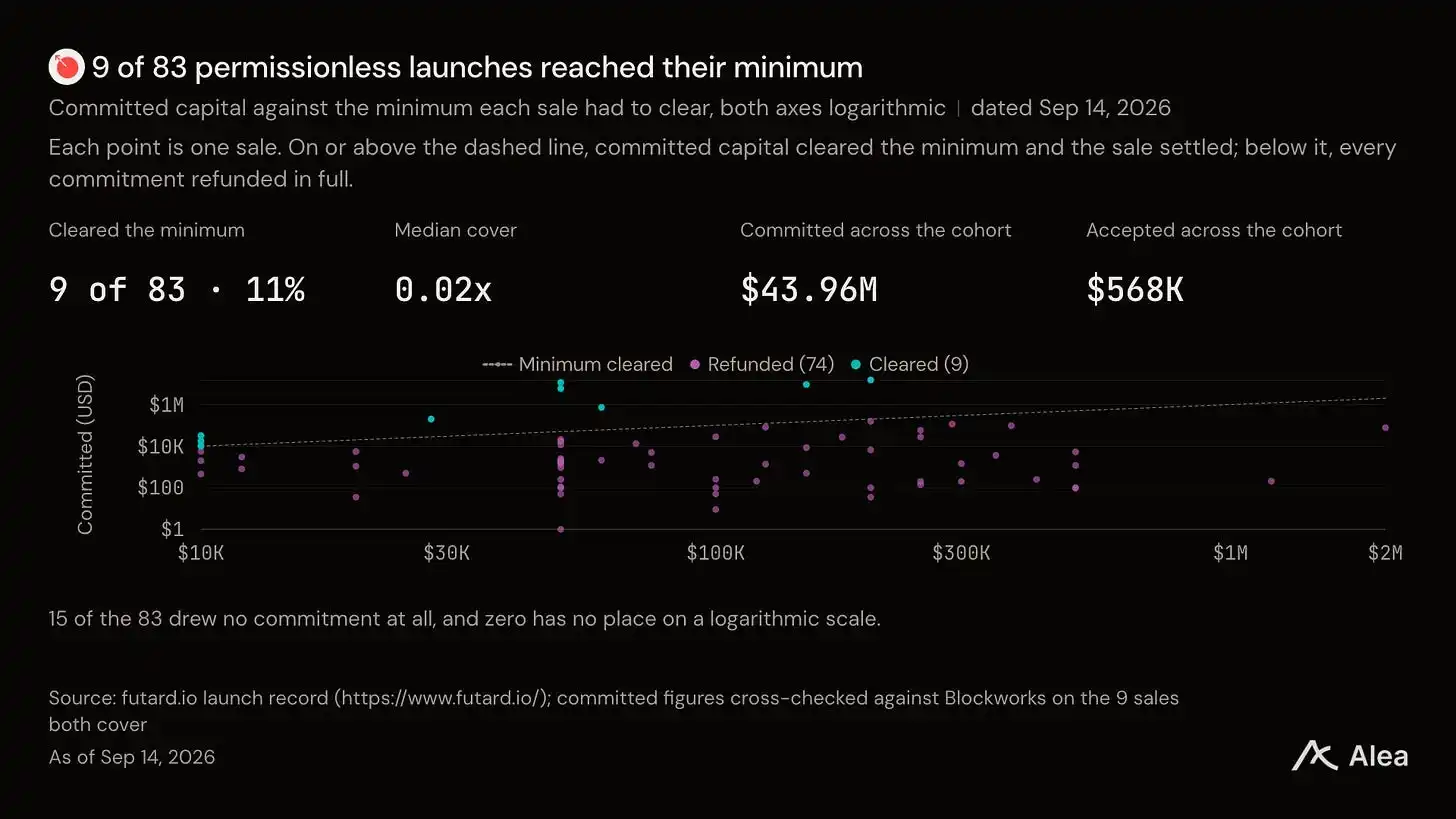
The open-access venue is futard.io. Alea says anyone can launch there and MetaDAO publishes the full record. So far, 90 sales have run on that side. Only 9 cleared the minimum threshold. Out of $44 million in subscriptions, just $568,000 was accepted. Same buyers, same contracts, same fees. The difference, Alea says, is whether someone is selecting the companies.
MetaDAO has also written more judgment into the rules. In July it introduced Ownership Score, which allocated half of Rip Cars’ capacity based on how early participants subscribed and how long they stayed. Alea says it published a full breakdown of that formula in July.
Even so, the cap table still fills from the top. Alea says onchain lending project Credible raised through MetaDAO in June, with 77% of subscribed capital coming from wallets of $100,000 or more. Another roughly $2.3 million had already been committed before the sale opened. Open access did not make the buyer base smaller.
Live pricing, binding control, and exits without a corporate buyer
Alea says MetaDAO is selling token buyers one core promise: they do not have to trust founders. The report notes that this wording appears directly in the platform’s investor materials.
It uses Solana’s 2021 cycle to show why that matters. Parrot raised $85 million, and reports said the team kept $72 million. Aurory raised $108 million, and its token later fell 99.5% from its peak. Both outcomes were legal, Alea says, because nothing in those deals stopped teams from deciding on their own how to spend the money.
That is not how MetaDAO works. Treasury spending requires a public proposal, and anyone can take the other side of that proposal in the market.
Alea says ownership coins give buyers three things private shareholders do not get.
- First, live pricing. MetaDAO publishes monthly runway and valuation figures for each company, and it discloses its own treasury every quarter down to the dollar. Private companies disclose nothing. Public companies disclose quarterly, and even then with a 40-day delay.
- Second, binding influence over every dollar. In July, someone proposed moving $1.6 million from Umbra’s treasury to an external wallet. Traders priced the proposal negatively, indicating the company would be worth less if the money left, and the proposal was recorded as rejected. In August, holders refused to liquidate Kimia and chose to keep funding the team. In September, they renegotiated one founder’s unlock schedule in public. None of that required founder permission.
- Third, an exit that does not depend on finding a company buyer. Ranger liquidated and returned $5.05 million to holders, or about $0.78 per coin. Paystream was voted into liquidation on Sept. 2. ZKFG only succeeded in going private on its second attempt: the first failed with 50 participants, the second passed with 67.
The same rules written into token documents also bind META itself. Alea says the treasury, intellectual property, and issuance rights all sit under decision markets, with traders rather than voters settling each proposal. New tokens require a public proposal, a 200,000 META stake, and a three-day market before they exist. There are no scheduled unlocks and no vesting outside governance. MetaDAO also published a MiCA white paper under the digital token identifier BQ53DH590.
How MetaDAO makes money, and how thin participation still looks
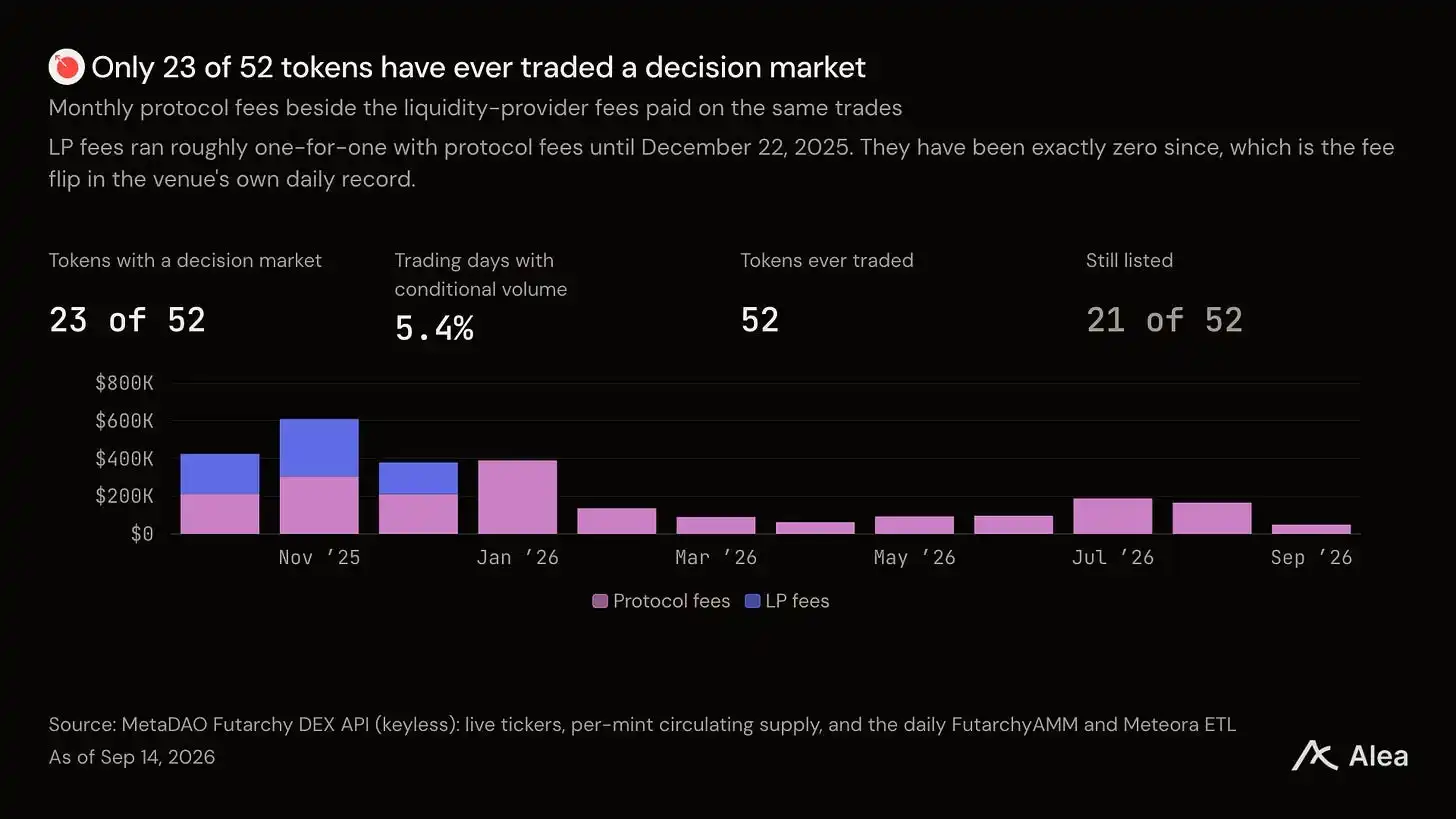
MetaDAO charges 0.50% on each trade through its Futarchy AMM. Since Dec. 22, 2025, all of that has gone to the protocol, Alea says.
Those fees have accumulated into a treasury of about $9.95 million, including $1.4 million in META itself. Against a market capitalization of $109.6 million, Alea calculates META at about 11.0x its governance assets, or about 12.7x if the token itself is excluded from treasury assets.
For now, the fees remain in the treasury and holders decide what to do with them. Alea says MetaDAO has already built fee switches, revenue sharing, and burn mechanisms for companies it incubated, so it already knows how to route value to holders if its own holders choose to do that.
The group making those decisions is still small. MetaDAO records show a median of about 12 traders per decision. One proposal in September passed with only two participants. Out of 51 tokens, only 23 have ever seen decision-market trading, and those markets were open on just 5.4% of days.
Participation rises when real money is clearly on the line. One recapitalization drew 102 traders, one allocation drew 92, and one privatization drew 67. Alea says routine operating expenses attract little attention, which is what thin markets usually look like before they become worth spending time on.
What rivals would have to rebuild
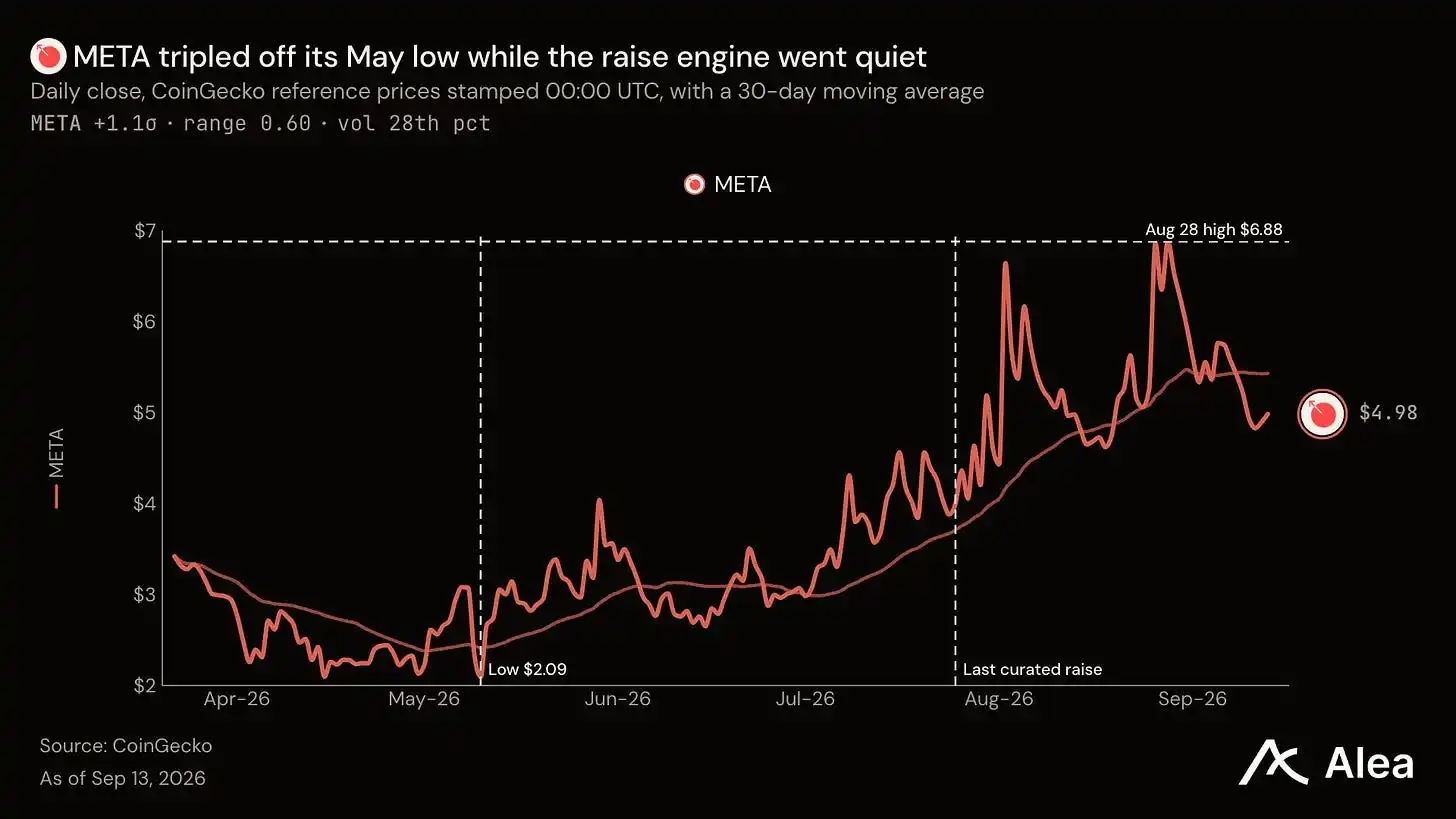
Because MetaDAO earns fees from trading, and fundraising creates the tokens that later trade, fee revenue tends to lag the fundraising calendar by about a quarter. Alea says the protocol recorded $1.8 million in the fourth quarter of 2025 after the autumn cohort listed, then $556,000 in the first quarter of 2026. March fell as low as $67,000. Revenue recovered to $199,000 in July as Credible and Rip Cars started trading. The first 13 days of September produced $47,000, even though the last curated raise had closed on July 25. Alea says that curve is the shape of the business.
That is why this year’s work is centered on finding more companies worth raising for. Alea argues that this is the part competitors cannot copy quickly.
It points to the STAMP agreement released in December by Colosseum and Orrick, a standard legal package in which investors hold only the token. Hackathon winners move into an accelerator and then into fundraising, giving MetaDAO months to watch teams build before underwriting them.
The report also cites two treasury moves. METADAO-039 allocated $2 million to seed Ownership Capital, a fund that buys these companies and votes. META-040 moved another $2 million in treasury USDC into a yield-bearing stablecoin built by a company incubated by MetaDAO itself. Add the September restart and the For Funds seats, and the platform is now selling guaranteed allocations to institutions.
Alea groups that into four pieces: pipeline, legal templates, an in-house fund, and institutional demand. Rivals would need all four in place before even running a first sale.
META traded ahead of new fundraising, and the buyback machinery already exists
The report says buyers are already paying for the pipeline before it produces new deals. META bottomed at $2.09 during the May revenue trough, then reached $6.88 on Aug. 28, three days before the restart announcement and five weeks after the previous sale had closed. It finished at $4.98 on Sept. 13, up 225% over one year and down 54% from its October 2025 high.
Returning value to holders is already part of MetaDAO’s operating model, Alea says. The platform has run Jito’s fee switch and Flash’s revenue share. On Sept. 8, Umbra holders approved a $250,000 buyback. A proposal for Sanctum to burn 259 million tokens was also reported this month. Each of those actions used the same decision-market structure that governs META itself.
Alea says the machine for META buybacks already exists. The treasury that could fund it has not been used for that purpose yet, and any holder can send the proposal into the market.
The open question is supply, not demand
Alea’s conclusion is straightforward. Buyers are willing to come. The mechanism works. Disclosure is stronger than what private markets or public markets usually provide. The unresolved issue is supply: can MetaDAO find and verify enough good companies to put the waiting capital to work?
The report notes that UMIA is chasing the same founder base on Base and has already raised $6.2 million from 2,700 wallets. Even so, Alea says MetaDAO starts with several advantages: 15 companies already funded, $13 subscribed for every $1 accepted, and a treasury controlled by holders.