

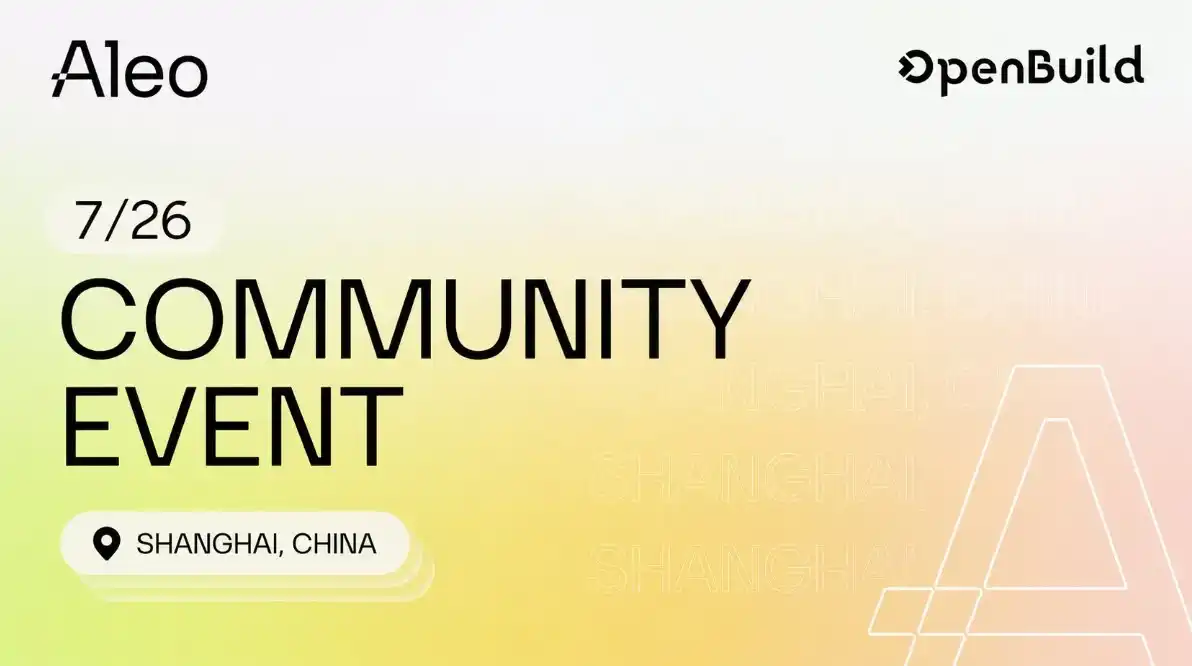
Aleo will hold the Aleo Shanghai Community Event on July 26 in Shanghai with OpenBuild, an open-source developer community, marking what the organizers describe as an important stop in the project’s Asia-Pacific ecosystem expansion.
The privacy-focused Layer1 blockchain said the event will bring together developers, entrepreneurs, Web3 practitioners and AI technology enthusiasts to examine trends in zero-knowledge proof technology and programmable privacy, as well as new opportunities created by the combination of AI and privacy computing.
Rather than following a conventional tech-sharing format, the event will place more weight on developer participation and practical engagement. Attendees will be able to try Aleo’s privacy infrastructure in person, complete live on-chain interactions and speak directly with the Aleo team to share product experience and feedback.
Shanghai event to open a new chapter for Aleo’s APAC developer community
According to the event description, the convergence of AI and Web3 has pushed data privacy, secure computation and trusted collaboration higher on the industry agenda in recent years. Aleo, which focuses on programmable privacy, said it has been building out a developer ecosystem around privacy computing technology.
The Shanghai gathering is also set to formally open a new phase for Aleo’s developer community efforts in China and the wider Asia-Pacific region. During the event, the official team will present the latest ecosystem developments and reveal initial details of its upcoming APAC Hackathon plan, including the contest structure, prize setup, mentor support and how teams will be formed.
AI and programmable privacy to headline the agenda
The main themed sessions will center on AI × Programmable Privacy, looking at how privacy computing could serve as part of the infrastructure for the next generation of the internet as AI agents and intelligent applications develop at a faster pace.
The program will also include a roundtable titled “Do Agents Need Privacy by Default?” Industry guests are expected to discuss data security, identity privacy and trusted interaction in future commercial applications of AI agents.
Hands-on product experience and community exchange included
In addition to keynote-style sessions, the event will include product experience, user feedback, community interaction and open networking. Organizers said the format is designed to help participants gain a deeper understanding of Aleo’s technology and connect with developers from Shanghai and nearby areas.
The event description says people already involved in zero-knowledge proof development, as well as those looking to better understand privacy-focused on-chain applications and AI-related technology directions, will be able to find room for discussion and collaboration on site.
Event details
- Event name: Aleo Shanghai Community Event
- Time: July 26, 2026 (Sunday), 13:30–18:00
- Location: Shengbang International Building, Shanghai
- Hosts: Aleo × OpenBuild
About Aleo
Aleo is a Layer1 blockchain built to support programmable privacy, aiming to let developers create decentralized applications that combine privacy protection with on-chain verifiability. The event materials say privacy transactions built on Aleo can settle on-chain while protecting sensitive data, with possible use cases including private stablecoins, global payroll, humanitarian aid, enterprise payments and other applications that require confidential information to remain protected.
The materials also state that Aleo has backing from a16z, Haun Ventures, Samsung Next and SoftBank, and continues to work on broader adoption of zero-knowledge proof technology.
About OpenBuild
OpenBuild is an open-source collaboration community for developers focused on areas such as Web3 and AI. It describes its role as helping developers move from ideas and learning to practice and product delivery, with the goal of cultivating a new generation of builders capable of independently creating products.