
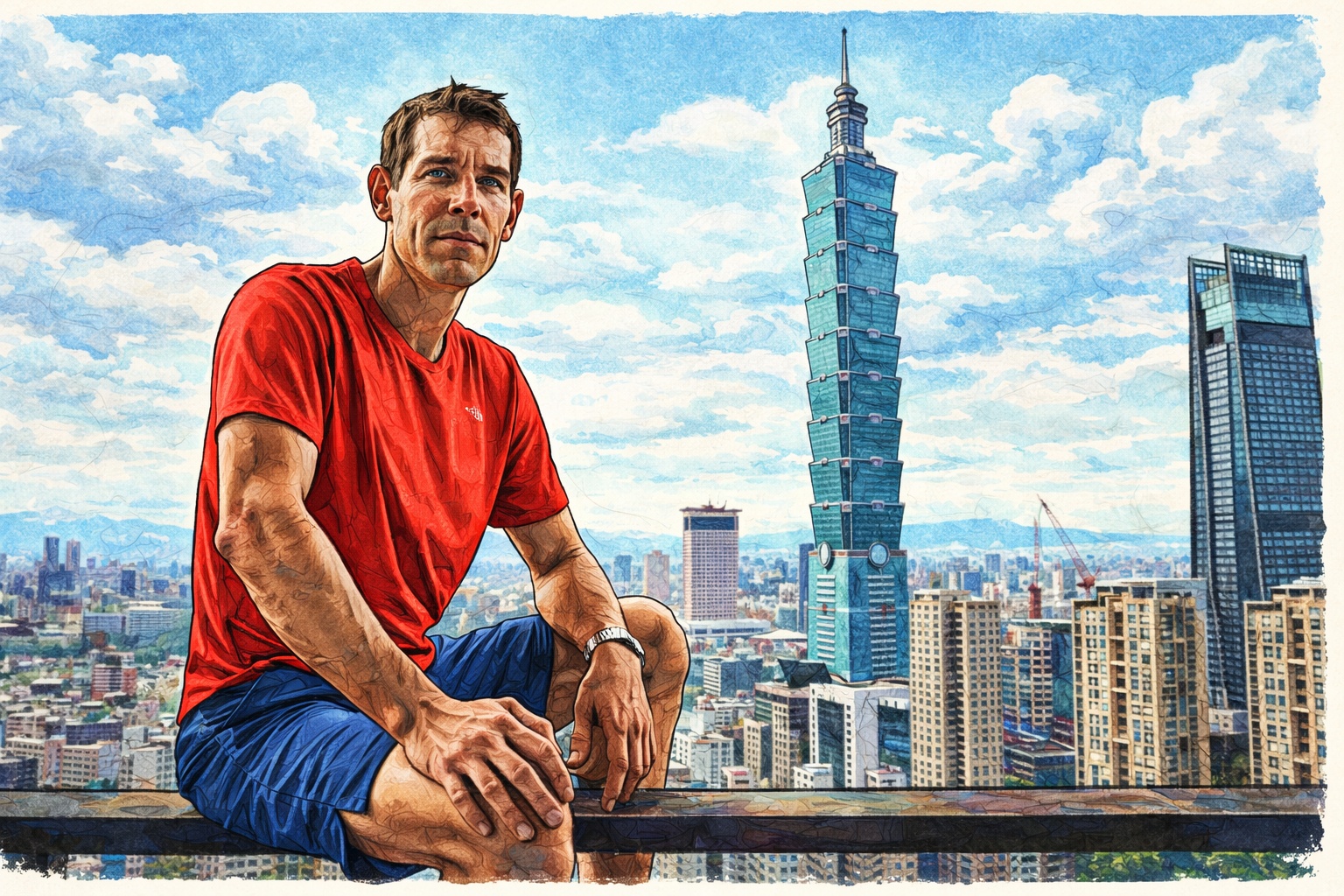
Alex Honnold is set to attempt a free solo climb of Taipei 101 at 9:00 a.m. Taiwan time on January 24, 2026, and the event has already spilled into crypto prediction markets. On Polymarket, the contract asking how long it will take him to complete the climb had drawn about $324,000 by press time, turning the stunt into a market event as well as a live sports spectacle.
Most Polymarket money is clustered around a 75 to 90 minute finish
The largest share of funds, 32%, was backing a finish time of 1 hour 15 minutes to 1 hour 30 minutes. Another 24% was placed on 1 hour 30 minutes to 1 hour 45 minutes, while 19% was betting on 1 hour to 1 hour 15 minutes. Those three windows were the most heavily funded outcomes at the time of reporting. A separate 10% of the money was backing the possibility that Honnold would not complete the climb.
Honnold, best known as the central figure in the Oscar-winning documentary Free Solo, is shifting from natural rock faces to one of Taiwan’s most recognizable skyscrapers. That alone has been enough to drive attention on-chain, with Polymarket users pricing the challenge in real time.
Taipei 101 presents a very different problem from natural rock
Unlike granite cracks and natural holds, Taipei 101 is built with glass curtain walls and aluminum alloy surfaces. Grip is limited. Honnold said at a recent press conference that the tower’s stacked, bamboo-like design is especially striking, but it also creates a repeated climbing problem: every eight floors, he must deal with an outward-leaning overhang rather than simply move straight up. On a natural wall, that would already be difficult. On this building, he expects to repeat that motion dozens of times.
According to the report, Honnold’s team arrived in Taipei weeks earlier to prepare. People in the Xinyi District have been able to see him making practice attempts with a safety rope, while studying decorative exterior features and the spacing between window frames.
Surface moisture, repetitive movement and wind are the main threats
Climbing specialists cited three core variables behind the attempt. The first is friction. Taipei 101’s metal and glass exterior is extremely smooth, and Taipei’s winter weather is often humid and rainy. Even if conditions clear on Saturday, moisture and fog at elevation could still leave handholds slick. The second is endurance. A man-made structure forces repeated movements instead of varied sequences, which can overload the same muscle groups and wear down concentration over time. The third is wind. Taipei 101 uses a tuned mass damper to stabilize the building itself, but a climber on the outside wall still has to absorb the full effect of strong gusts at height.
Netflix plans a large-scale live broadcast
Netflix has chosen the attempt as a major live production under the title Skyscraper Live. The report says the broadcast will use multiple helicopters and miniature cameras mounted on the building’s exterior to capture close-up shots of Honnold’s movements high above the ground. Taipei 101 chairperson Chia Yung-chieh said on social media that the team feels both excited and tense, adding that detailed security arrangements are in place and asking visitors in Xinyi to follow traffic controls and avoid using drones that could interfere with the climb.
Honnold described the motivation in simple terms: “No one is forcing me to do this. This is purely about exploring my limits.”