
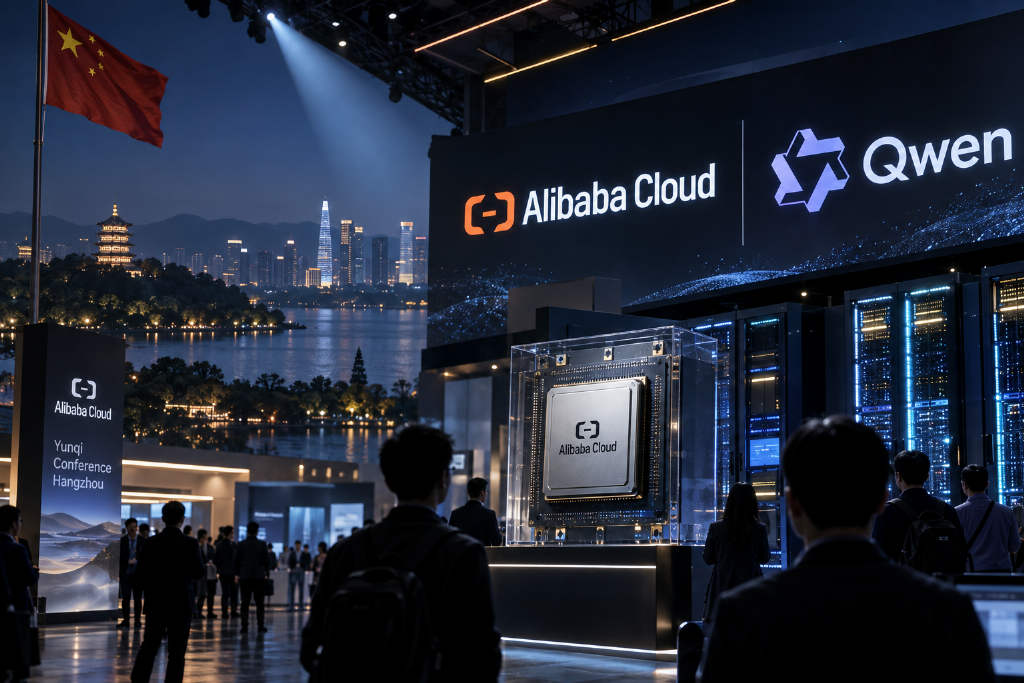
Alibaba used its annual Apsara Conference in Hangzhou on Sept. 22 to outline the next steps for its Qwen model family, saying Qwen4 is now in training and that later generations could expand to 5 trillion to 10 trillion parameters, according to the company’s official release.
Qwen roadmap moves beyond the current generation
Alibaba said the next model in the series, Qwen4, is already being trained. It added that the follow-up Qwen4.5 and Qwen5 families are expected to scale further, with planned parameter counts in the 5 trillion to 10 trillion range.
CNBC reported that Alibaba shares rose about 3% in Hong Kong on Sept. 22.
Alibaba details recursive self-improvement results for Qwen3.8-Max
The company also published an update on what it called recursive self-improvement, or RSI, driven by real-world feedback. Alibaba said Qwen3.8-Max ran fully automatically for more than a month, covering process design, data validation, repeated experiments and error diagnosis, and completed 33 iterations.
Using autonomous training optimization and post-training techniques, the model improved its Artificial Analysis score from 40 to 45, according to Alibaba.
In one chip-design experiment, the model kept improving itself for more than 60 hours across the full design workflow, called EDA tools more than 10,000 times, and produced a production-grade chip bus module. Alibaba said the result reduced chip area by 42% while keeping performance unchanged.
Audio, image and mobile agent products were also unveiled
Beyond the flagship model roadmap, Alibaba introduced Qwen-Audio-3.1-TTS-Next, a new audio generation model that can create a full soundscape from a text script in one pass, including dialogue and ambient sound. The company said the model is aimed at audiobooks, film and television, podcasts and games.
Alibaba also said Qwen-Image 3.1, an image generation model focused on e-commerce marketing and creative design, is scheduled for release later this year. It introduced Qwen Intelligence as well, a platform for smartphone makers that supports complex tasks across multiple apps.
T-Head launches Zhenwu V900 AI chip
Alibaba chip design affiliate T-Head unveiled the Zhenwu V900, an AI processor for training and inference. The company said it delivers three times the performance of the previous-generation Zhenwu M890 released in May.
Zhenwu V900 comes with 216 GB of graphics memory and 1,200 GB per second of inter-chip bandwidth, and supports multiple precision formats including FP8 and FP4. T-Head said the chip is scheduled to enter mass production and commercial deployment in the first quarter of 2027.
T-Head also said Zhenwu chips now serve more than 650 customers across sectors including automotive, finance, large language models, embodied intelligence, energy and manufacturing.
Server scale-up, CPU roadmap and data center target
Alibaba also introduced an upgraded supernode server integrating Zhenwu V900. The system can support supernode clusters with as many as 500,000 cards, the company said.
It also laid out a CPU roadmap for 2027. Within that plan, Yitian 730 is described as the first CPU based on a self-developed T-Head microarchitecture, with SPECint2017 performance per GHz up to 40% higher than Yitian 710.
Alibaba Chief Executive Officer Eddie Wu said in his speech, 「Today, the total amount of machine thinking is less than 3% of human thinking. If it eventually scales to 1,000 times that of humans, a simple calculation shows there is still enormous room for machine thinking to grow.」 He added that Alibaba’s target is for Alibaba Cloud’s globally operated data center capacity to exceed 20GW by 2032.
According to CNBC, Wu also compared the current stage of AI development to the early days of electrification and said, 「AI coding is only the light bulb of the machine intelligence era.」
Alibaba Group Chairman Joe Tsai said the theme of this year’s conference is “Intelligence Goes Beyond.” He said AI has substantial development potential, can be deployed and scaled in real-world scenarios, and can lift productivity across industries. He said the theme is meant to steer AI from technical breakthroughs toward value creation.