
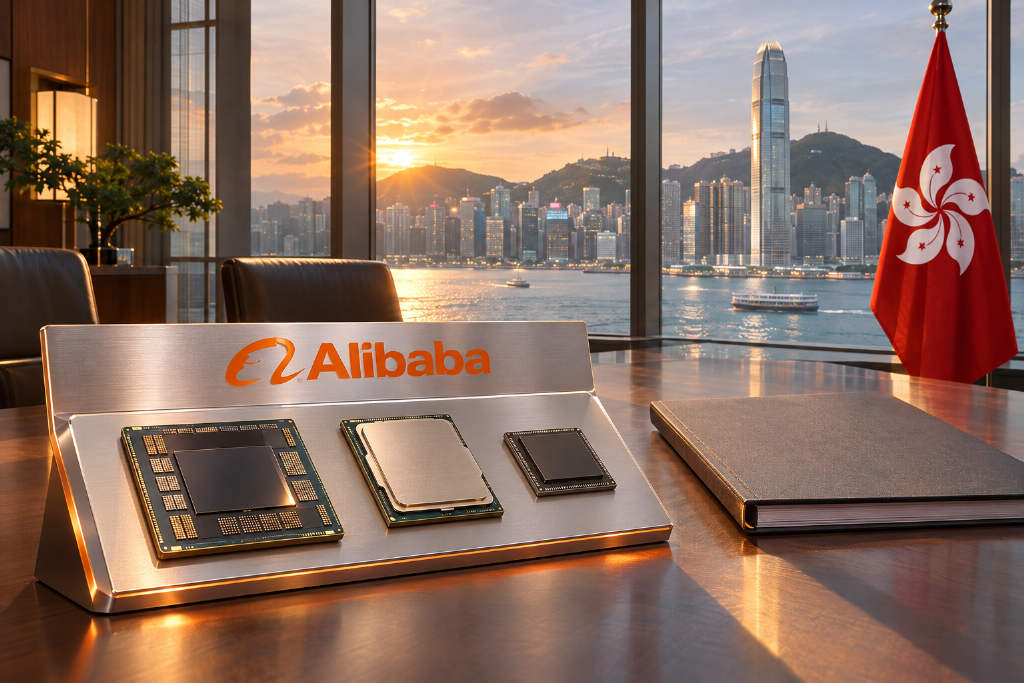
Alibaba said its chip subsidiary Pingtouge has confidentially filed an application to list on the Hong Kong Stock Exchange. The company will remain a wholly owned subsidiary of Alibaba after the proposed spin-off. If the listing moves forward, it would be the first IPO secured under Wu Yongming since he became Alibaba’s chief executive.
Pingtouge was established in 2018, when Alibaba announced that it would develop chips in-house. The move drew skepticism at the time. Jack Ma gave the independent chip company the name Pingtouge, a Chinese nickname for the honey badger. The animal is small but aggressive, with a flat head and a strip of white fur along its back. Its image was used to represent the traits associated with a startup: intelligence, toughness, agility and fearlessness.
From Hanguang 800 to the Zhenwu line
Alibaba began as a mobile internet company, but the company’s DAMO Academy identified chip development as a major research direction from the start. Many members of its chip team had experience at AMD, Arm, Nvidia and Intel. In 2018, Alibaba acquired Hangzhou C-SKY Microsystems in full. At that year’s Yunqi Conference, then-Alibaba CTO Jeff Zhang announced the creation of Pingtouge, combining the acquired company with the academy’s in-house chip operations.
Pingtouge released its first AI inference chip, Hanguang 800, in 2019. Its power efficiency, based on a proprietary architecture, was used to support the surge in visual tasks such as Pailitao during Alibaba’s Singles’ Day shopping event. Hanguang 800, however, was mainly used in Alibaba’s internal search and recommendation systems and was not sold externally at scale.
The company later released Yitian 710, its first Arm server CPU; the Yuzhen family for internet-of-things applications; and Zhenyue 510, its first SSD controller chip. The product names followed a wuxia sword theme. Together, the releases made Pingtouge one of the relatively few companies in the market with chip development capabilities spanning multiple parts of the stack.
The company drew wider attention with its Zhenwu AI chip family. In September 2025, China Central Television’s Xinwen Lianbo program disclosed Pingtouge’s proprietary PPU chip while reporting on China Unicom’s Sanjiangyuan green-power computing center project. The chip’s core specifications were described as comparable with Nvidia’s H20.
In 2026, the Zhenwu 810E series went live on Pingtouge’s website. The company later introduced the higher-performance Zhenwu M890 and Zhenwu V900. The V900 was unveiled at the Yunqi Conference in September 2026, with performance three times that of the M890. Alibaba called it the strongest Chinese-developed AI chip in computing performance at that point and said it could support training and inference for large models with trillions of parameters.
After eight years, Pingtouge has built a product portfolio covering AI chips, server CPUs, SSD controllers and RFID chips. Alibaba said the Zhenwu family has served more than 650 corporate customers in finance, autonomous driving, large language models, embodied intelligence, internet services, energy and manufacturing. The company described the family as one of the Chinese-developed AI chip products with the broadest application coverage.
Data disclosed by IDC showed that China’s AI chip market shipped about 4 million units in 2025. Pingtouge shipped 265,000 units and ranked third overall, placing second among domestic vendors behind Huawei.
Wu Yongming pushes commercialization
Jack Ma gave Pingtouge its starting point, while Alibaba CEO Wu Yongming has driven its later expansion. Wu is the youngest technical veteran among Alibaba’s group of 18 founding members and is known inside the company as Dongxie. He has repeatedly said that the combination of AI and cloud computing will be the biggest variable of the next decade.
Wu became Alibaba Group CEO in 2023 and was the first to call for 380 billion yuan of investment in AI infrastructure over the following three years. As large-model deployment accelerated, competition extended beyond coding to chips, compilers, supernode networks and cluster interconnection. Pingtouge entered a more commercial phase during that shift.
In January 2026, market reports said Alibaba planned to restructure Pingtouge as an independent entity with partial employee ownership and was exploring an IPO. Morgan Stanley analysts estimated a potential valuation of about $25 billion to $62 billion using a rough peer comparison.
Wu later said on an earnings call: Pingtouge had successfully commercialized its business, delivered 470,000 chips at scale and generated annualized revenue at the level of more than 10 billion yuan. He also said that an IPO could not be ruled out in the future.
Alibaba considers Pingtouge a strategic asset. Wu has said that global AI computing capacity will remain in severe shortage over the next three to five years, with the pressure particularly pronounced in China. Pingtouge is described as the only cloud computing company in the Chinese market with in-house chip capabilities, and as an important source of growth momentum for Alibaba’s broader AI business.
The company’s organizational changes reflect that position. Alibaba’s first-quarter fiscal 2027 report, released in August 2026, showed that Pingtouge and the Cloud Intelligence Group had been integrated to form an AI cloud and computing services unit.
Alibaba gave three reasons for the proposed spin-off in its latest announcement. First, a separate structure could help investors assess the value of Alibaba’s retained businesses more accurately while showing Pingtouge’s own value more clearly. Second, it could strengthen Pingtouge’s independent image among customers, suppliers and potential strategic partners, helping it pursue more business opportunities. Third, if needed, Pingtouge could enter equity and debt capital markets as an independent entity and allocate Alibaba’s financial resources more efficiently.
Alibaba’s disclosures also showed that more than 60% of Pingtouge chips used in Alibaba Cloud’s actual business scenarios serve external commercial customers. That figure refers to Alibaba Cloud integrating the chips into cloud services and selling those services to customers. It does not mean that Pingtouge, acting as an independent chip supplier, directly controls the external procurement decision.
The distinction is one of the central issues the spin-off would need to address. A Morgan Stanley report earlier this year listed several conditions for an independent listing: expansion of external customers and orders, the creation of an independent governance and employee ownership structure, and a clear pricing mechanism for related-party transactions with Alibaba. Those arrangements will face scrutiny from public investors.
Domestic AI chip companies move toward public markets
Pingtouge’s filing comes as several Chinese AI chip companies enter the capital markets. In January 2026, Baidu-backed Kunlunxin confidentially submitted a listing application to the Hong Kong Stock Exchange. In May, it began guidance for a potential listing on the STAR Market. Kunlunxin traces its origins to Baidu’s intelligent chip and architecture division and now has more than 50 shareholders. Market reports have put its target valuation above 300 billion yuan.
Baidu has high expectations for the listing. Since 2025, Kunlunxin has delivered several P800 clusters with more than 10,000 chips each. The systems have been deployed in internet services, finance, energy and manufacturing, with delivery sizes ranging from dozens of chips to tens of thousands. Kunlunxin ranks among the leading companies by share of China’s domestic AI chip market.
In September 2026, Enflame Technology began trading on the STAR Market, with a latest market capitalization of about 240 billion yuan. Its founder, Zhao Lidong, came from Tsinghua’s EE85 class and entered the domestic AI chip sector with former AMD colleague Zhang Yalin. Tencent became both Enflame’s largest external shareholder and its largest customer.
The result is a more crowded field of Chinese AI chip companies: Tencent’s Enflame, Baidu’s Kunlunxin and Alibaba’s Pingtouge are among the groups seeking to build domestic alternatives to Nvidia.
At the time of the report, Nvidia CEO Jensen Huang was facing a personal controversy. After the news gained traction, Nvidia’s market value at one point fell by more than 1 trillion yuan. The report said that a vacuum in management could introduce uncertainty into product development and customer delivery schedules.
Financial results from domestic computing companies also changed. The latest reports for the first three quarters of 2026 showed that revenue at Moore Threads, MetaX and Enflame more than doubled. The companies either turned profitable or narrowed their losses, a result cited in the report as evidence of the substitution of imported AI chips with domestic products.
Stock prices reacted quickly. After the market opened that day, Cambricon rose more than 11% at one point and returned to the group of stocks trading above 1,000 yuan. MetaX, Moore Threads, Enflame and Hygon Information also rallied sharply.
In December 2025, Moore Threads became the first of the group to list, gaining more than 400% on its debut and reaching a market capitalization above 300 billion yuan. MetaX followed with a first-day gain of 692% and a market capitalization above 300 billion yuan. Cambricon later set a series of new market-capitalization highs, while Biren Technology listed in Hong Kong.
Investment界 writer Yu Mengying wrote that 2025 may have been the starting year for domestic computing companies to take up the banner. China’s high-end AI chips had long depended heavily on imports, while building a Chinese Nvidia remained a goal for many in the industry. Pingtouge’s confidential filing will put the Alibaba chip unit’s independent commercialization capabilities before public-market investors.



