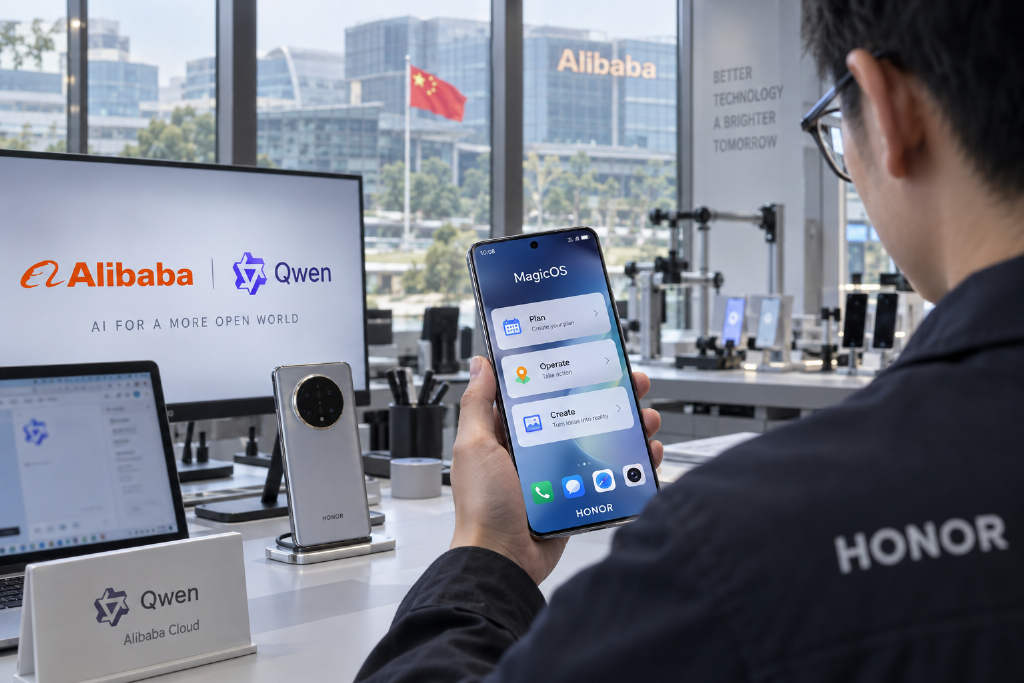
Alibaba has introduced Qwen Intelligence, a mobile-focused AI offering aimed at smartphone manufacturers rather than end users. The product is not a standalone app and does not involve Alibaba building its own handset. Instead, it packages the Qwen model family, an agent platform, and mobile scenario capabilities for OEM integration.
The initial release includes three components: Mobile Planner Agent for task planning, Mobile-Use Agent for operating the phone, and Mobile Creative Agent for image generation. Alibaba said the planner can break down complex tasks, arrange execution order, and retain both working memory and long-term memory to keep track of context and user preferences. The operation agent prioritizes MCP, API, and DeepLink access when available, and falls back to visual recognition and GUI interaction when direct interfaces are unavailable. For high-risk actions such as payments or data deletion, final confirmation remains with the user.
Alibaba also said the creative agent can turn a single prompt into an image by decomposing the workflow and calling different capabilities. The company said the process has been reduced from 100 steps to 8 steps, with the first image generated in about 3 seconds. The system has already been deployed with Honor MagicOS, and the two sides said complex long-horizon tasks can run for more than 100 consecutive steps, with an end-to-end service loop closure rate of 90%.
Alibaba has launched Qwen Intelligence, which it describes as a Qwen-based counterpart to a mobile AI assistant for smartphone vendors. The product is not Alibaba’s own phone and not a standalone app. Instead, it packages Qwen models, an agent platform, and mobile scenario capabilities for handset makers.
Three solutions in the first release
Qwen Intelligence debuts with three solutions covering planning, operation, and creation.
Mobile Planner Agent acts as the phone’s "brain." It breaks down complex tasks, arranges the execution order, and then calls different tools to complete them. Alibaba said it has both working memory and long-term memory, allowing it to retain context and user preferences.
Mobile-Use Agent handles direct phone operations. When interfaces are available, it gives priority to MCP, API, and DeepLink methods. If no interface is available, it switches to visual recognition and GUI-based screen interaction. For high-risk actions, including payments and data deletion, the final confirmation is left to the user.
Mobile Creative Agent is designed for image creation. A user only needs to provide a request, and the agent breaks the task into steps before calling different capabilities to generate the image. Alibaba said the generation process has been compressed from 100 steps to 8 steps, and the first image can be produced in about 3 seconds.
Already deployed with Honor MagicOS
Alibaba said the system has already been implemented with Honor MagicOS. The two sides disclosed that complex long-horizon tasks can run for more than 100 consecutive steps, while the end-to-end service loop closure rate has reached 90%.
Rather than stopping at an AI chat assistant, Qwen Intelligence is positioned as a foundation for smartphone makers building system-level agents.
This article was originally published by Bit.Fan. For more cryptocurrency news and market insights, visit www.bit.fan. Disclaimer:
The market information, project data, and third-party content displayed on this platform are for industry information sharing only and do not constitute any form of investment advice or return commitment.
Cryptocurrency trading carries high risks. Users should fully assess their risk tolerance and make independent decisions. All profits, losses, and legal responsibilities are borne by the users themselves.