
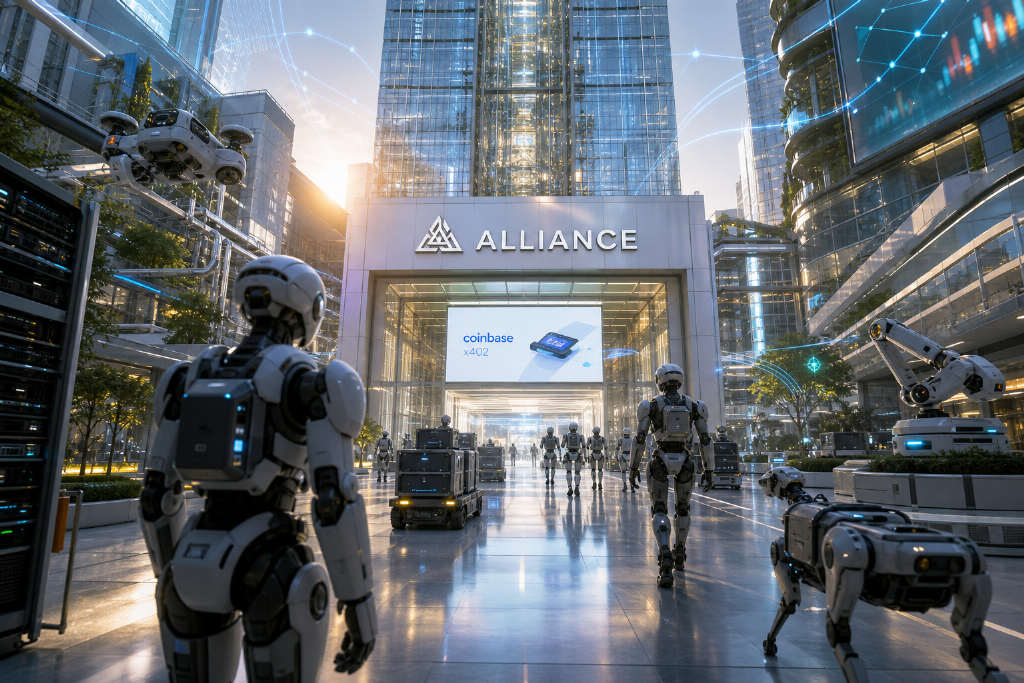
Alliance co-founder Imran Khan says Chris Dixon was broadly right about crypto’s direction: the technology, once grouped under the Web3 label, adds the economic and ownership layer the internet never fully had.
Khan points back to Marc Andreessen’s time at Netscape, when there was already an effort to embed payments directly into the browser. Early web architecture even reserved HTTP 402, meaning payment required, and Coinbase’s x402 takes its name from that code. In Khan’s telling, the label is also a nod to the earlier generation that kept trying to wire financial capability into the internet’s foundation.
Netscape also worked with Visa on integrating payments into the browser, but the effort never truly took hold. Khan writes that SSL became a major building block for internet commerce, while money itself remained outside the web’s original infrastructure.
Commerce did move online, he notes, but online payments were ultimately carried by credit cards and payment platforms such as PayPal and Stripe rather than by an internet-native monetary system.
He then revisits the early crypto vision: user-owned assets, permissionless markets, tokenization, decentralized identity, open social graphs, portable reputation, decentralized storage, and programmable finance. For a period, those ideas seemed to offer a way to redesign part of the internet. Khan says some early Ethereum community participants argued that internet structure could be rebuilt so users had more economic autonomy, and that this was one reason he entered crypto.
Over time, though, that original ambition was diluted by malicious actors, security threats, and policy constraints. It was in that wave, he says, that Chris Dixon put forward a central claim: decentralization and ownership are what matter most in crypto.
Khan summarizes Dixon’s logic this way. Centralized platforms control take rates and control points, and over time their incentives tilt toward the platform and its shareholders rather than toward users. Those companies also control distribution, identity, payments, APIs, data, and social relationships, while shaping how economic value is split between users and developers.
Crypto offered a different path. Identity, payments, and data could be carried by open protocols instead of a single company, and participants could share in the economics while actually owning their data and assets.
Still, Khan says the market showed that most people do not care much about whether a platform is centralized. They care whether it is convenient and whether it gives them what they want with minimal friction. If a product works well enough, users generally do not mind handing data to Google, Facebook, Apple, Amazon, or OpenAI.
He adds that people like him, coming from a cypherpunk mindset, care deeply about privacy, censorship resistance, decentralization, and personal sovereignty. Most users do not want to accept a clearly worse product experience in exchange for those principles. They are not waking up thinking first about whether they own their social graph; they want a product that works and gives them entertainment.
For Khan, the past several years did not unfold exactly along the path Dixon first imagined. Even so, he still thinks Dixon had the direction right. What the picture lacked, he argues, was AI.
AI agents as the demand side for open infrastructure
Khan says AI and crypto fit together closely. AI needs open economic infrastructure, while crypto needs a new source of large-scale demand. Put together, they supply the missing piece: demand.
He describes AI agents as a new class of internet participant. Cloudflare disclosed in 2026 that automated traffic had exceeded human activity for the first time, accounting for about 57% of all web requests. Khan says he believes a meaningful share of that activity is tied to AI agents, and he expects the shift to keep accelerating. In the future, much of humanity’s interaction with the internet may no longer wait for one prompt after another from a person. Agents may initiate those interactions themselves.
To become first-class citizens of the internet, however, AI agents must be able to connect permissionlessly to thousands of services, datasets, and markets. They also need to interact directly with counterparties and with other agents, without setting up bespoke relationships one by one.
Khan is explicit that this is not decentralization for its own sake, nor a replay of old arguments. His point is that once coordination scales from human magnitude to machine magnitude, portability, open access, shared state, and interoperability begin to carry direct economic value.
What agents need, he says, is open infrastructure that can be used at any time without permission. That includes identity on protocols such as Handshake, as well as programmable money and asset ownership.
Beyond that, they may need persistent storage, portable identity, open social and reputation graphs, verifiable information, permissionless markets, programmable contracts, and open networks or marketplaces where they can discover and communicate with each other, such as Moltbook, Farcaster, or some new format.
That leads Khan to a blunt conclusion: much of what Dixon outlined in Read Write Own was directionally correct, but the intended user may not be humans. It may be AI agents.
The next internet is bigger than crypto alone
Khan also frames the argument through the web’s earlier phases. Web1 was built on open protocols. Information could be accessed freely, anyone could publish and retrieve content, sites could link openly to each other, and developers could build without asking for permission. Most users, however, were readers.
Web2 turned those readers into creators. Social networks, smartphones, broadband, cloud services, online marketplaces, and large platforms arrived, and billions of people began creating content, moving business online, and connecting more tightly with each other.
At the same time, platforms came to control the critical layers: identity, payments, social connections, data, distribution, and the economic links between people. Khan then asks what comes next.
His answer is that Web3, or what he calls the next internet, should not be treated as another name for crypto alone. He sees the next internet as a combination of crypto, AI, robotics, energy, compute, and eventually biotech, all intertwined.
In that structure, AI would provide the intelligence and interaction layer. Crypto would provide the economic and ownership layer. Robots would connect the intelligence layer to the physical world. Compute and energy would form the resource layer supporting everything else. Biotech, in his view, will increasingly resemble a programmable system, and he points to Neuralink as one expression of that direction.
He uses decentralized identity, reputation, and social graphs as one example. In the future, AI agents may need Moltbook, Farcaster, or some other open platform where they can provide services, complete tasks, build reputation through delivery, form persistent internet identities, and establish relationships with other agents.
The same logic applies to decentralized storage. Humans usually do not mind keeping files on Google Drive, iCloud, or other cloud services, but AI agents may need greater autonomy and control. They may also need guarantees of long-term persistence or redundant backup, which could lead them to use both decentralized and centralized storage.
Khan cites IPFS and Filecoin as examples. Those systems can store content and allow another agent to verify whether retrieved data exactly matches the original.
He is not arguing that everything will move to decentralization. His claim is narrower: some of that infrastructure may be genuinely useful, and it can work alongside centralized services such as AWS and Google Cloud Platform.
Ownership is another case where he thinks agents may care more than humans. If the world is tokenized in some form, the range of assets available would be vast and highly fragmented. Humans may struggle to understand and allocate across them quickly.
For now, Khan says, AI agents remain stuck inside closed ecosystems controlled by individual MCP services or applications. That does not mean similar agents cannot be built with MCP, OAuth, A2A, Stripe, Visa, AWS, and traditional databases.
But with onchain infrastructure, more assets and markets in the financial world could move across platforms, open to global access, and be read directly by machines. AI agents could then access those assets and markets themselves and make financial decisions within goals and risk boundaries set by humans.
Khan’s conclusion is that Dixon correctly identified the layer the internet was missing: native ownership.
Even so, he says the next internet will not be produced by one technology in isolation. It will come from the combined effect of onchain infrastructure, robotics, AI, biotech, compute, and energy, just as Web2 emerged from the interaction of smartphones, high-bandwidth networks, centralized applications, and cloud storage.
In this framework, the missing piece is not humans. It is AI agents.