
Steady Lads Podcast returned after a four-month break with a simple question at the center of the episode: what are the hosts and guests actually holding now?
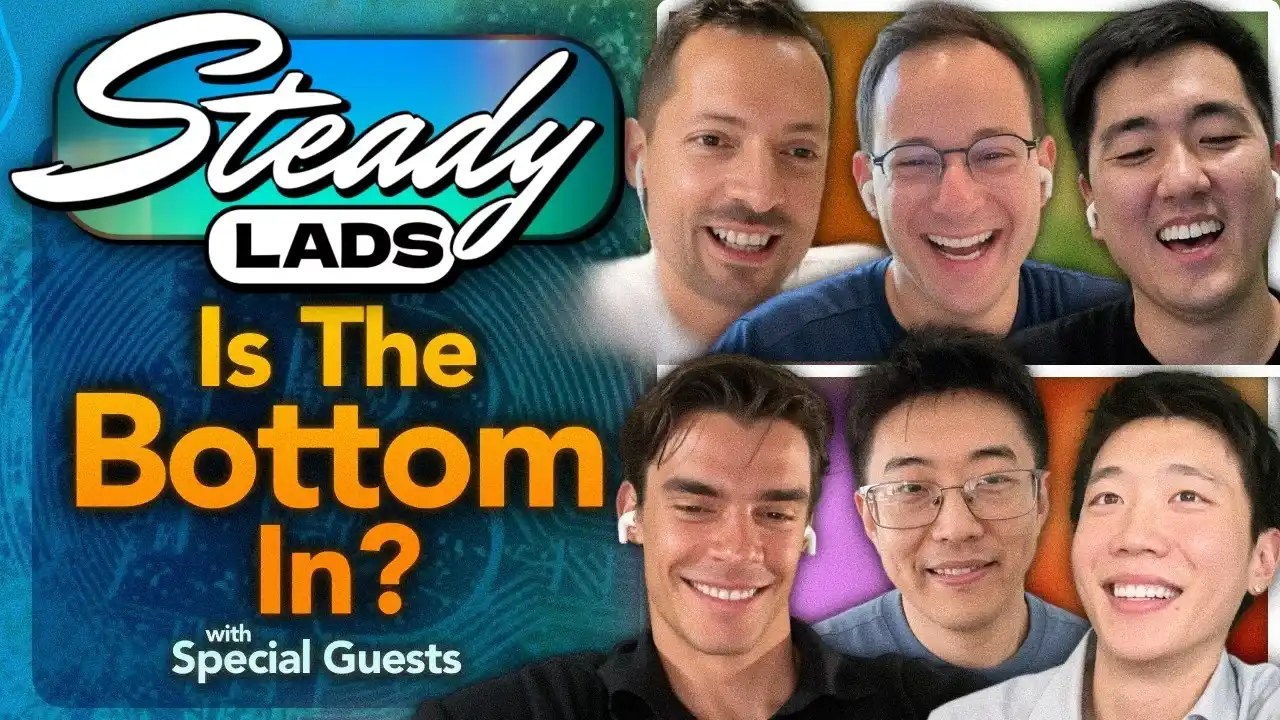
The show, aired on Aug. 28, 2026, featured Alliance DAO founding partner Qiao Wang and FOMO co-founder Se Yong Park, alongside regular hosts Jordy, Justin, Tiki, and Dimma. The timing mattered. Bitcoin had climbed back above $80,000, but instead of spending the episode on broad market calls, the group focused on real portfolio allocations and where they were no longer willing to take risk.
The episode also came with explicit conflict disclosures. Qiao Wang said his firm holds large positions in early Web3 projects, while his personal focus is on U.S. equities, BTC, and Zcash. Tiki said he holds the S&P 500, U.S. Treasuries, and a large collection of physical Pokémon cards. Justin disclosed Zcash and a Lit airdrop position. Jordy disclosed BTC and Hyperliquid (HYPE). Dimma disclosed Near and Grass. The data shared by the FOMO co-founder was also presented with the note that it carries a strong user-acquisition and product-promotion angle.
What the panel said they own
Qiao Wang said about 70% to 80% of his capital is in U.S. stocks, while his crypto allocation is limited to Bitcoin and Zcash. He said, “My capital is about 70% to 80% in U.S. equities. On the crypto side, I only hold Bitcoin and Zcash. In an industry where things can fall 50% in a day for no reason, you have to stay rational.”
According to the episode recap, Wang’s firm has broad exposure to emerging Web3 projects, but his liquid personal portfolio is far more defensive. He said he has abandoned small-cap tokens entirely. The recap added that, on a risk-adjusted basis, the amount he has committed to Zcash is comparable to his U.S. equity exposure.
Tiki described what he called a standard barbell strategy. On one side are S&P 500 ETFs and U.S. Treasuries. On the other is about $3 million worth of physical Pokémon cards. He said, “My strategy is a standard barbell strategy: on one side are the S&P 500 and Treasuries, and on the other are my $3 million worth of Pokémon cards. I’m extremely bearish on the vast majority of tokens.” He later added that unless he invested in a project at the early allocation stage, he is highly negative on most tokens currently trading in the market.
Jordy said Bitcoin is his clear core position. He still holds some Hyperliquid, but said the valuation has become too stretched. In his view, support for the current price is driven more by retail sentiment buying than by something durable, which is why he has been taking profits into strength.
Justin said he used tax-loss harvesting near the absolute bottom, around the $1 area, and then bought a large amount of spot Zcash. He also said he still holds an early Lit airdrop position and that the current balance is roughly 80% of his original allocation.
Dimma was the most open to active narratives among the group. He said he owns Near, Grass, and other AI-linked tokens that he sees as having fundamental support, alongside a growing venture-style portfolio of early AI tokens.
Why Zcash stood out
Zcash was one of the few crypto assets that came up repeatedly, and it was the clearest overlap between Wang and Justin.
Wang’s thesis started with market structure. He argued that nearly a decade of selling pressure has already washed out early holders, while miner issuance pressure has dropped meaningfully over time. In his words: “The Zcash logic hasn’t changed in 10 years. Most importantly, the early investors who needed to sell have already sold, and miner rewards have fallen sharply. Now buying pressure is finally exceeding selling pressure.”
The recap also cited a recent episode in which a whale bridged and sold $50 million worth of ZEC in one move, yet the market absorbed the supply without an obvious price collapse.
He also framed the chart setup as unusually strong on a long-term basis. “If you look at the long-term chart, it contains three rounded bottoms nested inside a giant 10-year base. It’s the most perfect chart structure you can find,” he said.
The panel then moved to valuation. Their comparison was straightforward: Bitcoin may no longer offer new entrants the path to 100x returns, while Zcash has the same total supply as Bitcoin but trades at roughly 1% of Bitcoin’s price. From there, the discussion extended into a more speculative narrative. If Bitcoin has secured the “digital gold” role, they argued, the market may still want a native “private AI currency,” and Zcash was described as a candidate for that position.
FOMO’s mobile trading numbers
Against the panel’s skepticism toward most legacy altcoins, Se Yong Park shared operating data from FOMO that pointed to a different part of the market.
He said the app is currently acquiring about 40,000 real new users a day through app stores, and that most of them are not crypto-native. The main acquisition channel is UGC marketing. FOMO spends about $100,000 to $150,000 a month sponsoring social media creators who show real trading records and lifestyle content.
On the product side, Park said FOMO strips away most of the complexity around base chains. He said users do not care which chain sits underneath the transaction flow. “Users simply don’t care what chain is underneath. Out of 110,000 daily active users yesterday, 90,000 traded Robinhood-chain assets, 100,000 traded on Solana, and the experience is completely seamless,” he said.
The recap added that 60,000 users were active on Base. Users do not need to switch wallets or manually bridge assets, with trading handled through a single interface.
FOMO charges a 0.5% fee, according to the episode. The show contrasted that with Coinbase retail fees that can run as high as 2.5%.
Park’s broader point was blunt. “Traditional match-three mobile games can make $1 billion a year. Mobile token trading is basically a social game with a lower barrier to entry and real-money stimulation,” he said. In that framing, mobile meme trading is less about chain ideology and more about a low-friction consumer product built around speculation.
Split views on the macro setup
The group also disagreed on what to do with Bitcoin after a week in which it swung by $20,000.
Jordy took the more constructive view. As expectations build around a Federal Reserve pivot and a weaker-dollar narrative, he argued, the market is moving back toward gold and Bitcoin. The recap cited Bloomberg data showing that the correlation between gold and Bitcoin has reached a record high, with traditional institutions buying both at the same time.
Justin was more cautious and stuck to the four-year cycle framework. He said it is too early to call a bottom. His math was simple: if Bitcoin bottoms at $60,000, then buying at current levels leaves less than a 1x upside to the prior-cycle target of $125,000. Given that payoff profile, he said he would rather put that capital into U.S. AI technology stocks than chase Bitcoin higher.
A narrow consensus
The panel did not end up with one macro call, and it did not pretend to. What did line up was their approach to position quality. Most of the participants were not rebuilding broad altcoin exposure. They were concentrating in liquid traditional assets, or in a very small set of crypto positions they believed still had a clear and durable thesis.
That was the pattern across the disclosures: Qiao Wang with 70% to 80% in U.S. equities and only BTC plus Zcash in crypto, Tiki with a barbell built around the S&P 500, Treasuries, and collectible cards, Justin adding spot Zcash after tax-loss harvesting, and Jordy keeping Bitcoin as his main holding while reducing HYPE exposure. For this group, the search for opportunity has narrowed sharply, and most fringe tokens no longer make the cut.