

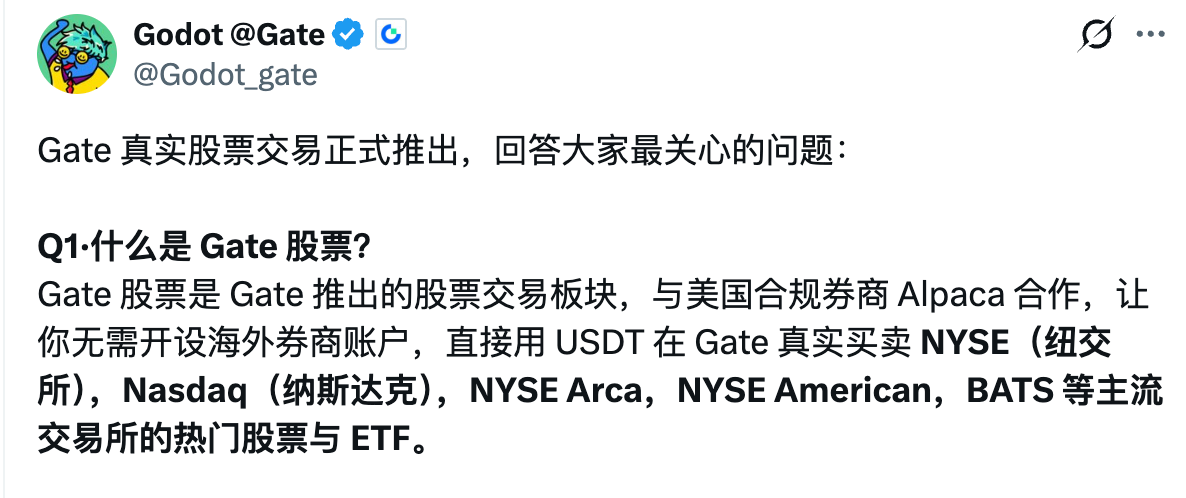
On June 1, Binance officially launched stock and ETF trading for non-US users, covering over 8,000 US stocks and ETFs with zero-commission fractional shares starting from $5. On the same day, Gate announced its real stock trading service allowing users to trade US equities directly with USDT. Just days earlier, on May 28, Bitget revealed its stock token platform Reality, which will issue derivative tokens called rTokens pegged 1:1 to underlying shares. While the simultaneous push into equities by three leading crypto exchanges grabbed headlines, a closer look reveals they all share the same underlying brokerage: Alpaca.

Binance confirmed it chose US-licensed broker Alpaca to handle asset custody, dividend distributions, and corporate actions. Bitget’s Chinese-speaking head Xie Jiayin stated that Reality’s underlying broker is also Alpaca, while Gate official Godot likewise confirmed the partnership. This is not a coincidence. In the DeFi space, the dominant stock tokenization protocol Ondo announced its collaboration with Alpaca as early as last September to tokenize US stocks and ETFs. Its direct competitor, Kraken-backed xStocks, followed suit last December, partnering with Alpaca to accelerate global adoption.
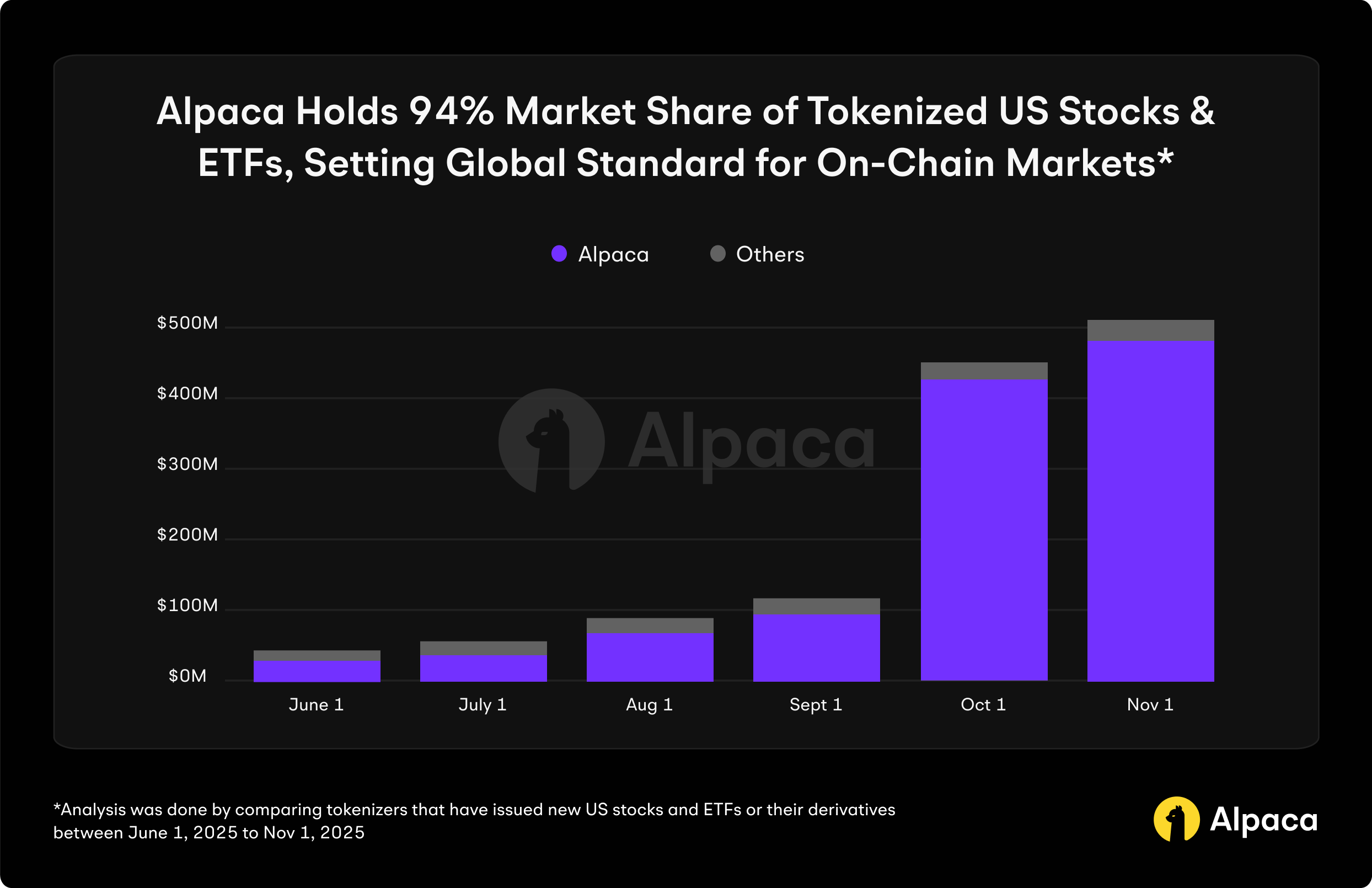
Indeed, across CeFi and DeFi, virtually every stock tokenization service you see today is powered by Alpaca. According to data disclosed by the company on December 4 last year, it has captured 94% of the tokenized US equities and ETF market. While the market debates who will win the “crypto-stock race,” the infrastructure provider selling shovels to all participants has quietly secured its victory.

Founded in 2015 and headquartered in California, Alpaca was co-founded by former Lehman Brothers employee and serial entrepreneur Yoshi Yokokawa (CEO) and engineer Hitoshi Harada (CPO). The company operates with a global remote workforce of over 250 employees across 25 countries, a model common in crypto. Originally a fintech startup focused on financial databases and machine learning for predictive analytics, Alpaca’s early product was a trading API for quantitative traders. Over time, it evolved from a simple execution interface into a full-stack financial infrastructure provider, now supporting stocks, ETFs, options, and cryptocurrencies, along with market data, securities lending, high-yield cash accounts, and extended-hours trading.

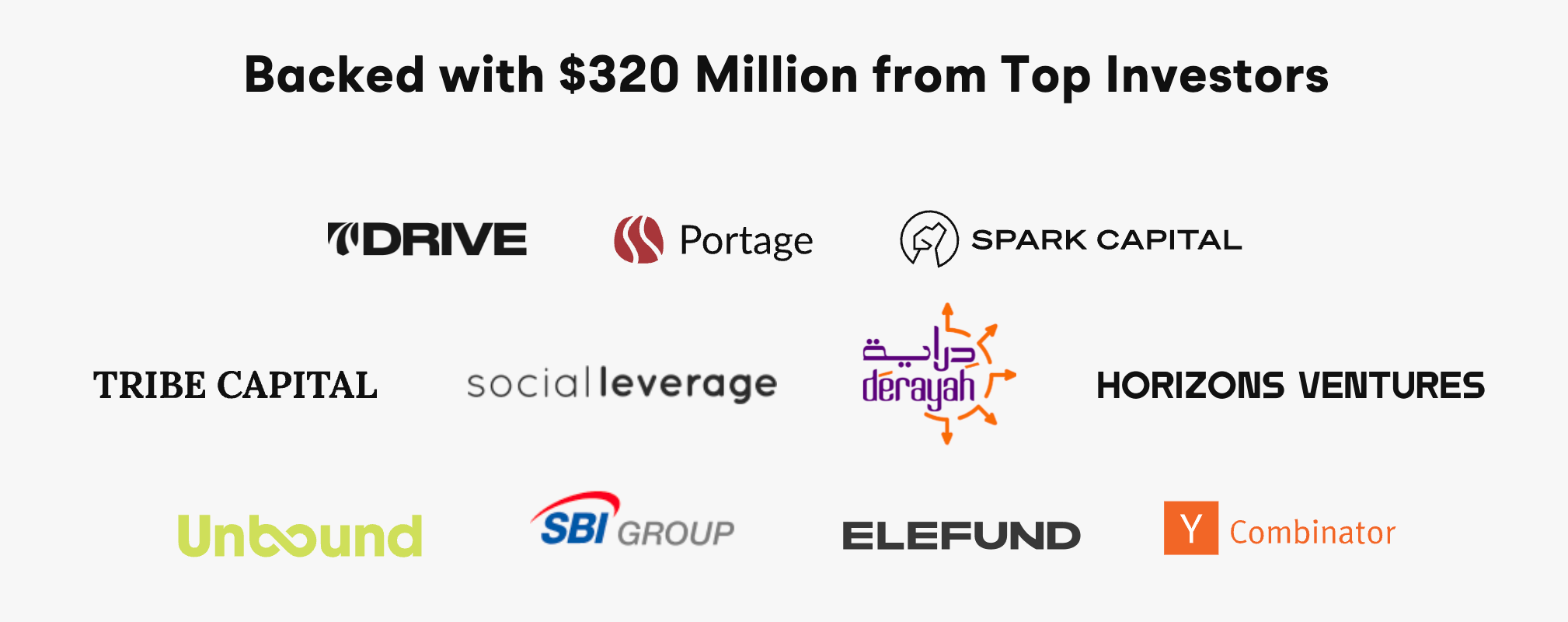
According to FundBet, Alpaca has raised over $320 million since 2019 from investors including Y Combinator, Spark Capital, Portage Ventures, Tribe Capital, and SBI Group. To date, it serves hundreds of financial institutions and fintech companies in more than 40 countries and has helped open over 7 million brokerage accounts for its partners.
Unlike traditional brokers serving end investors, Alpaca’s core customers are developers, fintech firms, and other brokerages. Its Broker API allows partners to rapidly build a complete securities trading service stack covering account opening, KYC, account management, order execution, clearing and settlement, and market data. In essence, if Binance, Bitget, Gate, or Ondo want to offer US stock trading, they face complex and costly challenges such as licensing, compliance, custody, clearing, and order routing. Alpaca packages these backend capabilities into easy-to-integrate APIs, enabling developers to “plug in” everything with a few calls. This is effectively “Brokerage-as-a-Service”: platforms handle user acquisition and traffic while Alpaca manages all connections to real-world securities markets.
Why do crypto institutions prefer Alpaca over giants like Charles Schwab, Interactive Brokers, or Fidelity? The answer lies in Alpaca’s DNA: it was never a traditional broker. While legacy brokers view investors as customers, Alpaca’s customers are developers. Its “API First” philosophy aligns perfectly with the needs of platforms like Binance, Bitget, Gate, and Ondo to embed securities trading into their existing exchanges or protocols. Moreover, while many traditional financial institutions remain cautious toward crypto, Alpaca was one of the earliest US-licensed brokers to actively embrace digital assets and tokenization, building ties with the crypto industry long before stock tokenization became a hot trend.

First-mover advantage and industry fit are the core reasons for Alpaca’s current dominance. As more CeFi and DeFi players adopt its infrastructure, the network effects build a widening moat: more platforms integrate Alpaca → more accounts and trading volume → Alpaca improves its products and infrastructure → attracting even more later entrants. This virtuous cycle makes Alpaca increasingly indispensable for anyone wanting to enter the tokenized equity space.
Stock tokenization is an irreversible trend. While the number of future “Binances” or “Ondos” remains uncertain, one thing is becoming increasingly clear: when platforms rush to compete for the tokenized equity market, the entity selling the shovels—Alpaca—may end up being the biggest winner of all.