
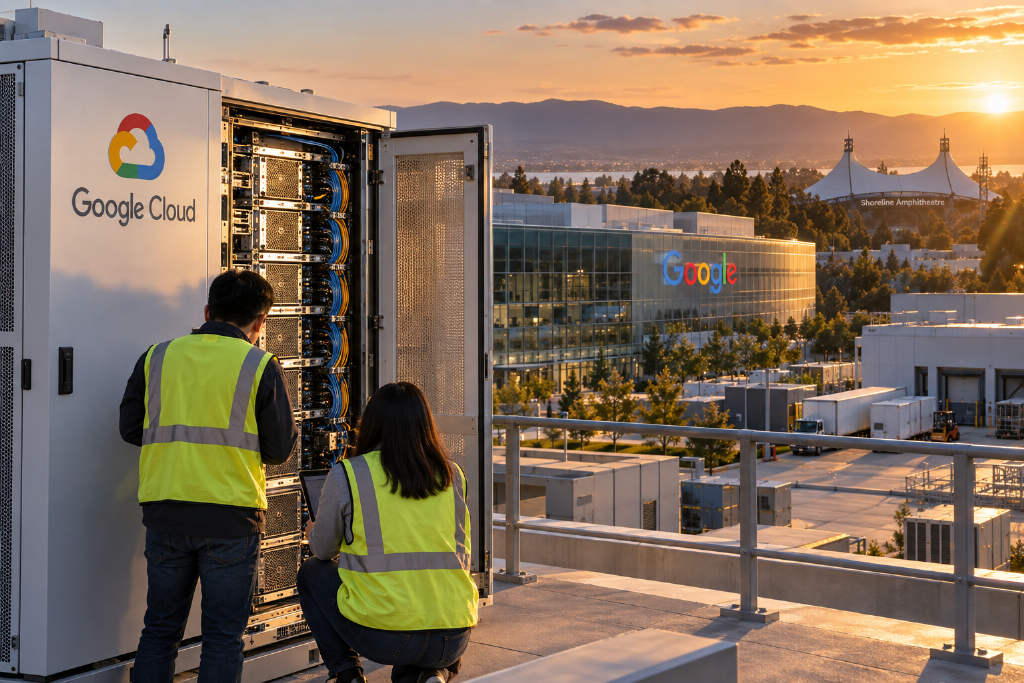
Alphabet’s AI weakness has become the market’s main talking point, but JR Research argues the company’s real comeback case sits elsewhere: Google Cloud and its in-house TPU platform.
In a new report published on Seeking Alpha, JR Research said investors have exaggerated Alphabet’s lag in frontier AI models while overlooking what the analyst sees as the company’s more important strategic pivot. The report says TPU cost-performance, the option to sell chips externally, and infrastructure distribution through Google Cloud are central to Alphabet’s path toward about $730 billion in FY2028 revenue. JR Research maintained a Buy rating on the stock.
Stock weakness followed May peak as investors focused on model competition
Alphabet shares, under the GOOG and GOOGL tickers, have struggled to regain momentum since peaking in May. Over the past three to four months, shareholders have been weighing whether the company can remain in the top tier as the AI race changes quickly.
The report says OpenAI and Anthropic have widened the gap, with OpenAI’s coding models drawing rising attention. It adds that Anthropic remains at the front of workflow changes tied to agentic AI, while Google still sits a distant third among leading AI model players in the US.
Competition also intensified this week after Meta launched its personal AI agent, Muse. JR Research described the move as Meta CEO Mark Zuckerberg’s first step toward what the author called a broader ambition around “personal superintelligence.” The report said it is too early to judge where Muse will end up, but noted that Wall Street has become increasingly convinced the product could lift engagement with Meta’s AI models and strengthen monetization through a freemium structure. It also said Muse climbed to No. 3 among free apps in Apple’s iOS store this week.
Google Cloud, not just Gemini, is presented as the real turning point
JR Research wrote that investor concern over weakening free cash flow margins has been high, but management has already made its direction clear: Google Cloud is the North Star for Alphabet’s next growth inflection. In the report’s view, the cloud unit not only serves Google’s own AI models but also opens a large opportunity in infrastructure deployment built around TPUs.
The note says that thesis is starting to show up in the market. As buyers pay closer attention to cost efficiency, Google’s TPUs are drawing renewed interest. Citing SemiAnalysis and its InferenceX benchmark, the report said Ironwood, also known as TPUv7, can deliver up to about 50% more performance per dollar.
That improvement, according to JR Research, is lifting expectations around future TPU deployments on both the inference and training sides, including TPUv8-related opportunities. The report also says Google is not only trying to challenge Nvidia on hardware economics but is also attempting to weaken the advantage created by CUDA’s software stack.
Rising AI capex puts more weight on the TPU cost story
The report argues that if the current pace of AI capital spending continues unchecked, large technology companies could face the reality of negative free cash flow margins. It cited a recent update from Ramp saying that among the top 1% of companies with the highest AI spending, spend per employee fell from about $8,000 in July to just above $7,200 in August.
Against that backdrop, JR Research said Google’s message is straightforward: access to Google AI infrastructure does not come through a single channel. The report cited Google Cloud CEO Thomas Kurian, who recently outlined several paths:
- access through cloud service subscriptions;
- direct purchases of hardware and full systems;
- access through a “neocloud” channel being developed with Blackstone.
The report says those hardware sales options could become an important force in helping Alphabet diversify beyond its advertising model. Based on updated Wall Street consensus, JR Research said Alphabet could reach about $730 billion in revenue in FY2028.
The note also said that as AI compute supply expands, investor concerns about whether token pricing can hold may push the market to take a closer look at Google’s TPU offering, especially given previously reported cost advantages. In the author’s view, the more aggressive this phase of AI spending becomes and the more free cash flow margins are compressed, the more important the TPU story becomes.
Valuation has moved closer to historical averages
JR Research said the market still looks hesitant about returning to Alphabet shares. After climbing to around $400 in May, the stock has pulled back sharply. The report ties some of that hesitation to a wait-and-see approach around whether Google’s AI coding capabilities will actually improve after the release of Gemini 3.8 Flash.
Even so, the analyst said the stock is now moving closer to its June low area, at slightly below $315, where dip buyers could become more active.
On valuation, JR Research said Alphabet now trades at a forward price-to-earnings multiple of slightly below 25x, much closer to its long-term five-year average of about 22.6x. The report said GOOGL is not exactly cheap, but it is nowhere near as expensive as it was in May and June, when the forward multiple moved well above 30x.
The analyst added that a major wave of bargain buying has not yet appeared, as investors still want to see how TPU growth opportunities turn into actual business results. Even so, JR Research said the current setup should be viewed as a timely buying window before a faster reversal potentially takes shape, and kept the stock at Buy.
Disclosures
The analyst disclosure said the author or the author’s team holds beneficial long positions in GOOGL and META through stock ownership, options, or other derivatives. The author said the article reflects personal views, was written by the author, and that no compensation was received for it other than from Seeking Alpha. The author also said there is no business relationship with any company mentioned.
Seeking Alpha separately disclosed that past performance does not guarantee future results, that the article is not investment advice for any specific investor, and that the views expressed do not necessarily reflect the platform’s broader position. It also said Seeking Alpha is not a licensed securities dealer, broker, US investment adviser, or investment bank, and that its analysts are third-party contributors, including both professional and individual investors, who may not hold licenses or certifications from any institution or regulator.